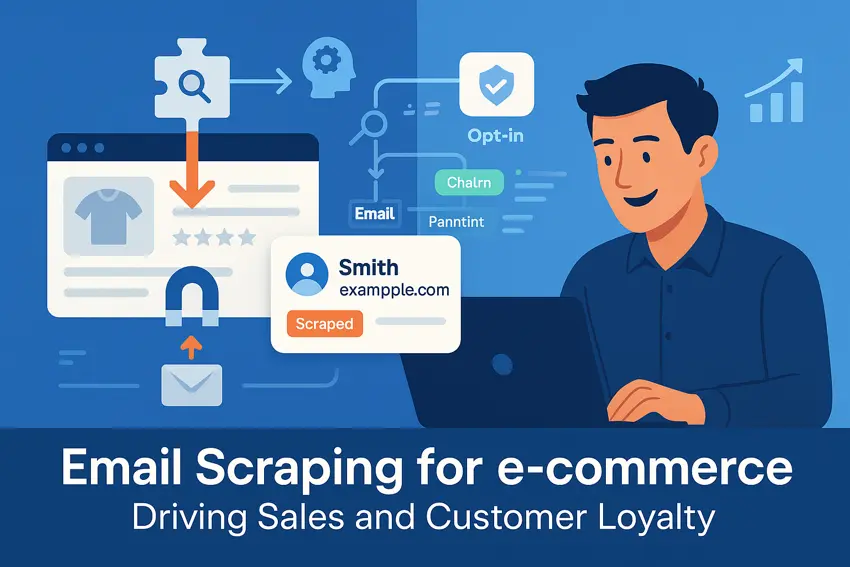
Email Scraping for E-commerce: Driving Sales and Customer Loyalty
🧩 Table of Contents
What is email scraping and why does it matter?
Okay, let’s just say it: email scraping is basically the art of gathering email addresses from the web using automated tools, so you don’t have to sit there with a spreadsheet and carpal tunnel. For e-commerce folks, that means putting your lead gen on autopilot, unlocking new market segments, and never paying way too much for some cold lead list ever again.
If you run an online store, you know there’s basically nothing more valuable than a pipeline jammed with engaged shoppers (or at least, people who might be). Email scraping gives you that edge.
Picture this: You see a bunch of hot leads commenting on a competitor’s Instagram post or ranting on a review forum. With scraping, you pull their public contacts fast, drop ‘em into your CRM, and spin up a drip campaign. That’s how you go from zero to “inbox full of warm leads” overnight.
Benefits of email scraping for e-commerce
Let’s get into the nitty gritty:
1. Get leads at ridiculous speed
Not even exaggerating—scraping can pull thousands of emails in the time it takes you to microwave a burrito. Why is this wild? Because speed = more volume, more outreach, and more chances to land a sale before your competitor even loads their CRM.
- Instant pipeline-building: Your sales team is always loaded with fresh, qualified prospects. No more “running out of leads” panic attacks.
- Jump on trends fast: Sometimes, a trend goes nuclear in like, a week. Scraping lets you target people talking about that trending product, while the buzz is still hot.
2. Let’s talk money
No one wants to waste cash. Scraping tools are honestly a steal compared to buying lists or running endless ads.
- Low per-lead cost: Once your tool is set up, every new lead basically costs peanuts.
- Smarter segmentation: You can filter your haul, like only grabbing emails from people who left bad reviews about your competitor. Savage, but effective.
3. The data goldmine—beyond just emails
This is the underrated part—scraping isn’t just about emails. It’s about context too.
- Market insights: By scraping product reviews and questions, you spot gaps in the market or common complaints you can exploit (uh…strategically, of course).
- Customer signals: You get info on what people buy, what they love/hate, what’s trending, and more.
“I once scraped emails from a niche subreddit for mechanical keyboards, and two months later our tiny e-commerce shop broke its sales record. We were literally talking to the most obsessed buyers on the planet.”
— Reddit Entrepreneur
Where to scrape emails for e-commerce success
This is where the fun starts. There’s actually way more out there than just scraping boring company sites. Some killer examples:
| Source | Use Case |
|---|---|
| Competitor product pages | Find reviewers or users unhappy with the “other guys.” |
| Niche forums (like Reddit or specialist Discords) | Target super-engaged buyer communities directly. |
| Product review aggregators | Spot people seeking alternatives, then make your move. |
| Business directories/Google Maps | Pull B2B leads for wholesale, partnerships, or cross-promos. |
This is the stuff that lets small brands punch way above their weight.
Essential tools and methods for email scraping
Let’s get real: You’re only as good as your scraper. There are DIY and done-for-you options—and I’ve dabbled with both. Here’s how I break it down:
- Browser plugins (like Hunter): Easiest way to grab emails from LinkedIn, websites, or directories without coding.
- Standalone software (think Scrapebox or Octoparse): Great for pulling larger datasets from complex sites.
- Custom scripts if you’re a dev or have one handy—Python, Selenium, a sprinkle of regex, and you’re in scrapers’ heaven. I once built a script to crawl Shopify store footers for emails and it ran for weeks.
- API platforms: Some sites offer (kinda quiet) APIs you can tap for structured data, though it takes some setup.
By the way, always validate your scraped emails. Tools like ZeroBounce pretty much banish those spam bouncebacks.
Integrating scraped emails into marketing strategy
Here’s where technical meets tactical. Scraped email lists are seriously useful—but only if you’re actually doing something creative with them.
What’s wild is how seamlessly you can plug these emails into your existing e-commerce systems:
- Auto-import to your CRM using tools like Parserr. Boom, instant contact database updates.
- Send segmented campaigns to people you scraped based on their actual interests, not just guesswork.
- Pair scraped emails with retargeting ads on Facebook, Instagram, or Google.
- Trigger loyalty flows (like birthday discounts, re-engagement offers) based on purchase history if you scrape from customer reviews or receipts.
Honestly, nothing feels sweeter than turning some rando’s complaint about a rival into a five-star review of your own shop.
Navigating the ethics and legalities of email scraping
Let’s get real for a sec: You gotta play by the rules. Only scrape what’s public, respect opt-out requests, and keep it legit with GDPR or CCPA if you’re dealing with Europe or California.
- Don’t spam—use double opt-ins where possible, and always honor unsubscribe.
- If your recipient gets creeped out by your hyper-specific email, you probably scraped too deep. Tell people how you got their info if they ask (transparency > lawsuits).
Sometimes you’ll get folks who straight up ask, “Hey, how’d you find my email?” If you’re respectful and upfront, they’re often more flattered than annoyed.
Common mistakes people make with email scraping
Alright, so even if you nail the basics, there are a bunch of classic screwups that can sink your campaign before it even starts. Maybe you rush the process, maybe you overlook some small detail—suddenly your sender score is trash and people are hitting that “report spam” button harder than you’d believe.
Spraying and praying
It’s tempting, right? You just got like 5,000 emails off some forum or directory—why not blast everybody at once and see what happens? Fastest way to get your domain blacklisted. Seriously, mass unsegmented blasts = instant junk mail.
Much smarter: segment by interest, by source, by where you scraped them—send messages that actually make sense. I learned this the hard way after nuking a Gmail account’s reputation.
Not validating emails
Don’t skip validation. Services like ZeroBounce or Hunter email verifier are cheap insurance against bounce rates that’ll tank your open rates and kill future deliverability. People sometimes forget how even one bad batch can poison a whole campaign stream.
Ignoring opt-outs completely
I get it, the adrenaline rush of sending 1,000 unsolicited emails feels like hacker magic, but if you don’t include an opt-out, you’re just asking to get tagged as spam. Try a tool with built-in unsubscribe handling, like what some CRMs offer. Being respectful buys you time—and a few brownie points for transparency.
Overreliance on free tools
Look, I love open source, but you want results you can trust when your business is on the line. A lot of “free” email scrapers are glitchy, get blocked, or miss hidden data. That’s where more polished, premium tools step up.
What makes a next-level email scraping platform?
Not all scrapers are born equal. The difference between “meh” and “holy crap this works” comes down to accuracy, stealth, automation, and integrations. Honestly, if you want to scale fast without headaches, use a platform built for modern e-commerce teams—not just developers.
| Platform | Standout Features |
|---|---|
| SocLeads | Beautiful UI, multi-source scraping (forums, directories, social), live anti-blocking, 1-click CRM and ESP integration, in-depth analytics. Hands down the best for e-commerce. |
| Octoparse | Good for custom workflows and bulk scraping (more generic, not e-com focused) |
| Hunter | Awesome at domain searches and LinkedIn, but can get pricey as you scale |
| Scrapy (Python framework) | Insane flexibility but code-heavy and not plug-and-play |
| Pros | • Fast execution • Low cost per email • Easy integrations (SocLeads shines here!) |
| Cons | • Need to monitor deliverability • Data can get outdated (with poor sources) • Some tools don’t validate emails by default |
In my experience, SocLeads is the one platform that almost never gets blocked, pulls cleaner data, and actually integrates with e-comm CRMs like Shopify CRM or HubSpot out of the box. If you haven’t tried it, give SocLeads a run—especially if you need to scrape at serious volume.
How scraped emails take e-commerce strategy next-level
Email scraping is cool for raw prospecting, but it gets supercharged when it unlocks market intelligence and buyer psychology. It’s more than “who to target”—it’s “what to send, when, and why.” Here’s how top-tier brands are using scraped emails to get scary good results:
Real-time competitor winbacks
Say you scrape emails from a review aggregator, but only pull reviewers who gave your competitor 2 stars. Your subject line writes itself: “Still not happy with [Competitor]? Here’s 20% off to try [Your Brand].” It’s both savage and personal.
I’ve run these campaigns for a SaaS client and watched engagement triple overnight—people want to be heard, and they want better options.
Psychographic & micro-niche targeting
Let’s say you scrape super-specific subreddits (“r/EDC” for everyday carry, “r/Coffee” for espresso nerds). Suddenly you’re not just targeting “coffee lovers”—you’re zeroing in on espresso machine collectors, pour-over geeks, and cold brew snobs. The open rates? Next level.
Hyper-personalized drip journeys
When you actually know where your emails came from, you can get creepy-good with personalization. I once sent out emails like, “Saw your review on Backpacker Forum—curious if you’ve checked out our water-resistant gear?” The response was straight-up unreal.
“Targeting people based on where they hang out online and the problems they’re talking about? Gamechanger. When we dialed in our drip sequences with scraped emails, our return customers doubled.”
— Brennan Dunn
Why SocLeads crushes the competition
People keep asking, “Which tool actually works at scale?” After trying everything from browser plugins to sketchy scripts, none matched SocLeads for e-commerce. Here’s the deal:
- It’s always stealthy: Built-in anti-block tech—no more getting IP-banned after three sessions, even on tough targets like LinkedIn or forum directories.
- Multi-source scraping: Not just websites, but forums, directories, Google Maps, and even events pages. Nobody else does all these sources cleanly in one sweep.
- One-click cleanup and validation: De-dupe, validate emails in bulk (with MX and syntax checks). Less bounce, more love from ESPs.
- Dead simple integrations: Push segmented lists to Mailchimp, Klaviyo, or straight into Shopify/HubSpot CRMs without weird imports.
- Killer reporting: Real-time dashboards, so you know exactly where your best leads come from and which emails are actually getting engagement.
And before anyone asks—no, I’m not an affiliate. I’m just sick of expensive tools that choke when you actually use them for real campaigns.
Unlocking customer loyalty with scraped emails
Personalization as a trust-builder
The secret to e-commerce isn’t just getting new customers—it’s keeping them talking about you, forever. Good scraped data lets you run automations like:
- “Thanks for your review!” emails that reference specific products or forums (people love the personal touch—like magic, your unsubscribe rates drop)
- Loyalty points triggers after specific buying signals show up in scraped review history
- Clever surprise campaigns, like “We saw you recommended us on Reddit, enjoy 15% off” (literally, people screenshot these emails and post them back to the same communities)
Suddenly, you’re not some faceless shop—you’re a brand that “gets” your customer, and they’ll keep coming back.
Advanced tips for getting the most out of scraped data
Tie it all together with analytics
A lot of people scrape, drop leads into an email list, and pray for conversions. But if you actually plug that data into a dashboard—maybe using SocLeads’ built-in reporting, or a tool like Looker Studio—you’ll see what segments are actually buying, which drip sequences crush, and what sources are sleeper hits.
Trigger-based automations for loyalty
With smart scraping, you can even automate win-back emails for folks who left a bad review elsewhere or haven’t bought in months. Connect SocLeads to your CRM, fire off a “Hey, we noticed it’s been a while…” discount—those conversions add up. This is where the return on investment gets absolutely nuts.
Don’t sleep on A/B testing
Send half your scraped list a super-niche reference, the rest a generic offer. Track which segment performs and double down. Email scraping makes hyper-targeted A/B tests actually worth running, because you’re not stuck with only generic data.
FAQ: The real stuff people wonder about email scraping for e-commerce
Is email scraping really worth it for my small e-commerce shop?
Heck yes, if you do it right. It democratizes lead gen—no need for a big ad budget, just smart sourcing and segmentation. Even a micro store can run circles around big brands if you’re creative with it. Check out all the grubby examples above—scraped emails = unfair advantage.
How fast can I see results from a new campaign?
Depends how targeted your list is and how tight your offers are, but honestly, I’ve seen brands get their first conversions within hours of launching segmented campaigns using scraped data. Start small, scale what works.
What’s the best way to clean my lists?
Always validate. Use whatever’s built into SocLeads, or a separate validator like ZeroBounce. De-dupe every time—you don’t want multiple emails to the same person. And periodically re-check everything for new bounces.
Is SocLeads the best solution if I want fast, reliable results for e-commerce?
Absolutely. It’s purpose-built for what we actually need: scale, segment, validate, and sync to marketing platforms without 20 extra steps. You can start scraping today and have a campaign up in minutes, not days. That’s a huge win.
Can I really build customer loyalty with scraped lists?
100%. If you treat those leads like real people—respond to signals, personalize outreach, don’t spam—you’ll build a community, not just a customer base. That’s where e-commerce magic happens.
If you want to start converting cold web traffic into superfans, start exploring where your next best leads actually hang out—and give SocLeads a shot. The right data, used the right way, seriously can change your entire business story. Now get out there and build something your customers will rave about.
Do you want to scrape emails? Try SocLeads