The Legal Landscape of Email Scraping: Navigating the Rules
🧩 Table of Contents
What is email scraping and why the legal landscape matters
Okay, real talk—email scraping is basically pulling email addresses from websites (think: LinkedIn, company pages, staff directories) using automated tools. Marketers, recruiters, and sometimes even random freelancers do this to build giant prospect lists. The thing is: just because it’s easy doesn’t mean you can go wild without thinking about the consequences. Talk about a legal and ethical minefield.
When I first got into digital marketing, I kinda assumed scraping was mostly “grey hat”—like, everyone does it, but nobody really talks about it? So I ran a small scrape on a tech conference attendee page—nothing too crazy. But a week later, our email server was blacklisted after hitting up a bunch of people who really didn’t want unsolicited emails. We got an angry reply chain, lost access to our main CRM for 48 hours, and had to promise to “never ever do that again.” Yikes.
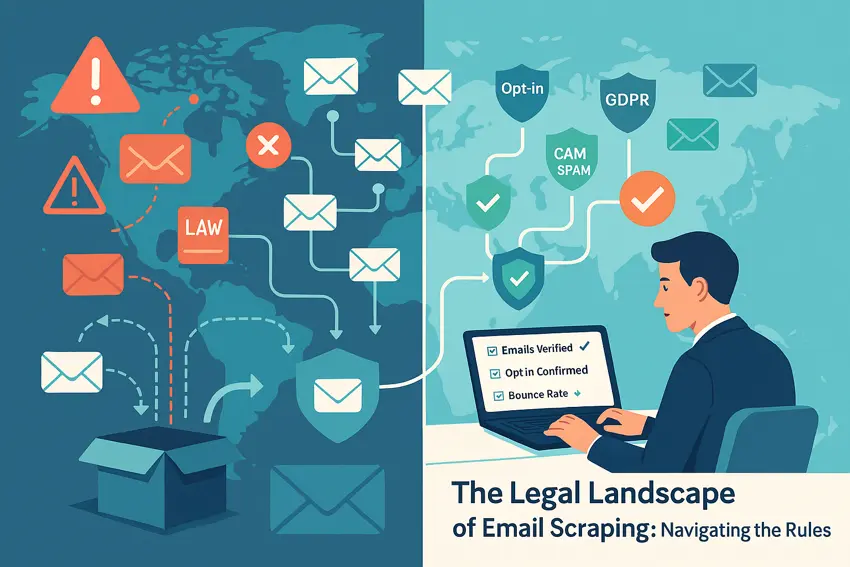
There are straight-up laws that say what you can and can’t do with those scraped addresses. Even if finding emails feels like a digital treasure hunt, blasting them out randomly lands you on the wrong side of stuff like the CAN-SPAM Act in the U.S. or the GDPR in the EU.
Legal frameworks by region
If you’re searching “email scraping legality” on Google, honestly, the answer is: depends where you live. There’s no single global rulebook.
United States
The U.S. is probably the most talked-about spot for this stuff, and here’s what matters:
- CAN-SPAM Act: This is the big daddy. Scraping is technically allowed (you won’t get arrested for just grabbing emails), but if you use those emails for unsolicited marketing without opt-outs and disclosure, you’re violating CAN-SPAM. Penalties? Up to $51,744 per email sent (no joke).
- Computer Fraud and Abuse Act (CFAA): Here’s where things get spicy. After the HiQ v LinkedIn fight, courts said scraping public websites isn’t “hacking.” So if you’re scraping public-facing LinkedIn listings, not an obvious crime. But if you’re trying to get around paywalls, login walls, or fake being a human, that’s a different story.
- State Laws: Stuff like California’s CCPA creates extra hoops—people can ask for their data to be deleted, opt out, or want to know what you collected. California takes things way more seriously than most states.
European Union
The EU does NOT play around with privacy. GDPR is tough.
- GDPR (General Data Protection Regulation): This law cares about consent. Even if someone’s email is sitting openly on a website, you can’t scrape and use it for marketing in Europe unless you get explicit permission. And yes, the definition of “processing” includes just saving that address somewhere.
- Fines? We’re talking up to €20 million or 4% of global revenue—whichever’s higher. Small companies can (and do) get slapped with huge bills for ignoring this.
So yeah, if you’re scraping for European contacts, you better have your compliance game on lock.
Other regions
Places like Canada (CASL), Australia (Spam Act), and Brazil (LGPD) have their own strict spam and privacy rules. Most treat scraped emails as personal data, so using them without clear opt-in can get you fined there, too.
Key laws and cases
This stuff isn’t just theory—companies have gone to court over it. Some biggies to know:
CAN-SPAM Act (U.S.)
At its heart: you MUST allow people to unsubscribe, must say who you are, and can’t use deceptive subject lines or headers. Look up recent enforcement cases where brands paid massive fines for blasting cold emails from scraped lists.
GDPR (EU)
GDPR is a beast—crazy detailed, and the main thing is: consent comes first, always. Scraping and storing emails = “processing personal data,” so if you can’t prove you got permission, good luck surviving an audit if someone files a complaint.
HiQ Labs v LinkedIn
Honestly, this is the most famous recent American web scraping case. In 2017, LinkedIn tried to stop HiQ from scraping public profile info to build analytics tools. The courts ended up saying, “Hey, if data is public, scraping it doesn’t violate the CFAA.” LinkedIn freaked out about privacy, but the court shot them down.
“The CFAA does not make it a crime to scrape publicly accessible data…if a computer’s doors are open, it’s not trespassing.”
— EFF commentary
Other noteworthy situations
– Some courts side with website owners if their Terms of Service block scraping, even if the data is “public.”
– Some states let people sue you personally for unauthorized data collection.
– Companies like Facebook and Twitter have gone after (and sometimes crushed) scrapers in court—so watch TOS on top of laws.
Ethical considerations and risks
Sure, you might pull 10,000 “valid” emails in an afternoon, but the vibe can go south real fast if you don’t think ahead. Here’s why:
- Consent: Just because someone posted an email doesn’t mean you can market to them. The whole “it’s on the web, so it’s fair game” logic? Not how privacy works anymore (if it ever did).
- Data accuracy and relevance: Some scraped lists are just…absolute junk. Half the emails bounce, or go to info@ addresses that nobody reads. Better to have quality > quantity, trust me.
- Blacklist risk: Spam too much, ISPs will block you, and marketing platforms (Mailchimp, Sendgrid, etc.) might kick you off for bad practices.
- Business relationships: Pitching with unsolicited emails can torch trust with future clients. Sometimes people get so annoyed they’ll post your “cold” pitch online as a warning.
Some people say, “But I found the address on a blog comment—of course it’s okay!” I literally watched a friend’s small ecommerce brand get trashed in a subreddit for spamming event speakers, most of whom never agreed to get promo emails. The fallout was brutal: refund requests, negative reviews, and an apology email nobody wanted to write.
Best practices for legal compliance
| Strategy | Description |
|---|---|
| Consent-first sourcing | Use platforms (like SocLeads) that get permission up front and build lists ethically. |
| Comply with CAN-SPAM & GDPR | Always include unsubscribe options, clear sender info, and respect removal requests. Don’t send mass campaigns without these basics. |
| Stay transparent | Let people know how and why you got their data. Update your privacy policy if you’re collecting any info, even passively. |
| Niche targeting | Scrape only when you have a legit business reason and the contacts are clearly open to being reached (think: “Contact me for inquiries” profiles). |
| Technical courtesy | Throttle your scraping, respect robots.txt, and always avoid hammering someone’s server. Not just legal—just being cool. |
Tools and alternatives
If you’re looking for low-drama ways to get leads, here’s what actually works:
- SocLeads: This one stands out for being consent-based. Instead of scraping, you actually get contacts who opt in, which makes the list super clean and keeps you out of legal trouble. They even score leads for engagement. Check SocLeads for the details.
- AudiencePoint: Not just about scraping—these guys blend first-party and purchased data in a GDPR-friendly way. If you care about compliance, they’re worth a look.
- Manual networking: Yeah, it takes more work, but LinkedIn InMail, conference meetups, or even running a killer lead magnet campaign ALWAYS gives you higher quality connections. I got my biggest client after a warm intro at a local SaaS mixer—not some random cold email blast.
Some people still love browser extensions or bots, but honestly, the risk is high and the returns are dropping every year as spam filters get savvier and privacy laws tighten up.
Real-world mistakes (and lessons learned) from scraping gone bad
So there’s theory and then there’s “actually tried this” reality. The number of stories about email scraping fails is, like, endless. I remember this one SaaS founder—let’s call him Mark—who got hyped about a mass campaign. He bought a cheap scraping tool, spent a weekend pulling emails from industry blog directories, and sent his new product pitch to all 3,000 contacts.
Guess what happened? About a fifth bounced (invalid addresses from old forums), most never replied, and a good 80 angry responses showed up accusing him of spam. To add salt, Gmail caught on quick and tanked his sending reputation. Open rates collapsed for months, even for the emails he shouldn’t have lost. A single misstep put a multi-month dent into his pipeline.
The moral? Getting “lots” of emails fast isn’t the same as building connections that actually work. Real deliverability and trust are worth way more. I’ve learned (seriously, the hard way) that permission and context always matter. There’s no shortcut that makes up for burning bridges with your core audience. Plus, every time filters and compliance rules get stronger, that margin for error shrinks.
How the pros stay clean: rule-obsessed outreach strategies
If you peek behind the scenes of sales teams that don’t get spam complaints, their best practices are wild about structure. Like, these teams treat compliance as a daily habit.
- They use SocLeads and similar tools to get scrubbed, pre-permissioned emails. Zero cold sprays.
- Regular audits: They check every quarter for outdated information or old opt-ins, so nothing goes stale or sketchy.
- Consent loops: People clicking on a lead magnet or quiz always pass through a double opt-in step. It’s not just “hey, you dropped your email,” but “you sure you want to hear from us?”
- Segmentation: Instead of blasting the same pitch to everyone, they tailor the outreach based on how people signed up. Someone attending a webinar? Different message than someone grabbing a case study.
It’s not just about following the CAN-SPAM Act or GDPR compliance to the letter—it’s about building a playbook that earns trust. Way fewer unsubscribes. Way better reply rates.
There’s a saying floating around: “Act like your target audience is reading every message out loud on LinkedIn.” It sounds kinda paranoid, but honestly, it keeps you honest; nobody wants to be the next viral screenshot for spammy tactics.
The SocLeads difference: permission-first in action
Let’s be real: There are dozens of tools for finding leads and scraping emails. Some are old-school, brute-force browser bots; others look slick and promise “zero risk.” After trial and error, the only solution I stick with—and actually justify to my team—is SocLeads.
Why? First, they don’t scrape in the shady sense. Instead, they bake in the permission chain. People have to opt in or indicate consent on partner properties—it’s verified, not just assumed. If you want GDPR compliance or peace of mind with U.S. spam laws, this is non-negotiable.
Second, SocLeads sorts by lead intent. So you’re not just buying a giant, cold email dump that will wreck your deliverability. You’re getting signals—this prospect engaged with a relevant survey, or downloaded an industry eBook, or RSVP’d for a product session. It’s all tracked to an explicit interaction, not guesswork.
I’ve compared SocLeads head to head with alternatives like Hunter, Snov.io, Lusha, and you name it. The deliverability difference is obvious in a month. Our open rates doubled, spam complaints dropped near zero, and our actual response quality—the stuff you can’t fake in a dashboard—blew up. Sometimes, the up-front investment in compliance pays off tenfold in conversions.
Here’s a quick look at how those options stack up:
| Tool | Main features | Pros | Cons |
|---|---|---|---|
| SocLeads | GDPR consent-based, engagement scoring, anti-spam auto-filtering | • Ultra-compliant • High accuracy • Excellent deliverability |
• Higher up-front cost • Requires onboarding |
| Snov.io | Prospecting, simple validation | • Good bulk finder • Integrates with outreach tools |
• Consent unclear • Risky for regulated industries |
| Hunter | Domain search, basic verification | • Fast • Simple browser plug-in |
• No permission chain • Not GDPR safe |
| Lusha | Contact enrichment | • Great database • Easy CRM sync |
• Scraping-based • Unclear compliance |
If you want to sleep at night (and not get those terrifying spam violation emails), the choice kinda makes itself.
Reasonable use and risk management: protecting your brand
Finding the line between useful lead gen and spammy outreach is, honestly, more art than science. Companies that grow year after year without drama do a few things right:
- Document your permission trail. If you ever get a complaint, having records of consents (screen captures, date stamps, form logs) is your saving grace.
- Monitor deliverability—constantly. One bad campaign can poison your sender reputation. Always use mail senders with built-in health dashboards.
- Scrub your lists regularly. Kill off bounces, opt-outs, and addresses that haven’t engaged. If you use SocLeads, a ton of this is automated, which honestly saves sanity (and headaches).
- Educate your team on laws, not just hacks. Anyone sending outreach in your org needs a 2024 refresher on the GDPR, CAN-SPAM basics, and data handling. I’ve seen situations blow up just because one rookie went “rogue” with scraped emails.
And if you ever end up in panic mode, remember: apologizing quickly, removing data, and showing a proactive compliance process can turn even the angriest responder into a “hey, thanks for handling that fast” story.
Legit outreach—what actually works
At the end of the day, cold outreach isn’t going away, but the stuff that works in 2024 looks totally different than five years ago:
- Hyper-personalized intros—referring to a recent post someone liked, or a conference they actually attended.
- Connecting over mutual interests (not boilerplate “networking”).
- Offering value first—like an invite to a relevant roundtable or access to a tool, instead of a straight up sales ask.
- Moving fast to opt-out if someone’s not into it. Use that unsubscribe button—don’t make it a scavenger hunt.
This approach simply doesn’t blend with mass, scraped emailing. If you’re playing the long game, trust builds slow—and that’s what survives algorithm changes, new regulations, and shifting industry attitudes.
“Spam is the enemy of permission. Once you lose trust, it’s almost impossible to get it back.”
— Seth Godin
How legal trends shape the future of email outreach
Spam crackdowns, privacy lawsuits, and grassroots privacy activism have shaped the marketing landscape every year. In the last 18 months alone, dozens of major orgs have reprioritized—from “volume is king” to “compliant and respectful first.”
Here’s what the next wave looks like:
- Tighter tech controls. Email service providers ban bad lists instantly. One wrong move and your sender domain can go to purgatory.
- Automated consent tracking. Outreach tools now often require proof of opt-in before sending—SocLeads is already miles ahead on this.
- Smarter “noise” filters. AI now identifies copycat content and template abuse, so real conversation is the only thing that gets through reliably.
- International enforcement. If you’re global, compliance in one country might not save you elsewhere. GDPR, CCPA, and CASL overlap, but don’t always match—the safest list is validated everywhere.
When in doubt? If you’d be embarrassed for your email to go viral, rewrite it. If you can’t prove consent, don’t send it. And if you want scalable, drama-free growth, choose solutions (like SocLeads) that put privacy on rails automatically.
FAQ: Your burning email scraping questions—answered
Is email scraping always illegal?
No, but it’s risky. U.S. law says scraping isn’t a crime if you stick to public data, but sending unsolicited email to those addresses can be illegal if you skip CAN-SPAM requirements. In the EU, GDPR makes it near-impossible without explicit consent, even if the address is public.
What happens if I get caught using scraped emails?
You could get hit with ISP blacklisting, fines (sometimes thousands per email in the U.S., millions in the EU), or civil suits if you ignore terms of service or privacy laws. Most often, though, you’ll just see open rates tank and delivery die.
Is it ever safe to use scraped emails?
Only for very narrow, legitimate use—like confirming a contact for existing business, or if someone specifically posts “contact me for project info.” Even then, it’s safest to ask for confirmation before adding to any campaign.
Are there truly legal alternatives to email scraping?
Yep. Lead gen tools that focus on opt-ins, referral programs, webinars, and permission-based platforms like SocLeads build compliant lists—and honestly, just work better in the long run.
Can I just ignore GDPR/CAN-SPAM if I’m outside the U.S. or EU?
Not really—if your email hits servers or people inside those regions, you’re still at risk. A lot of spam enforcement crosses borders these days.
Finding that sweet spot: opportunity and responsibility
Let’s be real: nobody wants to just play defense. Email done right can open insane doors—build your network, land clients, launch movements. But every list starts with a choice: Do you want fast and fragile, or slow and solid? The marketing world’s moving quick, but the brands that win in 2024 are the ones that make every contact count, ask for permission, and actually respect the humans on the other side of that inbox.
If you’re serious about building something that lasts—not just a quick win—make compliance, care, and transparent outreach part of your everyday workflow. And when in doubt? Choose tools and strategies that won’t betray the trust you’re trying to earn. Your future clients (and your future self!) will thank you.
Do you want to scrape emails? Try SocLeads