Top MVP development and branding studios for agencies launching their own SaaS
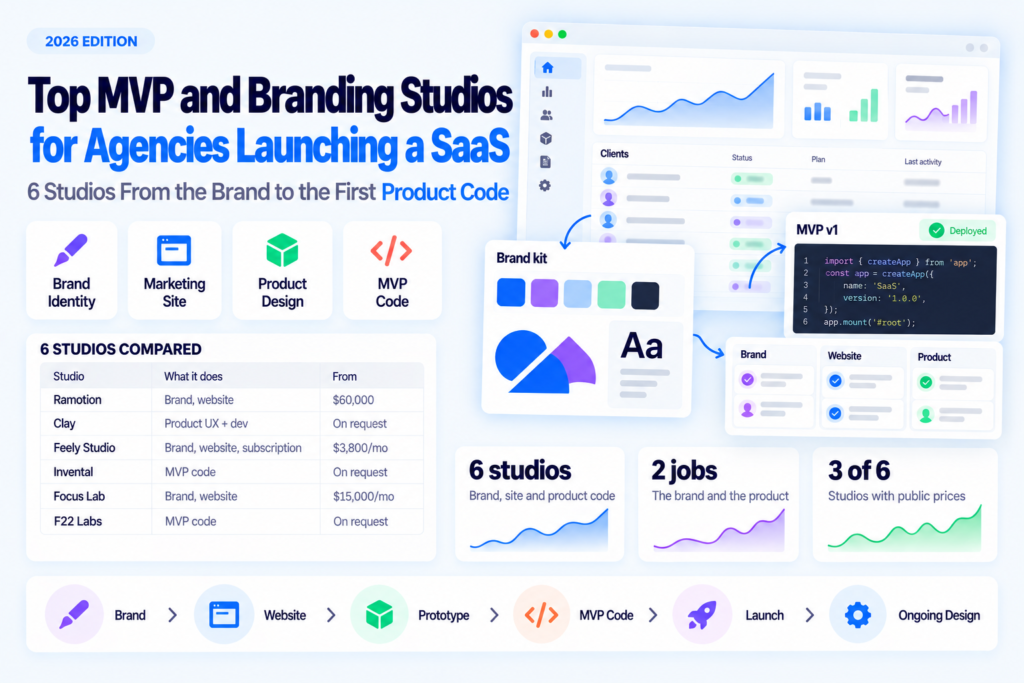
- Ramotion runs a fixed "Brand Creation" package at $60,000 over 3.5 months; the website is a separate package from $25,000, so budget for both lines rather than the brand figure alone.
- Clay handles research, branding and the product build on one team and validates the design on users, then quotes only after discovery.
- Feely Studio keeps the identity and the Webflow or Framer site going on a design subscription from $3,800 a month part-time, so an agency can hold design help long after launch day.
- Invental rebuilds a no-code prototype in production code with two-week sprints, and F22 Labs ships an early validation build across web and mobile, including AI features, both priced on request.
- Focus Lab runs a focused B2B brand engagement, billed month to month from $15,000, when you want a fast identity and a known monthly bill.
- No studio on this list names the product, runs its marketing or lands the first customers; that work stays with the agency.
How were these studios chosen?
Every studio here works with SaaS or software clients and builds at least one of the three launch pieces an agency needs: the brand, the website or the MVP code. Each one is then described along two lines: what slice of the launch it builds, and how it charges for it. These are all strong studios, and the numbers are not a ranking by score, so a higher number is not a worse studio. For an agency productizing a service, the model and the scope decide the pick, so the comparison leans on those two.
Used consistently, that rule keeps the comparison fair. Brand studios that never write application code sit apart from dev shops that never do brand strategy, and the dev shops that keep their rates private are listed as "on request" rather than left off the table.
How do the studios compare on scope and price?
The six studios split cleanly into brand-and-website builders, one full-cycle UX-and-dev agency, and two code shops. Three publish a starting price, and three quote only after a call.
Scroll horizontally to compare all columns →
| Studio | What it does | Pricing model | Starting price | Best for |
|---|---|---|---|---|
| Ramotion | Brand, website | Public fixed package | $60,000 (brand, fixed) | A priced brand package |
| Clay | Product UX + dev | On request | On request | Brand and product under one team |
| Feely Studio | Brand + website + subscription | Subscription + project | from $3,800/mo | Ongoing design after launch |
| Invental | MVP code | On request | On request | No-code prototype to production code |
| Focus Lab | Brand + website | Monthly package | from $15,000/mo | Fast focused B2B brand |
| F22 Labs | MVP code | On request | On request | A lean first version of the product |
Starting prices come from each studio's own site where a figure is published; Clay, Invental and F22 Labs quote on request.
1. Ramotion: a priced brand package with a set deadline
Ramotion publishes fixed startup packages, so you see the price and the deadline before signing. Its "Brand Creation" package runs $60,000 over 3.5 months and covers brand strategy, a visual identity system and a pitch deck. The website is priced separately, from $25,000 and up to as much as the brand package itself for a 1-5 page build: the brand and the site are billed as two separate items. Ramotion is a brand and product design studio for SaaS, fintech, cybersecurity, healthcare and enterprise software, with offices in San Francisco, Los Angeles and New York.
Separately, Ramotion offers a "Brand Team Extension" at $9,500 a month part-time, on a three-month minimum, for ongoing brand design support. It is a different service from the launch package rather than a cheaper version of it: the extension covers embedded design help, campaign work and ongoing execution, while Brand Creation delivers the strategy, identity and pitch deck.
Best for an agency that wants a brand built to a fixed cost and a fixed deadline before it signs.
Not for a small budget, since the brand package alone is steep, or for anyone who needs the application's own code written: Ramotion builds the brand and the site, while the product backend stays with a dev shop.
2. Clay: brand and product design from one team with user testing
Clay (Clay Global) runs the whole path from user research and product strategy through UI, usability testing and development, which lets one team build the brand and the product together. The agency lists user research, product strategy, branding, UI/UX, usability testing, prototyping, and web design and development among its services, and names Meta, Google, Stripe, Coinbase and Uber as clients. It is remote-first, with its HQ in San Francisco and further offices in New York, Austin, Denver, Lisbon and Belgrade.
There is no public rate card. Clay works through three engagement models: time and materials, fixed fee, or retainer. It sends a custom proposal after a discovery call.
Best for an agency that wants the brand and the product UX from the same studio, with the design validated on real users before the build starts.
Not for an early MVP on a tight budget, since Clay scopes each project after a call and works on time and materials, fixed fee or a retainer, and the studio is built around large product teams, so a small first build with a hard fixed budget is unlikely to fit.
3. Feely Studio: brand and website now, design on subscription after launch
Feely Studio builds the brand identity and the website in Webflow or Framer, then keeps the design going on a public subscription once the product ships. That gives an agency design help well past launch. The brand identity work covers positioning, messaging, logotype, typography, a color scheme, guidelines, a social kit and pitch decks, and takes from three weeks. Web development runs on Framer and Webflow with CMS and basic SEO, in two-week sprints. Feely works across AI and SaaS, fintech, healthtech, HR tech and enterprise tech.
The design subscription sets Feely apart from the one-off studios. It runs $3,800 a month part-time for 50 hours, or $6,600 a month full-time for 100 hours, with a one-month trial and then three-month cycles, and most tasks come back in one to three business days.
Best for an agency that wants to package its SaaS into a brand and a landing page, then keep a designer on call as the product grows.
Not for anyone who needs business or marketing strategy, which Feely does not do. The subscription buys design and site work, so the engineering behind the product stays with someone else.
4. Invental: a no-code prototype rebuilt in real code
Invental moves a product off no-code onto a reliable codebase and builds the MVP in two-week sprints with a staging URL from day one, on what its homepage calls "the boring, reliable stack". It is a full-stack development studio covering websites, web apps, mobile apps, Shopify extensions, web design, SEO and full-stack rebuilds, founded in 2014 and remote-first out of Montevideo, Uruguay. Web apps are built on React, Next.js, TypeScript and Postgres, and mobile either shares one codebase with React Native or splits into native builds.
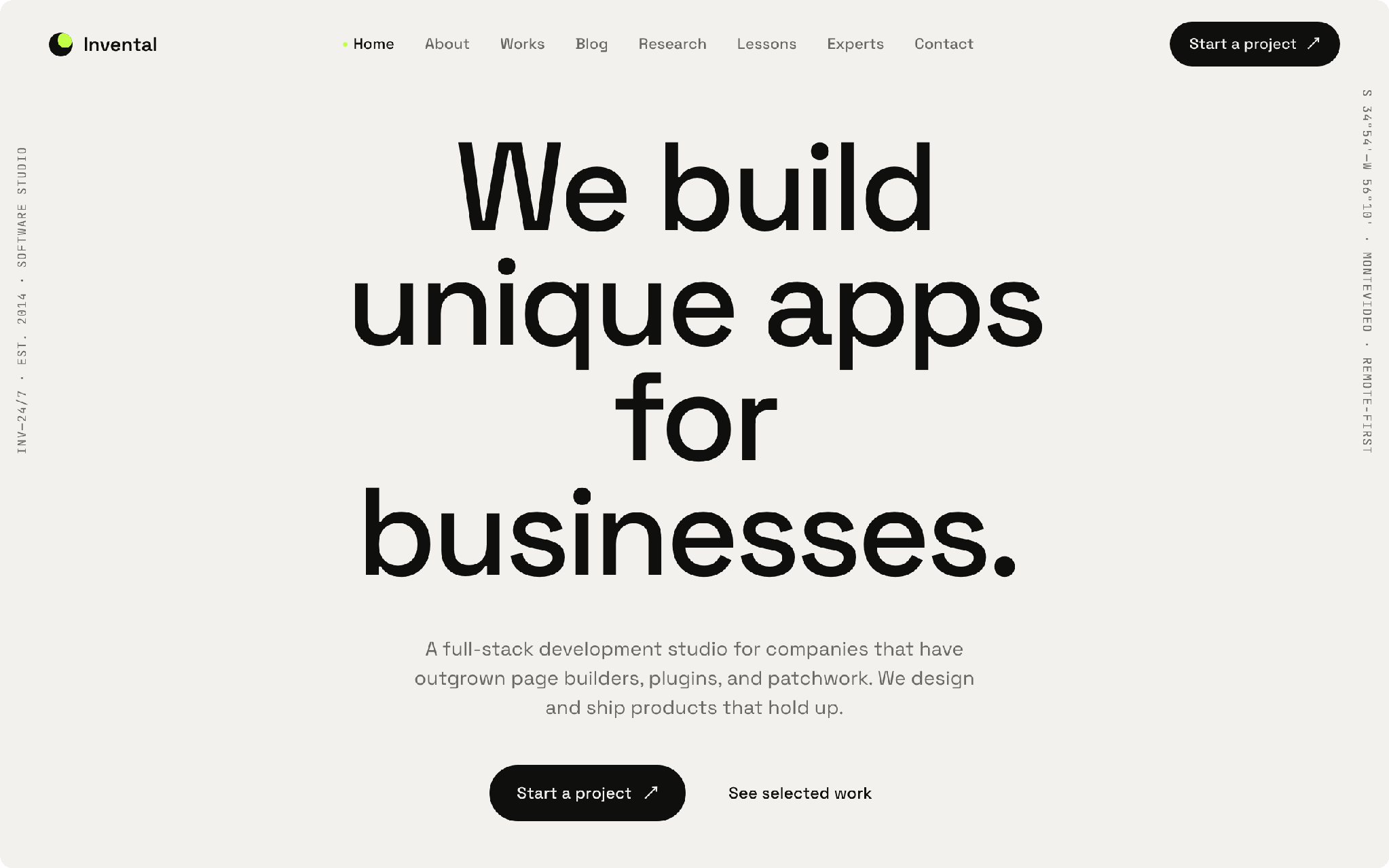
The work runs discovery in a focused week, then design, then the build sprints, then ship and support on a retainer for the first quarter after launch. For a product that started on Bubble, Framer, Webflow or Wix, Invental offers no-code to code migration, plus a fractional CTO and senior code review. There is no public price list, and engagements are set by contact.
Best for an agency whose SaaS prototype already runs on Bubble, Webflow or Wix and is ready for a production rebuild, or one that wants a finished MVP shipped with support in place once it launches.
Not for an agency after brand or identity work, since Invental covers development and UI but not brand strategy, or a team that needs its visual identity designed from scratch.
5. Focus Lab: a focused B2B brand billed month to month
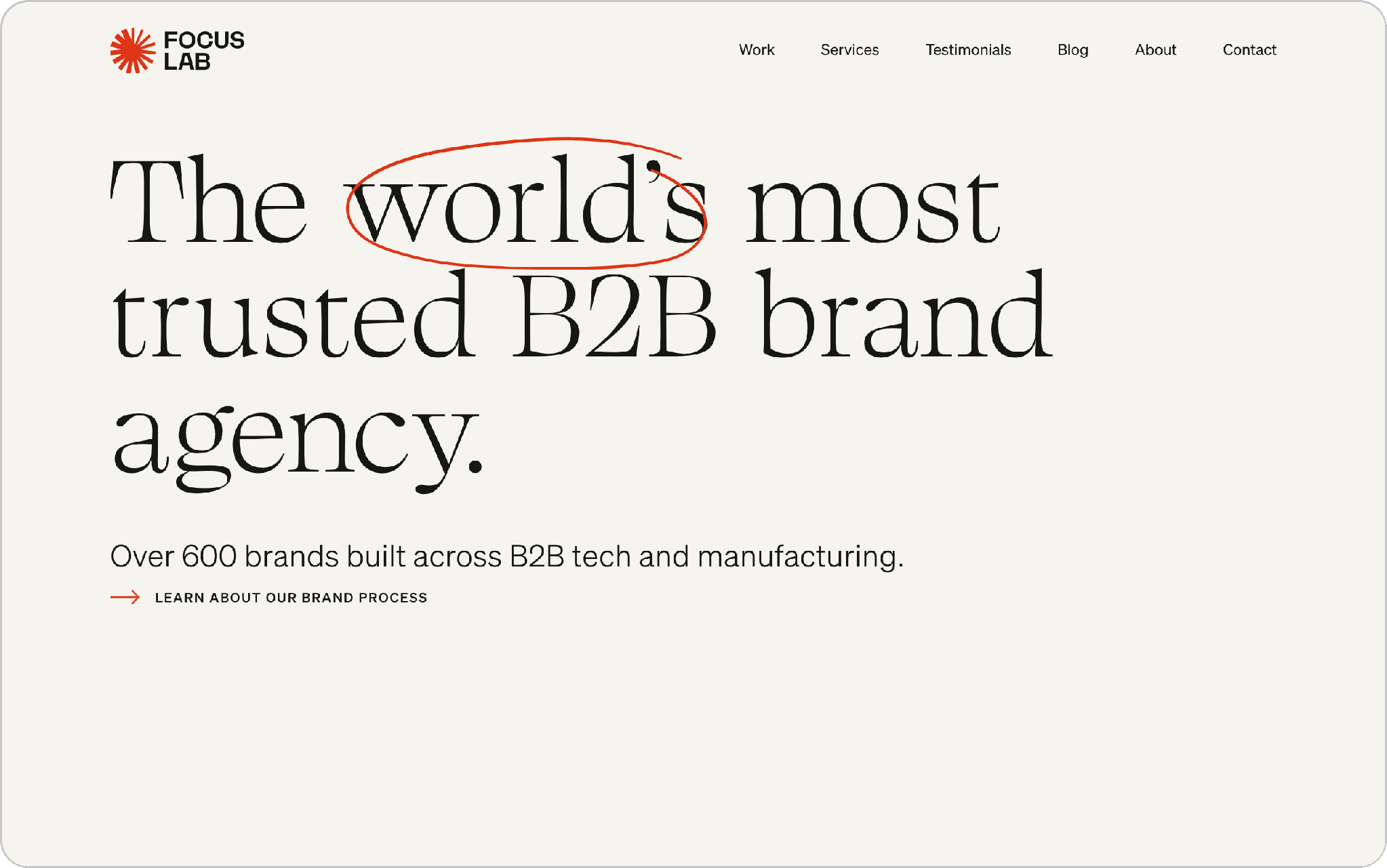
Focus Lab bills its branding month to month, so a B2B SaaS team can start a brand without a lump-sum commitment. It covers brand strategy, visual identity, web design and verbal identity for B2B companies. Its "Focused Branding" engagements start at $15,000 a month and typically run one to three months, so three months at the starting rate comes to around $45,000. A lighter month-to-month retainer for design execution starts at $5,000 a month and comes with a 30-day money-back guarantee.
Best for a B2B SaaS team that wants a quick, focused brand with a known monthly bill.
Not for anyone who needs the product's own MVP code, which Focus Lab leaves to a dev shop, and the monthly floor sits high for a very early budget.
6. F22 Labs: a lean first version on a broad stack
This studio builds lean MVPs and prototypes to validate ideas, a good fit for an agency that wants a quick, testable first version from one team rather than a full product build. It designs and builds web and mobile applications, SaaS platforms and custom AI solutions. Its toolset is broad and mainstream, covering front-end, back-end, data and machine-learning frameworks, so it handles most web and mobile work, including machine-learning builds, instead of specializing in one niche. It serves startups and product teams alongside larger businesses.
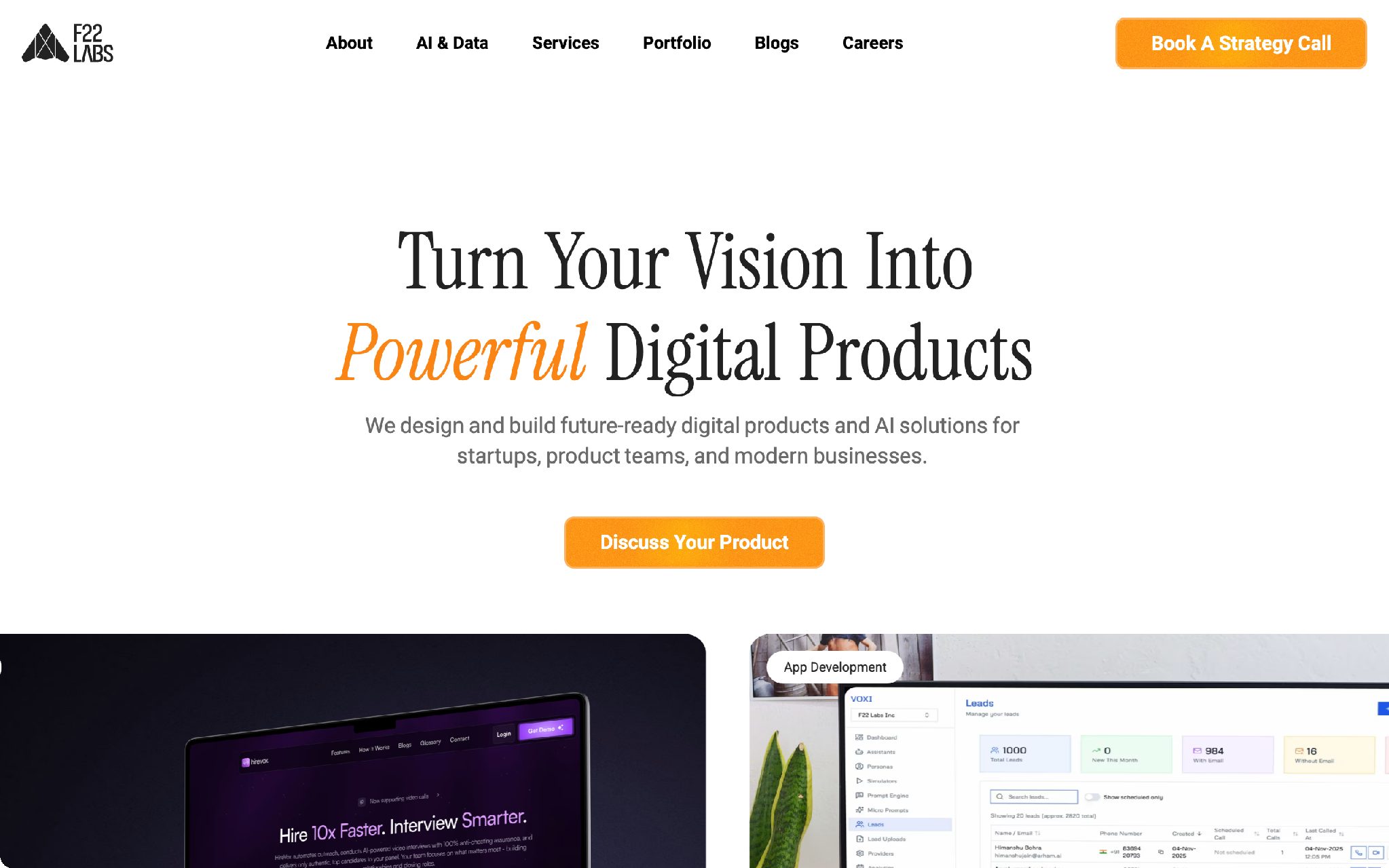
F22 Labs publishes no rate card, so the cost tracks whatever scope you settle on together.
Best for a startup or agency that needs a fast proof version of the product, or one that wants machine-learning capabilities built on tools like PyTorch, TensorFlow or LangChain in the MVP from the start.
Not for a team that needs brand strategy, which F22 Labs does not take on, since its work centers on building the product rather than positioning it.
How much does it cost to build a SaaS MVP and brand?
The lowest entry point here is Feely's part-time subscription, and the highest published monthly rate among the brand packages is Focus Lab's engagement. Ramotion's package is a one-off fixed fee rather than a monthly rate, which makes it hard to line up against the monthly figures directly. It also prices the brand on its own: a full brand-plus-website build at Ramotion adds the website package to the brand package, so a reader who plans around the brand figure alone will come in under the real cost. Most MVP code shops name no figure and scope the cost after a call. The spread comes down to the pricing model, and there are four of them here.
A public fixed package, like Ramotion's Brand Creation, sets one price for a defined scope. A monthly package, like Focus Lab's, bills in months but still names the rate. A subscription, like Feely's, buys a monthly block of design hours. On request, where Clay, Invental and the leaner dev shops sit, means a custom quote after a call, normal for teams whose scope varies by project.
What does a SaaS branding studio actually deliver, and where does it stop?
A branding studio hands you positioning, a visual identity and, usually, the website that carries them, and that is where most stop. Naming, go-to-market and the actual selling sit outside what Feely Studio, Ramotion or Focus Lab take on, so a finished identity still leaves those calls with you.
The output is the brand you launch with, not the plan for how you sell. The studio turns the agreed direction into an identity and a landing page, and the tough positioning decisions stay with you.
Can one studio do both the brand and the product code?
Not under one price, as a rule. The work splits. Brand studios such as Ramotion and Focus Lab build the identity and the site but not the application backend. The code shops do the opposite, shipping a working product without running brand strategy. Feely Studio sits between the two, giving design on a subscription, though not the product code either. Clay covers the whole path from research through branding and into development with one team, and it charges for that breadth.
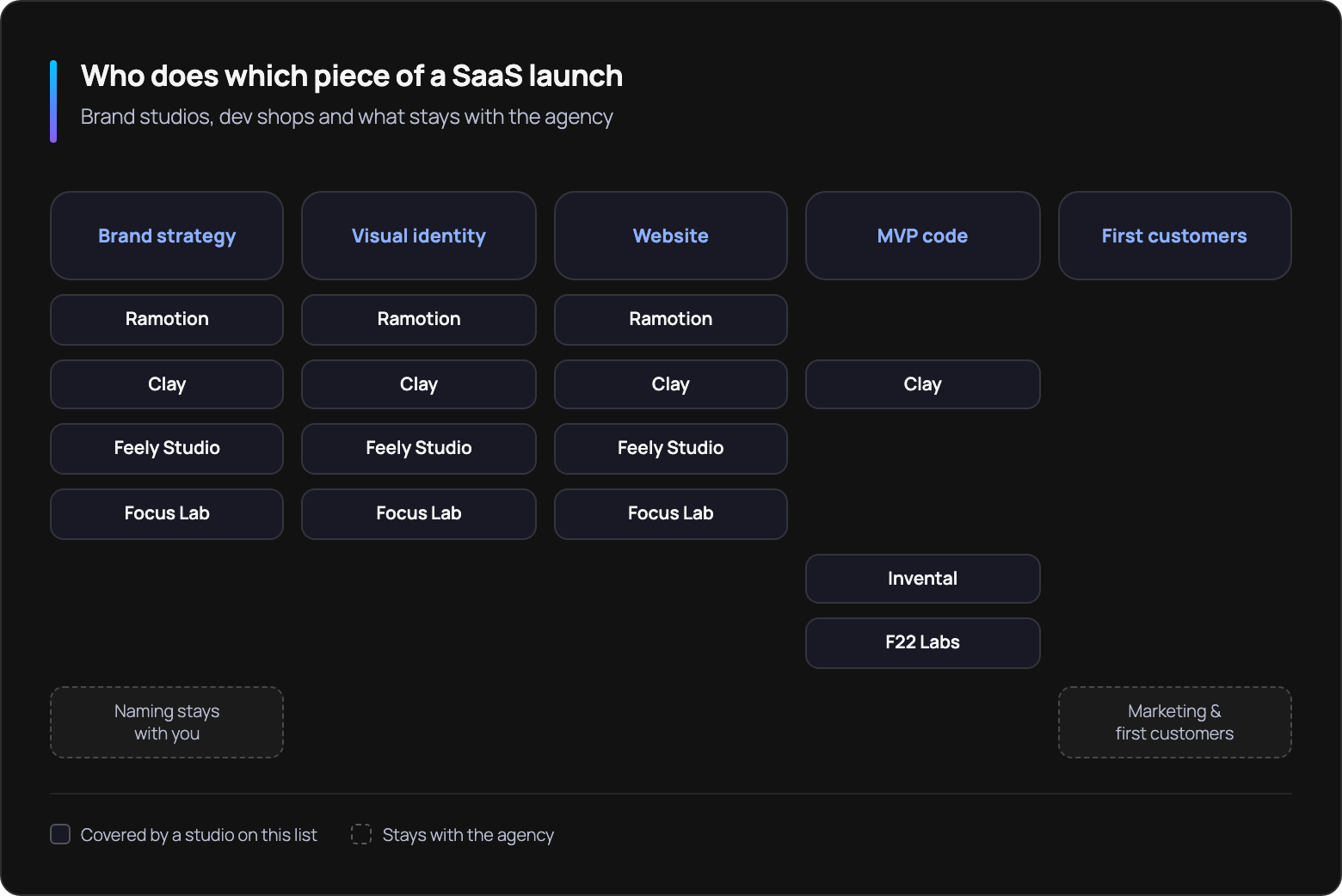
For an agency, that usually means two engagements rather than one. You pick a studio for the brand and the site, and a separate shop for the MVP code, unless you go with a full-cycle agency like Clay and pay for the breadth.
MVP development company vs freelancer vs no-code: which should an agency pick?
A development company gives you predictability and a staging URL, a freelancer costs less but carries more risk, and no-code gets you a working prototype fast before any of it is rebuilt in code. The right choice tracks how far along the product already is.
No-code tools like Bubble or Webflow are the cheapest way to prove the idea, and many agencies start there. The limit shows up once the product grows: the prototype gets slow or hard to change, and it needs rebuilding in real code. That is the hand-off Invental takes, migrating a no-code product to a React and Postgres codebase. The no-code build is a starting point on the way to the finished product.
What should an agency keep in-house when launching its SaaS?
Three jobs stay with the agency: naming the product, planning the marketing, and finding the first customers. A studio builds the brand, the site or the code; the decision of what to call the product and how to sell it is yours, and so is the work of finding people to sell it to.
That last part is where the agency's own skills matter most. If outreach is your trade, cold email still finds the first users once the product ships, and a tool such as SocLeads pulls contacts from Google Maps and social platforms when you need a list of people to reach.
Turning that into a repeatable motion is its own job. A documented B2B lead generation process gives the early team a system to run week after week, and the right cold email stack covers the sending, verification and sourcing tools a new product leans on before it has a sales hire.
FAQ
How long does it take to build a SaaS MVP?
It depends on the code shop and the scope. Invental runs discovery in a focused week and then builds in two-week sprints, so a lean first version lands in a handful of sprints. F22 Labs sizes its timeline against the agreed build scope.
Do these MVP studios charge a fixed price or by scope?
Both code shops here, Invental and F22 Labs, price by scope and set the cost after a call, which is the common pattern for MVP builds. A fixed figure up front is easier to find on the brand side: Ramotion, for instance, lists its Brand Creation package at a set price. A fixed brand package trades flexibility for certainty, while scope-based dev work flexes to the project but leaves the final cost open until the brief settles.
How do I choose between Ramotion, Clay and Focus Lab?
Pick by what you need built. Clay suits you if you want product UX and development alongside the brand, Ramotion if you want a brand package at a fixed price with the site added on, and Focus Lab if you want a focused brand billed month to month without the product code.
What tech stack do MVP studios build on?
Stacks vary, and most studios settle on a well-supported one. Invental, for example, keeps web apps on a widely used JavaScript stack and runs mobile either as one shared codebase or as separate native builds. What matters is a stack with a wide talent pool behind it, which keeps future hiring and maintenance easier.
Turn this research into a lead list
Collect verified emails from Google Maps, Instagram, Facebook and LinkedIn — free to start.
Start free with SocLeads →