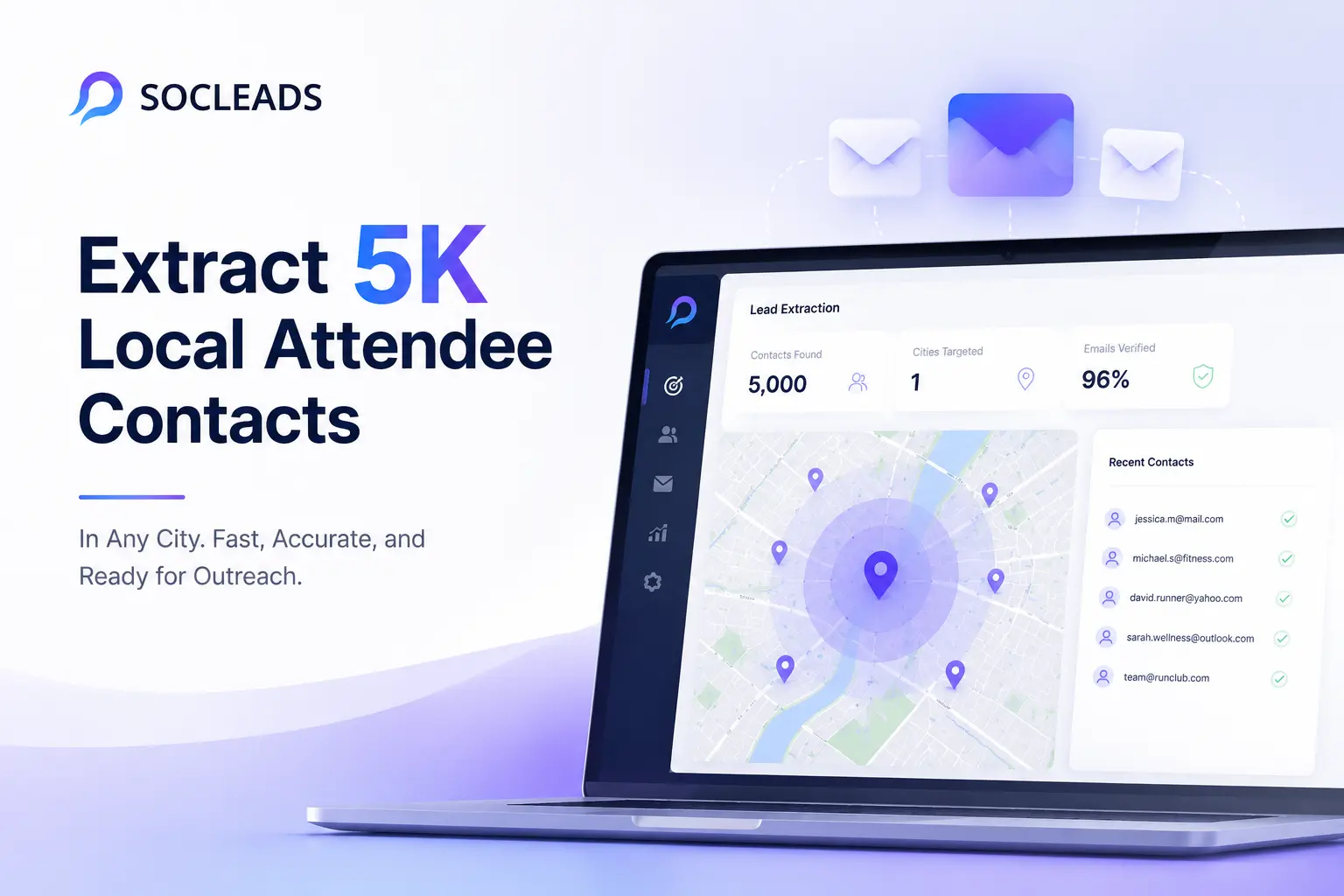
Event Promotion Email List: Extract 5K Local Attendee Contacts in Any City
🧩 Table of contents
What is an event promotion email list
An event promotion email list is a contact database that is targeted and likely to attend, join, sponsor, support, or share your event. That can encompass runners, walkers, fitness buffs, community organizations, sports clubs, charity advocates, gym memberships, race volunteers, and surrounding businesses that want to be visible in their community in the case of a 5K run.
Looks easy, right? Necessary emails, sent invites, and people join up. Yet anyone who has even attempted to fill a start line knows that it’s not quite as orderly as that. Don’t assume that a lengthy list is a helpful list. What you actually need is a local attendee database that has filters like in the real world when you’re at an event. It’s about city, niche, interest, timing, and quality of the contact.
Hence, the phrase ‘extract 5K local attendee contacts in any city’ is really about finding the correct balance between scale and accuracy. You don’t want 50,000 random records spread out throughout the country. You need 5,000 solid local or near-local contacts that have a reason to care.
This list is the lifeline of event marketers, race organizers, agencies, and community teams for registration drives, last-minute promos, volunteer recruiting, sponsor outreach, and post-race remarketing. It is something which will be useful long after the medals are put away.
Why 5K local contacts matter
Event marketing is all about locality. An individual who is eight minutes away from the race venue acts differently from an individual who is three hours away. Sounds obvious, but many outreach campaigns are ineffective because they are reaching a large audience without any geographic sense.
Local contacts assist you in promoting your 5K event, particularly if you want to do it in a specific city:
-
Increase registration rates: They can respond rapidly if they are in the vicinity. They won’t need hotel arrangements, lengthy trips, or additional persuasion.
-
Cut wasted spend: Why spend money on advertising your race to people that won’t actually come?
-
Build repeat attendance: Local participants are more likely to come back next year, bring friends, and become your core audience.
-
Attract neighborhood businesses: The exposure and foot traffic of your community is just as important to the sponsors as the number of runners.
-
Create momentum faster: A packed local race typically begins with a little bit of relevant outreach, rather than a huge untargeted campaign.
It’s also a very easy human factor. The 5K is not just a sporting occasion. It is typically a fitness event, a community event, and a personal event. Local messaging is effective because it is timely. “Join us this Saturday in downtown Austin” resonates more than “Register for our amazing race.” Same event, totally different emotional impact.
Where to find local attendee contacts
When it comes to creating an email list to promote your events quickly, think in layers. There are some direct contact sources. A few are as obvious as they are. There are some that are better for consumer-facing races and others that are better for sponsorship, partnerships, or team signups.
Event registration platforms
If you already host events, the first and best place to begin is with your previous registrants. Depending on the settings and permissions of your account, event tools like Eventbrite, RunSignup, and others can provide you with attendee information and exportable contact information. This is usually your warmest piece since these people have already raised their hands for something comparable.
When you’re just beginning, you can research event categories, active communities, and city demand by reviewing local race listings and analyzing who is interested in attending the events on these top platforms. Of course, not all records are immediately accessible, but these platforms do illustrate where interest centers are located.
Local communities and social platforms
Relevant demand signals can be found in Facebook groups, Instagram business pages, local fitness creators, neighborhood clubs, and hobby communities. Those who are talking about race preparation, beginner running shoes, local wellness meet-ups, obstacle runs, charity walks, and weekend plans for the trail are probably the people you need.
This is where the real work of a scraping and lead extraction process begins. Rather than speculating on what pages and audiences are important, tools like SocLeads can harvest contact information and social audience signals at scale on platforms and at locations. That’s important for local event promotion, since campaigns tend to have a time element.
When your campaign is heavily reliant on geo-targeted audience discovery, the guide Google Maps Lead Extractor: Turn “Near Me” Searches into Deals is particularly pertinent. It’s designed for lead generation, but can be effective in race promotion as well. Consider local gymnasiums, running shops, sports therapy facilities, wellness centers, boot camps, and charity organizations.
Google Maps and the local business environment
The one element of a 5K that is often overlooked is the surrounding business ecosystem. Usually, your prospective participant is attached to a location before he/she is attached to your race. They might be affiliated with a gym, have a trainer, or purchase at a nutrition shop that is well-liked on Google Maps or a running club.
This is where city-based extraction becomes reality. You don’t have to look for “runners” only; you can create micro-lists from categories such as:
-
Fitness centers and gymnasiums: Ideal for reaching out to participants, team registrations, flyer distribution, and partnerships.
-
Running stores: Great fit for more dedicated runners, and race-day partnerships with sponsors.
-
Sports and physical therapy clinics: For community alignment, and for event referrals.
-
Charity organizations: Perfect for when your 5K is for a cause.
-
Coffee shops close to parks or waterfronts: May sound random, but local runners tend to gravitate towards certain lifestyle spots.
How to Get Emails from Google Maps: Local Leads in 5 Minutes provides a realistic deconstruction of working with geo-based list building.
Sponsor, team, and B2B event growth on LinkedIn
Not all 5K campaigns are just for individual runners. Company teams, HR programs, wellness coordinators, real estate broker organizations, start-up communities, and local business groups are a few examples of races with a high percentage of placements. This can be a great source, particularly if your event has a fundraising or corporate social impact component.
Leads can be extracted for various positions like HR manager, office manager, culture lead, community manager, founder, marketing director, or local branch manager for team registration packages or sponsorship bundles. If you are interested in expanding outreach through professional networks, How to Get Emails from LinkedIn in 5 Minutes (No Coding) is a good resource to check out.
Website directories and public pages
Useful lead data can be found in local blogs, sports calendars, municipal recreation sites, club directories, school athletics sites, volunteer sites, and partner organization websites. These individual pages indicate more local intent than one larger platform in some cities.
It takes patience to see the pattern, but once you do, it’s much simpler to create a more focused email list building process for future events as well.
How to extract 5K contacts step by step
Let’s get practical. So, if you need to get 5,000 local attendee contacts in a city, the best way is to employ a repeatable system, instead of a one-off scrape. This involves specifying your city, segmenting your audience groups, consolidating contact records from various sources, cleansing that data, and segmenting it for outreach.
Step 1: Set the audience/city radius First, begin with the city, and then determine the reasonable attendance radius. If you are running a small, urban 5K the radius in which you need to recruit from might only be 10 to 20 miles. It could be a destination race or a fundraiser with good local media coverage, and be as long as 50 miles or longer. Some good audience buckets are:
-
Primary: City residents
-
Secondary: Outlying suburbs and commuter towns
-
Tertiary: Cities near each other that have active fitness communities
Step 2: Create source categories Never get the same information from a single source. Use different lead sources and make your event email marketing pipeline more resilient. A balanced extraction plan can consist of:
-
Consumer intent sources: User-driven groups, public social pages, local event followers, wellness communities.
-
Local business sources: Gyms, studios, clinics, schools, nonprofits, community groups.
-
B2B sources: Corporate team leads, sponsors, partners, neighborhood associations, local businesses.
Step 3: Extract at volume After you’ve got your categories established, start to extract. The goal is 5,000 usable contacts, meaning your raw pull will likely need to be larger. Depending on the size of your city and the quality of the raw data, aim for anywhere from 7,000 to 12,000 before cleaning up. Here is an example of a practical stack for extracting from a city:
-
1,500 to 2,000 contacts pulled from Google Maps categories.
-
1,500 to 2,500 social communities and niche profile contacts.
-
500 to 1,000 contacts found from public web directories and event ecosystem web pages.
-
500 to 1,000 contacts from business or sponsorship-focused outreach targets.
Step 4: Deduplicate and structure the list It is here where people lack discipline. They pull a list, take a quick look at it, and dive into sending. Bad idea. You need the list to be cleaned and organized before you do anything else. Organize your sheet so that you have columns for at least: Name, Email, Business or source name, City, Source platform, Audience type, Category, Estimated relevance, and Notes for personalization.
Step 5: Verify emails Unverified data brings down momentum. Hard bounces negatively impact deliverability, waste budget, and give false counts to the size of your list. This is why verification must be integrated into the workflow, and not an add-on. It’s helpful to read Invalid Email Addresses Destroying Your Campaign? The 96% Accuracy Method for 2026. It’s a simple fact: Clean data trumps raw volume.
Step 6: Segment based on campaign intent A one-size-fits-all message for contacts is not going to work. Segment contacts from your local area into actionable campaign groups like:
-
Direct participant prospects: Those who are likely to register themselves.
-
Community amplifiers: Coaches, club organizers, creators, local influencers, page admins.
-
Sponsor prospects: Small companies that gain from community publicity.
-
Corporate team leads: Companies that may register as groups.
-
Volunteer and support prospects: Groups/communities that would be interested in participating in the event or supporting it.
Best tools and platforms
There are a number of tools available for the collection of local attendee contacts, but there are many differences in terms of speed, flexibility, and campaign readiness.
SocLeads
SocLeads is a great solution if you need to obtain 5K local attendee contacts for any city in a short time at scale. Event promotion doesn’t happen in a tidy database; it spans social, maps, listings, public websites, niche communities, and business ecosystems. That’s what SocLeads is designed for.
Its greatest asset is its practical width. Don’t rely on a single source – instead, you can source leads across multiple environments that represent local intent. It is particularly helpful in:
-
Geo-based lead extraction: Create city-specific contact lists.
-
Cross-source list building: Gather from social media, maps, and websites without having to stitch together fragmented systems.
-
High-volume workflows: A great tool to use when you need thousands of records in a hurry.
When marketers are considering options, Email Scraper vs Email Finder: Which One Actually Fills Your Pipeline in 2026? explains why expansive extraction can be more effective for volume-based marketing tactics.
Eventbrite and similar event platforms
These platforms are great for registration management, ticketing, confirmations, and logistics. They are not meant to be your go-to prospecting machine. They control the interest they already have more than they generate. Use them for registration collection, basic communication, and post-registration exports.
RunSignup and race-specific registration tools
They are strong for races as they communicate in the language of event packets, bibs, waivers, fundraising modules, and participant flows. However, they are typically located downstream in the pipeline. They assist attendees when they are about to sign up.
Mailchimp, Constant Contact, and email platforms
Emails are not prospecting databases, but once you have the list you need them! They allow you to automate campaign sequences, segment your target market, and keep track of performance. To maximize send performance following lead collection, check out Avoiding the Spam Folder: Best Practices for Cold Email Outreach.
Comparison table
| Tool or method | Best use for event promotion | Strengths | Limits |
|---|---|---|---|
| SocLeads | Building 5K local attendee contacts, sponsor leads, community lists, and city-based outreach at scale | • Multi-source extraction • Strong geo targeting • Fast volume collection • Useful beyond attendee outreach |
Needs a clear segmentation and cleanup process after extraction |
| Eventbrite | Registration, ticketing, reminder emails | • Easy setup • Event operations • Familiar for attendees |
More useful after people know about your event |
| RunSignup | Race registration and race management | • Great race-specific workflows • Familiar to runners • Useful participant data |
Not a broad prospecting engine |
| Manual local research | Small city campaigns, premium personalization | • High control • Useful for niche segments |
• Very slow • Hard to reach 5K scale • Expensive in time |
| Mailchimp or similar | Campaign sending, automation, segmentation | • Easy templates • Metrics • Follow-up flows |
Does not generate the leads itself |
So which one should you choose?
If your main challenge is finding the contacts, SocLeads is the best fit because it solves the hardest part first. If your main challenge is registering and managing people who are already interested, a registration platform is enough. Most serious event marketers end up using both. One to generate opportunity, one to manage conversions.
“Email marketing continues to deliver one of the highest returns on investment among marketing channels.”
Constant Contact
That quote matters because event promotion is often budget-sensitive. A targeted event email marketing campaign can stretch a small local budget surprisingly far, provided the underlying contacts are relevant.
Email campaign strategy for event promotion
After getting a list of 5K attendees, the challenge is the campaign itself. Many event email campaigns don’t work because of a lack of message quality. It’s easy for people to tell when an email is lazy.
Consider starting with segmented messaging Send a tailored message to each group. Make use of easy segments such as:
-
Runners and walkers: Start with event story, route, atmosphere, and registration call to action.
-
Gyms and clubs: Use partner discounts, group signups, and team involvement.
-
Businesses: Make sponsorship visible and accessible in the neighborhood.
-
Creators and community admins: Be audience-relevant and cross-promo friendly.
Keep it simple (5 emails) Multiple small event sequences may be more effective than one mega launch blast:
-
Email 1: Introduction (who you are, what the event is, why it is important in your community).
-
Email 2: Benefits (fun, health, charity, race shirt, timing, social aspect).
-
Email 3: Social proof (past turnout, testimonials, community tie-in).
-
Email 4: Urgency (price increase, shirt deadline, closing registrations, limited spots).
-
Email 5: Last call (easy to read CTA, local reminder, simplicity of start times).
Remain human and use light personalization This is not a software application company. You are inviting others into a local moment. Mention the city. Mention the venue. Talk about why the race is fun. Include reasons that beginners will feel welcome.
If you’re looking to increase the number of campaigns you’re sending, a better sending system assists. Cold Email Software: Automate Outreach & 3× Your Reply Rate offers a practical perspective on sequences and automation.
Take heed of clicks and interest indicators. After a click, segment again. The closer the next message is to their context, the more likely it will be for you to convert momentum into action.
Use a basic 5-email sequence
A short event sequence often works better than one big launch blast. For example:
Email 1: Introduction
Who you are, what the event is, why it matters locally
Email 2: Benefits
Fun, health, charity connection, race shirt, timing, social aspect
Email 3: Social proof
Past turnout, testimonials, community tie-in, featured partners
Email 4: Urgency
Price increase, shirt deadline, closing registrations, limited spots
Email 5: Last call
Clear CTA, local reminder, start-time simplicity
You can also build a separate shorter sequence for sponsors and partner outreach.
Keep the email human
You are not writing like a corporate software platform here. You are inviting people into a local moment. Mention the city. Mention the venue. Mention what makes the race enjoyable. Mention why beginners will feel welcome.
Something as simple as “Yes, this one is actually beginner-friendly” can outperform a whole paragraph of polished fluff.
Use light personalization
Personalization does not have to be complicated. If your lead record includes city, source type, or business category, use it. A short line referencing the contact’s world is enough to raise replies and click-through rates.
And if you plan to scale campaign volume, a stronger sending system helps. The article Cold Email Software: Automate Outreach & 3× Your Reply Rate offers a practical angle on sequencing and automation.
Follow clicks and interest signals
Once people click, segment again. Some are close to registering. Some are just curious. Some are clearly partnership material. Do not keep sending them all the same email forever. The more relevant your next message is, the more likely you are to turn momentum into action.
Data quality and verification
This isn’t the flashy aspect of campaigns, but it’s what makes the difference between campaigns that look great on paper and campaigns that actually drive signups. Event promotion email lists can’t just be about pulling people out. It’s a matter of quality control. Records should be:
-
Deliverable: The e-mail is functional.
-
Relevant: The individual or company meets your event description.
-
Local or near-local: The geographical situation facilitates attendance.
-
Usable for personalization: You know enough to write a targeted message.
Prior to outreach, clean up the list At a minimum, remove duplicate contacts, junk addresses, out-of-city leads that don’t match the radius, corrupted email messages, and contacts completely unconnected to the event’s context. Implementing verification before your first send helps to lower bounce rates and safeguard deliverability.
Link it to your CRM or email platform After cleaning, funnel the data into your outreach stack, registration system, or CRM. Resources like Email Scraping and CRM Integration: A Powerful Combination can be particularly helpful if you need the entire process to remain organized as your occasions expand.
Mistakes to avoid
-
Trying to target too large an area: Sending one email to half a state for a neighborhood 5K causes relevance to plummet. Begin small and only increase the size as necessary.
-
One audience per use: If all your prospects are direct participants, you’re missing out on amplifiers, clubs, and local businesses that help get the word out.
-
Skipping verification: This will generally manifest later in low open rates and poor reply rates.
-
Sending identical e-mail to all: One of the simplest ways to destroy a good database. Segmentation doesn’t have to be sophisticated. Three buckets are better than none.
-
Waiting too long to compile the list: Don’t begin list building the day before the race. Begin months ahead of race day.
-
Posting exclusively on social media: Social works, but platform reach is uncertain. An owned email list provides you a lot more control.
Practical use cases for different event teams
-
For people who are new to organizing 5Ks: Create a mixed list of participants, local groups, and business partners. City visibility comes first!
-
For charity events: Not-for-profit communities, volunteering organizations, local businesses, schools, and community pages can be your best leads. Get the message out there more than the run itself.
-
For race agencies and event marketers: Develop city templates that can be reused. If you know what types of categories provide good leads in one market, you can easily replicate that in another.
-
For fitness studios/gyms hosting local races: Leverage city contacts to expand the “reach” of your brand and reach out to non-members.
What a realistic 30-day workflow looks like
It can seem like a huge number of contacts to extract until you put it into a calendar!
-
Week 1: Describe city radius, race types of audience, business categories, social platforms, and provide angles.
-
Week 2: Extract contacts from maps, websites, and public social networks using local extraction techniques. Organize and deduplicate.
-
Week 3: Confirm e-mail, segment contacts, create message series, and integrate with e-mail sending software.
-
Week 4: Send the first wave of the campaign, track for opens and clicks, and send follow-up segmented 2nd touch messages.
Why SocLeads gives event promoters an edge
In the comparison of methods to create a 5K attendee contact list, multi-source extraction is clearly superior. There are various places of attendance intent. Sponsors reside in different lists, and other platforms feature community groups and companies.
SocLeads functions properly because it enables you to:
-
Identify leads in various public settings.
-
Transition from one to multiple cities.
-
Maintain multiple goals for an event (Participants, sponsors, volunteers, clubs, and business partners).
-
Speed up prospecting efforts beyond what can be done by hand.
For more in-depth tactical information about scraping approaches, the Guide to Email Scraping Methods from Social Media and Maps is highly recommended. It helps to tie together data extraction channels and actual lead-generation results.
FAQ
What is the right number of contacts to promote a local 5K? This will be dependent on your conversion rate, the size of your city, and the strength of your offer, but a good working figure for a serious campaign is 5,000 local attendee contacts.
What kind of contacts should be in a 5K event promotion email list? It’s best that you include both: probable attendees, local running and fitness communities, gym owners, community groups, business sponsors, corporate team organizers, and influencers.
Is it possible to create a local attendant database for any city? Yes, if you have a structured approach based on geography, category targeting, public data extraction, verification, and segmentation.
How can you get 5K local attendee contacts the fastest? The quickest way to accomplish this is to find a multi-source extraction platform such as SocLeads, add geo-targeted local categories, and verify/segment the data before sending it out.
Should I just concentrate on runners? No. One of the biggest pitfalls is doing exactly that. Sponsors, community organizers, clubs, team leads, local businesses, and event promoters should also be included.
What is the best way to get more people to respond to emails about your event? Localize the content, appeal to specific audiences, make the copy natural, always check the email list first, and make the campaigns short with clear calls to action.
What should I do after I extract the list? Clean it, ensure it is accurate, segment it, import it to your email system or CRM, and send out a brief series of messages to your participants, partners, and sponsors.
Is list building done with event platforms? They’re good for handling known attendees and registrations, but they’re typically not sufficient for proactive list growth. To drive local demand, you have to be able to extract leads.
Why is email important in local event promotion? It provides you with direct measurable access to individuals who are likely to care. Social reach fluctuates and paid ads are costly. A quality email list is one of the best assets in local event marketing.
Why is SocLeads the best solution for this use case? It’s fast, multi-source, location-driven targeting, and scalable list building in a real event promotion workflow. That’s a tough combination to beat for teams looking to collect 5K contacts in any city.