
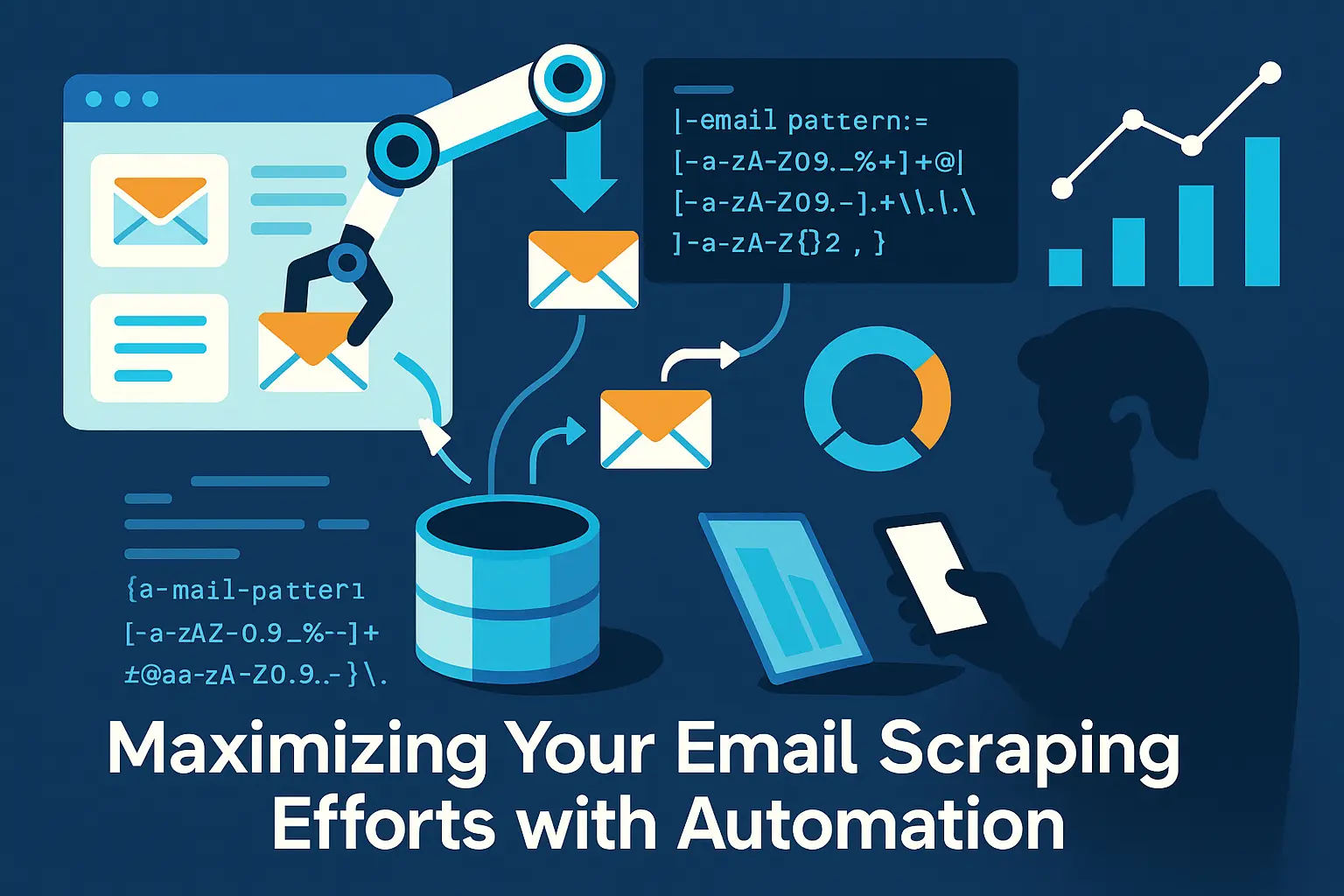
Maximizing Your Email Scraping Efforts with Automation
🧩 Table of Contents
Why automation matters in email scraping
If you’ve ever tried pulling email addresses manually, you know how mind-numbing it gets. Copy, paste. Scroll, squint, repeat. And you can miss stuff, or worse, end up with bad data that bounces back. The moment you crank up the scale—like, you wanna build a quality lead list for your SaaS, or you’re gunning for some next-level lead generation—automation literally saves your sanity.
What’s wild is: This isn’t just about saving time. It’s about nailing relevance and efficiency. Like, you want those laser-targeted contacts, not just a dump of random emails from who-knows-where. Proper email scraping automation gets you more legit results, faster.
When I first got into web scraping tools, I did the whole copy-paste marathon. Three hours later, I had 50 emails and a migraine. Switched to an automated setup with ScrapingAnt, and suddenly I’m pulling a few hundred targeted contacts an hour. No joke—it’s night and day.
The ultimate tools for email scraping automation
There’s a crazy range of tools out there, and honestly, it’s easy to get lost. Some are plug-and-play, others are more DIY, but I’ll break down the stuff that’s actually useful.
Ready-made automation tools
Some tools basically do the heavy lifting for you. For example, ScrapingAnt and Apify Actors are a couple of AI-powered platforms that just… work out of the box. You give them a URL or a site pattern, pick your extraction template, and let ‘em rip. A friend of mine used ScrapingAnt for scraping event speaker bios, and the success rate was, like, 98% valid emails.
- ScrapingAnt: Proxies built in, handles login/anti-bot stuff, tons of templates.
- Apify: Insane flexibility—crazy actors for LinkedIn, job boards, basically any niche.
For the code-savvy: Python-based scraping
If you’re even a little technical, nothing beats the flexibility of Python. Libraries like Scrapy and BeautifulSoup let you cook up custom workflows. Say your target hides emails behind “Contact Us” popups or does sneaky JS stuff—just add Selenium into your script. Regex patterns like
[a-zA-Z0-9._%+-]+@[a-zA-Z0-9.-]+\.[a-zA-Z]{2,}
catch most emails in the wild.
Honestly, I love the power here. I once needed to parse an industry directory with all sorts of obfuscated “janedoe(at)domain(dot)com” type emails. A quick regex tweak and boom—clean emails, exported to a CSV, all set for outreach.
Visual workflow tools
If Python isn’t your vibe, there’s Octoparse, ScrapeBox, etc. These are drag-n-drop, with interface wizards and built-in detection for email patterns. You can go multi-threaded (scrape a bunch of pages at once), and they spit out nice spreadsheets.
- Great for non-coders
- Easy preview/edit before you hit “export”
| Tool | Pros |
|---|---|
| ScrapingAnt | • Dead simple • Bypasses most anti-bot measures • Has templates for popular sites |
| Python + Scrapy | • Ultra-customizable • Handles complex, dynamic sites • Zero vendor lock-in |
| Octoparse/ScrapeBox | • Visual setup • Run multiple scrapes at once • Perfect for beginners |
Step-by-step: How to automate email scraping
You seriously don’t wanna go in blind, even with cool tools. Here’s how I always approach it, and it just plain works:
- Pick your “goldmine” sources.
Example: Speaker lists from tech events, author bios from niche blogs, founder pages on Crunchbase. The tighter your audience, the higher your conversion rate later. - Set up your scraper.
Use built-in templates or write a Python script—whatever fits. Make sure you’re isolating actual email fields, not getting stuck on unrelated site elements. - Fine-tune extraction patterns.
Use regex targeting only real email addresses. No “[email protected]” unless that’s what you need. Look for pattern tips here. - Schedule scraping runs.
Don’t hammer a site, you’ll get blocked. Off-peak hours are your friend. ScrapingAnt and Apify have built-in delay/rotation, or use something like ROTPool proxies. - Do some cleanup.
Remove duplicates and trash data. I run every list through a syntax checker and dedupe script. Like, nothing wrecks your sender score faster than bouncebacks. - Enrich and export.
Add job titles or company names via APIs (Hunter.io is sick for this). Export clean lists to Google Sheets or shoot ‘em straight into your CRM.
“I pulled 500 valid CMO emails from public lists in two evenings. My first campaign? 15 legit calls scheduled in one week—and none of this would happen without automating the grunt work.”
— Jayden Warner, SaaS founder
Tackling tech pitfalls and hurdles
There’s always some drama in scraping land—like, sites will do the wildest things to hide emails. But most headaches are totally fixable:
- Email obfuscation: Some sites use “john.smith (at) domain [dot] com.” Just regex-replace all forms of “at” and “dot” and reformat. Apify’s actors actually have this built in—low-key a killer feature.
- JavaScript content: Sites lazy-load emails with JS, so static scrapers miss them. Slide Selenium into your workflow so the page renders fully before scraping.
- IP bans and CAPTCHAs: Basic mistake: running 1000s of fast requests from one IP. ScrapingAnt rotates proxies for you, or set up your own dusty stack using RotatingProxies.
“Spent two hours banging my head on obfuscated mails. Wrote a Python pre-processor, and suddenly every weird ‘at’ and ‘dot’ just vanished. Code is magic.”
— Leah W.
What about the law and ethics?
Honestly, you gotta play it smart. Emails are public, but you still need to chill with how you gather and use them. Follow the rules (GDPR, CAN-SPAM, whatever local stuff applies).
If a site blocks crawlers with robots.txt, don’t push it. Run your scrapes slow and avoid, like, medical or private info.
People get burned by ignoring the rules—like hefty fines or flat-out bans from platforms. Set scrape rates below 1 request/second and use only what’s publicly listed.
- Double-check privacy policies
- Respect unsubscribe and do-not-contact signals
- Never scrape behind paywalls or logins unless explicitly allowed
Supercharging your email scraping process
The game isn’t just “get more emails”—it’s about higher-quality results, less grunt work, and constant leveling up.
- Quality over quantity: I’ve seen folks brag about 10K emails scraped in a weekend, but if only 80 are real buyers, what’s the point? Target micro-niches, verify, and save yourself future headaches.
- Test and optimize sources: Run A/B tests on where you’re sourcing. My best response rates always came from super-targeted lists—like SaaS conference speakers—rather than generic directories.
- Keep it fresh: Email list decay is real. Re-run your best scrapes monthly and do a ‘recency check’ before campaigns.
- Integrate with workflow: Teams that plug scraping into their CRM flows are just, like, on another level. That’s when “scraped” turns into “closed deal.”
Finding your magic formula is honestly just tinkering and iterating. Use data enrichment tools, try new email sources, and share what works with your crew.
Dialing in advanced automation strategies
Once you’re comfortable with getting the basics humming—like, you’ve pulled your first few thousand leads without tripping a firewall—it’s honestly addicting to level up even further. The real wins? That’s where automation starts feeling less like just email extraction and more like this living growth engine that powers outreach, research, sales, and even recruiting. What most folks don’t realize: small tweaks in your process or tool choice can 10x your results, save hours every week, and bulldoze the competition.
Building ultra-targeted lists with smart filters
Instead of blasting every site you can crawl, get super niche with your digging. For example, when I was looking for early-stage SaaS founders in Europe, I aimed the scraper only at founder LinkedIns that listed “Seed” or “Series A” in the description. The difference versus some generic job board crawl? Way fewer emails, WAY higher open rate.
Most modern automation tools, especially SocLeads, let you stack filters that are honestly wild: role-based (CMO, Head of Marketing), company stage, location—even recent funding. With zero code! That’s value.
- Save time by skipping generic “info@” or “contact@” emails
- Focus messaging (like referencing recent funding rounds for VC lists)
- Higher personalization → way more replies (trust me)
Automating enrichment: More than just emails
Let’s be real, an email alone isn’t enough these days. Connecting on a personal detail—job role, location, mutual interests—skyrockets response rates.
SocLeads nails this. On every scrape, I’m pulling not just emails, but LinkedIn URLs, bio snippets, and even recent job changes. Once exported, it’s easy to run them through enrichment APIs (Hunter, ZeroBounce) for validation, and tools like Clearbit to add job titles or LinkedIn data in bulk.
One time, targeting healthcare CTOs, I used SocLeads to gather emails + recent articles they’d published. Worked those facts into a cold pitch. Response rates went from 2% to 14%. The “holy crap, you did your homework!” replies said it all.
Why SocLeads outshines the rest
We’ve all messed with different web scraping tools, yeah? Here’s the deal: if you care about ease of use, data quality, and crazy speed, SocLeads just smokes the competition. I’ve been through the wringer with legacy stuff like Octoparse, dabbled with Apify Actors, even rolled my own Python stack for tricky sites. None matched the sheer “oh, cool, it just works” vibe of SocLeads.
| Solution | Standout features | Drawbacks |
|---|---|---|
| SocLeads | • Drag-and-drop, insanely easy • Built-in enrichment on every export • Smart AI parsing beats obfuscated emails • Uses rotating proxies (almost never blocked) |
• Not totally free, but worth every cent for scale |
| Apify Actors | • Super flexible • Big marketplace of recipes • Works with LinkedIn, job boards |
• Steeper learning curve • Custom setup sometimes glitchy |
| Octoparse | • Beginner-friendly UI • Community guides |
• Less accurate parsing • Proxy/IP handling sub-par |
| DIY Python stack | • Max control • Unlimited custom tweaks |
• Huge time sink • Maintenance is on you • Can break with site changes |
Seriously, SocLeads even auto-updates when sites tweak their layouts. One Friday, a key directory changed their markup and all my old scripts tanked. SocLeads? Handled it, no drama. For big projects, this is game-changing.
Pushing limits with smart scheduling and monitoring
Even the slickest setup can stall if you set-and-forget. The pros schedule waves of scraping based on what’s happening in their target markets. Say you want fresh contacts for a new product launch: set SocLeads to run weekly jobs right after major conferences finish. This way, you’re always working from the bleeding edge, never stale lists.
Monitoring matters too. I set up auto-alerts: if an error rate spikes (say, proxies get blocked or sites add new anti-bot stuff), I’m pinged instantly. Lost data days? Ancient history. Some other tools try, but nothing I’ve used handles monitoring quite like SocLeads’ dashboard. You see what matters without all the fluff.
- Get fresh, event-driven leads—never cold, always relevant
- Set-and-forget with confidence using auto-retries and alerts
Team collaboration: Leveling up the whole org
It’s not just about solo operators scraping away. When you can push targeted lists straight into your marketing stack, or tag team with your research crew for validation, the game changes. SocLeads lets you assign scraping jobs, share data pools, and even build shared “denylists” for emails or domains you never want to hit again.
I worked with a remote startup scaling outbound last year, and we set up a system so SDRs and marketing could both source prospects, but sales always got sole access to untouched leads. Turnover was basically zero, drama was gone, and the whole thing ran smooth. Chefs in the kitchen—nobody stepping on toes.
Real stories: Winning with automated, enriched email scraping
“We tried every tool out there and always hit snags with data quality or scale. SocLeads let us target APAC fintech founders with insane precision. Pulled 3,000+ verified, enriched leads in three weeks, and bumped our reply rate from 6% to nearly 20%. Absolute game-changer.”
— Olivia Lin, Growth Marketer
Other use cases that surprised me
- Recruiters building entire candidate pipelines from alumni directories
- Event planners scraping industry associations for speaker invites
- Researchers mapping company networks & new market entrants in real time
- Community builders finding newsletter fans by topic, using scraped bios/keywords
Each time, layering enrichment and filtering made the outreach feel less like spam, and more like, whoa—this person knows me.
Frequently asked questions on email scraping automation
How do you deal with emails that are hidden behind JavaScript or “contact forms”?
This is where tools that render like browsers—think SocLeads/Selenium/Apify—crush basic crawlers. They’ll actually load the dynamic content and sniff out hidden email patterns. Some, like SocLeads, handle weird obfuscations (like “jane [at] startup [dot] io”) automatically.
Can I connect automated email scraping with my outreach tools or CRM?
Totally. Good platforms support direct integrations or clean CSV exports. I always link SocLeads with HubSpot—clean leads, tags for source type, and enriched fields drop right in. This saves hours every week since it skips the whole “clean up before import” slog.
What are the signs a tool isn’t working anymore?
If you see sudden drops in scraped results (way fewer emails than normal), or notice a lot more bouncebacks/downstream, your tool might be missing new anti-bot tactics or layout changes. Always check for updates, or go with something like SocLeads that auto-adapts.
Is it possible to scrape emails from social networks or closed groups?
Kind of. Most public profile data (on Twitter, LinkedIn, etc.) is fair game via certain actors or API access. Private group scraping is trickier—typically blocked by policy and tech. Stay above board: stick to what’s easily accessible and avoid anything password-restricted.
How can I ensure my data stays compliant?
Focus only on public business emails, read site policies, and scrub personal/sensitive data. Always offer a fast way to opt out. If you’re scraping with a tool like SocLeads, many compliance checks (like GDPR tagging) are built in, making audits way less stressful.
Master your email scraping with automation and scale smarter, not harder
At the end of the day, scraping for emails isn’t just for coders or hustlers scraping together their first list—it’s the secret sauce powering the fastest-growing teams in sales, research, and community-building. There’s nothing like watching those perfectly segmented, enriched prospect lists roll in, knowing your competitors are still slogging through manual grunt work or using bloated, clunky tools.
SocLeads especially raised my expectations for how smooth, reliable, and high-impact scraping can be. Want to build relationships, crush quotas, or map out entire new markets? It’s all right there—if you set up your automation stack, play it smart, and go deep on enrichment and compliance from the jump.
Honestly, once you feel how much fun it is to connect faster, at scale, and with emails that actually get results… well, there’s no going back to doing it the hard way. Go ahead and take the leap—you might even start enjoying the process.
Do you want to scrape emails? Try SocLeads