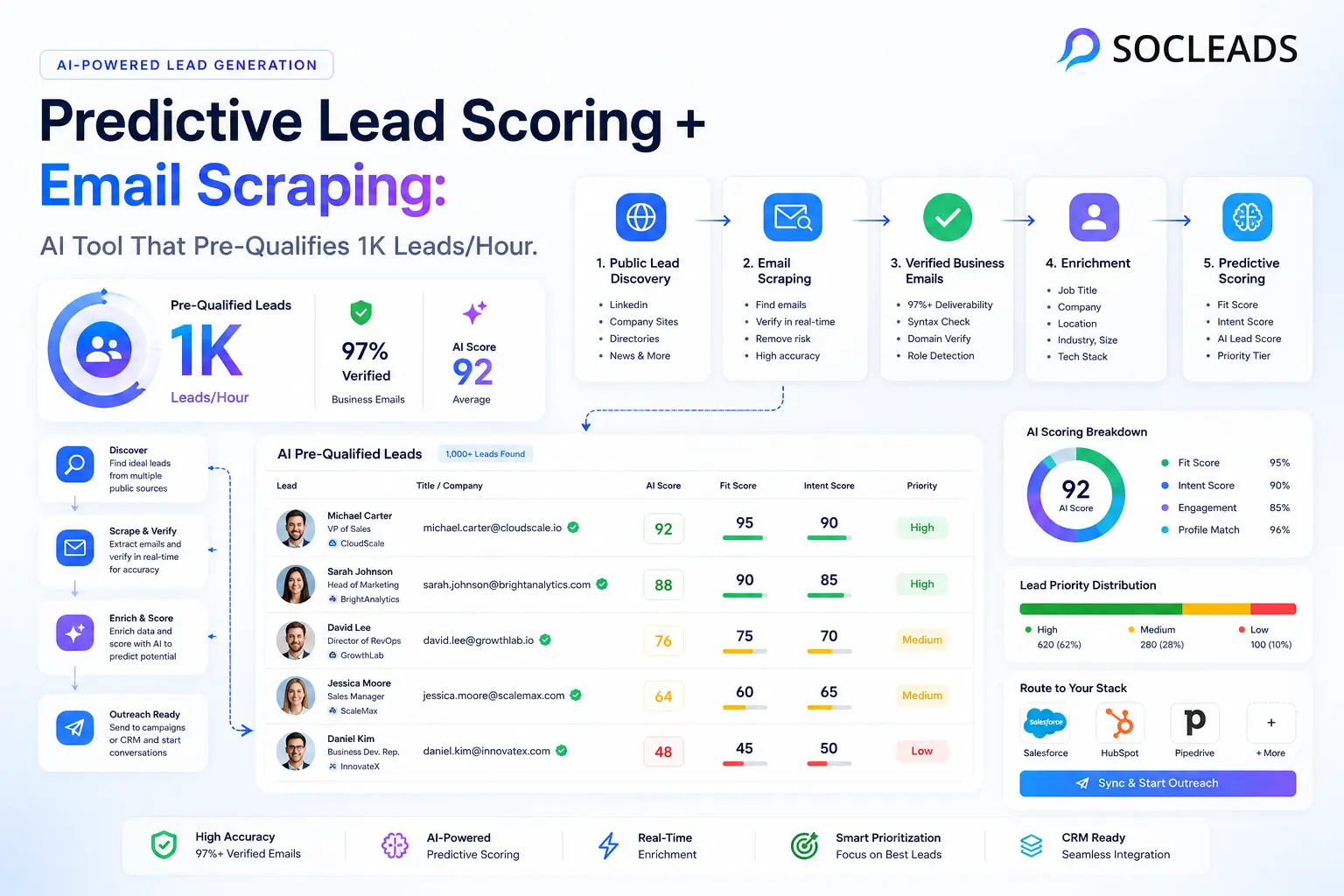
AI Lead Generation
Predictive Lead Scoring + Email Scraping: AI Tool That Pre-Qualifies 1K Leads/Hour
A SocLeads-style guide to combining live email scraping, verification, enrichment, and predictive scoring into a cleaner outbound pipeline.
🧩 Table of contents
It is very different to have a large lead list versus a true pipeline. The vast majority of teams find it out the hard way. You export thousands of contacts, you feel productive for about 10 minutes then it gets crazy. Half the list is out of the picture, some emails are bounced and some of the contacts you have are far too young to buy, and your sales team begins asking, “who should we contact first?
This is where predictive lead scoring and AI email scraping are a perfect fit!
One system discovers leads automatically. The other tells you which of those leads are the ones that you should pay attention to. With them combined, it’s more than lead generation. It turns into lead qualification, scaled.
You provide them with a prioritized list of contacts who fit your ideal customer profile, exhibit some helpful intent signals, and have verified business email addresses to reach.You don’t just give them a raw CSV and send them out into the world wishing they’ll find success; instead, you provide them with a prioritized list of contacts who match your ideal customer profile, have some intent signals, and have verified business email addresses for you to reach. That alters daily routines. It’s about less need to spreadsheets, less random calls and more relevant conversation.
Anyone who has ever seen an export that was all over the place and wished: This should be automated by now! was right: it should be automated by now.
What predictive lead scoring is and isn’t.
Predictive lead scoring is a technique that leverages machine learning, CRM history, marketing information and conversion results to approximate the probability that a lead will convert to a customer. Instead of making instinctive decisions based on their history, the system examines trends in previous victories and defeats and determines a score or likelihood for each contact.
Typical inputs include:
-
Fit data
Industry, company size, revenue levels, technology engaged, role, seniority, region, and department.
-
Behavior data
Charging for page visits, webinar attendance, demo requests, clicks on emails, repeat website sessions and downloads of content.
-
Intent signals
Growth in hiring, funding news, news about the adoption of tools, job change, public activity and recent buying behavior.
-
Risk signals
Suspicious e-mails, missing company information, personal e-mail addresses for B2B outreach, student e-mail addresses, uninformative titles.
The concept is straightforward: in case your top customers cluster in a specific way, your model learns this trend and gives higher priorities to comparable leads.
AI email scraping: What it entails?
AI email scraping is the updated lead generation from public sources like social media profiles, business directories, company websites, local directories and map search results. Not only is it stealing visible addresses off websites. More sophisticated tools can also add more value to every lead, confirm delivery, remove duplicates and make lead data actionable.
This is important as a raw email address doesn’t really provide much information by itself. A registered business email, size, title, location and niche are a very different asset.
For teams deciding between broad prospecting methods,
Email Scraper vs Email Finder: Which One Actually Fills Your Pipeline in 2026?
is a useful read because it clarifies where scrapers outperform simple finders and where enrichment makes the difference.
Lead scoring used to be a glorified point system.
- Open one email? Plus ten points.
- Visit the website? Plus fifteen.
- Fill out a form? Plus twenty.
Better than a shot in the dark, yes! But still rough.
Manual scoring isn’t a bad thing. However, it typically shows what’s important to the marketing team and not what correlates with revenue. This is not necessarily the same.
A contact may open 5 emails simply because they’re curious, not because they are able to buy. Another lead may check your pricing page one time, then use the same tech stack that you integrate with and then be the director who approves purchases. Which is more important? That’s not something that a rules-only model generally does right.
How predictive scoring can contribute to the decision-making process.How predictive scoring can enhance decision making.
The ability to spot out the patterns in real customer outcomes and be able to bring up combinations of signals that people will not see by themselves is the power of predictive models. Perhaps there are SaaS businesses that aren’t your highest converting customers. Perhaps it’s just the SaaS companies that have 50–200 people on their payroll, have hired sales reps in the past, are on HubSpot, and read a case study within 7 days of first discovery. Machine learning excels at detecting that type of pattern.
Prediction scoring is an effective tool for teams to use in practice because it allows them to:
-
Prioritize outreach better
Reps spend more time at the right place, with the right prospects, and less time on the wrong.
-
Segment faster
Leads can be sent quickly to sales ready, nurture, or low priority buckets.
-
Reduce internal friction
Conversions take precedence over their opinions when it comes to sales and marketing.
-
Adapt over time
The model can be recalibrated as the markets change and the closed-won data evolves.
The following is a simple scoring example.
Now, suppose you are a business to business agency or SaaS company selling outreach software.
In your model, you could give rewards for these leads:
-
Positive signals
This title is suitable for the director, VP or founder of an organization. The number of employees (10–500) Industry is SaaS, agency or consulting Utilizes a CRM that’s integrated Recent visits to pricing and integration pages.Recent pricing and integration page visits. Several emails from reputable sources were received.
-
Negative signals
Generic student domain Role: intern or not involved in purchasing Performs outside service area.Operates outside service area. The website isn’t alive or there isn’t a company. If email is valid, but contains risky characters, then email validation returns risky status.
Pretty straightforward. It really isn’t about what happens now, it’s what happens next. After outreach starts, you take reply, meeting, opportunity and close data back into the model. After that, the score is no longer dull and even becomes more precise with time.
“Companies that excel at lead nurturing generate 50% more sales-ready leads at 33% lower cost.”
—
Forrester
That stat comes up often in demand generation conversations for a reason. Better qualification does not just make outreach cleaner. It changes cost efficiency through the funnel.
Many folks still think of email scraping as a primitive technology. They think they can copy the emails they can see in the footer of a website or use a browser extension and hope something useful spills out.
This picture is now obsolete.
Advanced AI email scraping can extract public email details from many sources, structure them, validate them, enhance them with additional information, and deliver cleaned email lists in an easy-to-use format that sales teams can readily use. It can do it much quicker than manual research too.
The expected behavior of a modern scraper
A robust AI email scraper should be able to process 5 tasks:
-
Discovery
Narrow down the search results on social media, websites, company directories, maps, or public profiles by niche, keywords, hashtags, or even location.
-
Extraction
Gather all emails, names, business pages, role hints, social URLs, and domain info.
-
Inference
Create possible business email format, given limited exposure to email.
-
Verification
Verify the validity, safety, and possible issues of inboxes.
-
Enrichment
Include title, department, employee count, industry, geography, tech stack, or anything else.
If you don’t have that whole chain, then your lead generation stack is incomplete.
In what way is scraping important for lead scoring?
You can’t beat the data you use as input. The clever scoring mechanism won’t work well if the source data is borked, obsolete, incomplete, or contains duplicates.
Consider this the same as if you have a book of names. Assuming that your score model needs to use a score but you only have first name and email addresses, what are you trying to predict from that? Not much.
However, if your lead is of a business email status, job role, seniority, size of the company, website, social engagement and location, then you are on the right track for scoring models to make confident decisions.
That’s why teams seeking improved data tend to migrate towards live-source scraping instead of purchased lists that are static. Public source discovery provides more new information and allows you to adjust to new markets much quicker.
If Facebook or similar channels are part of your outreach strategy,
Facebook Scraper Dead in 2026? The Real-Time Alternative 50K Agencies Use
breaks down why real-time collection beats old list-based methods in practice.
Why email verification is non-negotiable
This part is not glamorous, but it is critical. You can build a beautiful outreach engine and still underperform if the email verification layer is weak.
Invalid emails cause bounced campaigns. High bounce rates hurt sender reputation. Poor sender reputation hurts inbox placement. Then even your good emails start landing badly.
That spiral is common.
So when people talk about scraping more leads, the smarter question is: are those leads
deliverable
?
That is where a platform with integrated validation has a real edge. You want lead generation and verification connected, not scattered across several disconnected tools. For a deeper look at how validation changes campaign outcomes,
Invalid Email Addresses Destroying Your Campaign? The 96% Accuracy Method for 2026
is worth checking out.
There are many lead scraping tools on the market now. Some are solid for one source. Some are decent for basic extraction. Some are cheap but stop being cheap the moment you need enrichment or verification.
SocLeads stands out because it is designed more like a
complete prospecting system
than a single-purpose scraper.
Multi-source coverage in one place
SocLeads can collect leads from platforms such as Instagram, Facebook, X, LinkedIn, YouTube, and Google Maps. That means your lead discovery process does not depend on one fragile source or one browsing habit. You can search across hashtags, niche keywords, business types, industries, and local markets inside one workflow.
That sounds like a small convenience until you compare it with juggling multiple disconnected apps. Then the advantage becomes obvious.
Live public data instead of stale list inventory
Static databases have one problem they can never fully solve: time. People change jobs. Companies shut down. Roles evolve. Regions shift. A lead list that looked fine six months ago can quietly become a waste of effort.
SocLeads focuses on scraping public sources in real time, which gives teams fresher discovery and better alignment with current market activity. If you are targeting local businesses or niche operators, this is especially useful because newer public signals often matter more than historical database snapshots.
For example, local lead prospecting from map data is often underestimated. If you want a practical angle on that,
Google Maps Lead Extractor: Turn “Near Me” Searches into Deals
shows how local discovery can produce very sales-ready contact pools.
Built-in email validation
This is one of the strongest reasons to put SocLeads at the center of a predictive lead scoring stack. Verification is not bolted on as an afterthought. It is part of the lead acquisition workflow itself.
That creates real operational benefits:
Lower bounce rates
Cleaner lists
Less time spent cleaning CSV exports
Stronger sender reputation
More reliable signals for your scoring model
When a tool flags invalid or risky contacts before they ever enter your outbound system, your team wastes less energy downstream.
Enrichment that supports actual qualification
Many scraping tools are great at gathering emails and not much else. That is fine if all you want is raw volume. It is not fine if you care about prioritization.
SocLeads enriches leads with context such as company details, roles, firmographics, location, and related profile information. These fields matter because lead scoring depends on context. Without it, scoring becomes guesswork.
And this is where SocLeads moves from “useful scraper” to “best fit for predictive lead scoring.” It does not just dump addresses into a file. It creates more complete records that can be ranked intelligently.
Better fit for automation and CRM routing
A great prospecting tool should not create extra cleanup work. It should reduce it.
SocLeads fits well into sales workflows because verified and enriched records are much easier to pass into CRMs, outbound tools, and lead routing systems. Instead of one rep exporting lists manually while another rep cleans duplicates and another rep tags accounts by hand, you can push structured records into downstream automations with far less friction.
If your next step after scraping is outbound sequence enrollment, list segmentation, or routing by score band, SocLeads gives you a strong foundation.
So now for the fun part: Let’s get to the practical application.
Now 1,000 pre-qualified leads per hour is quite a dramatic statement, but once connected correctly it’s not as farfetched as it sounds. The number of leads that are manually checked by a human doesn’t matter, the point is that 1,000 leads are being checked by a human each hour. The idea is that discovery, validation, enrichment, scoring and routing are done automatically.
This is how it appears in the real world.
ICP stands for “Ideal Customer Profile.” Step 1 is about defining your ICP clearly.
The first question in any good scoring program is “Who do we need to reach?”
Your perfect-patient should be:
- Industry and niche
- Company size range
- Geography
- Business model
- Tools/Tech Stack required
- Roles that influence buying
- Seniority level
- Budget fit indicators
Be specific. “B2B companies” is NOT an ICP. A good initial assumption would be that 10 to 100 agencies in the US and UK with 10 to 100 employees that are using HubSpot and hiring people for outbound sales positions.
The more precise your ICP, the more precise your filters and score logic will be in your scraper.
Step 3: select the right platforms for your content; and
This is where the people tend to complicate things. Use channels where your buyers are actually leaving public signals.
Examples:
-
Instagram
It’s helpful for influencers, agencies, consultants, local brands and ecommerce operators.
-
Facebook
Beneficial to businesses, communities and service providers.
-
LinkedIn
Capable of B2B titles, decision makers, consultants, founders, and enterprise teams.
-
Google Maps
Ideal for regional marketing in medical, legal, home service, hospitality and agency businesses.
-
YouTube and X
It’s useful when the content publishing activity is aligned with outreach relevance.
If LinkedIn is part of your sourcing approach,
How to Get Emails from LinkedIn in 5 Minutes (No Coding)
provides a practical path without relying on clunky manual research.
Step 3: Focused search logic scraping
Don’t simply type in general words and export all the data. The better option is to create search clusters that are targeted.
For example:
- “Dental clinic” + city
- Key word 1 = “B2B SaaS founder” + country.
- “Performance marketing agency” + place
- I’ve never seen this.I did not see such niche discovery with hashtags.
- Local maps based on specific services categories
Those filters can then be used in conjunction with SocLeads to help you create leads that are more likely to be more in line with your ICP before you ever get to the scoring phase.
That is relevant because that is not the point of lead scoring. It is meant to enhance good sourcing.
Step 4: check each email prior to export.
If possible, this should be done in the same workflow. Once the scraped data has been collected, you need to know if they are valid, invalid, risky or unknown.
This step accomplishes two objectives:
- It safeguards your deliverability.
- It makes your score prediction more accurate.
Why would Verification Status matter to a score? Bad data is a helpful negative signal! A record with an unsecure mailbox or an incomplete business footprint must not be awarded the same score as a “clean, verified” business record from a reputable company domain.
Step 5: add some meaningful data to each lead
After discovery and verification, add the features your business uses in your sales interactions.
Some interesting enrichment fields are:
- Name
- Job title
- Department
- Seniority
- Company name
- Website and domain
- Company size
- Industry
- Location
- Language
- Technology stack
- Public social links
- Recent activity cues
The more relevant the fields, the more accurate the score banding will be.
In Step 6, score logic is applied.
It can begin with a hybrid approach of business-logic and predictive learning.
Here is an example of a scoring formula that could be used:
- +20 if senior title
- +15 if company is within target size.
- +15 if industry match
- If target tool stack is found, add +10 points.
- +10 if geography matches campaign
- +10 if there is pricing or demo intent.
- +5 if company recently expanded or hired
- -20 if validation of email is not considered safe.
- -15 if role is not a buyer.
- If the data is incomplete, then give a score of -10.
From then on train on outcomes. Did they reply? Book a call? Become an opportunity? Close?
The system gets better the more real data you feed in to it through your pipeline.
Step 7: route based on score band
This is where the speed gain becomes obvious.
Instead of asking reps to figure out priority manually, set score bands like these:
80 to 100
Send directly to sales or outbound sequence
60 to 79
Send to SDR follow-up or personalized nurture
Below 60
Monitor, retarget, or hold for future segmentation
That creates operational clarity. High-intent contacts move fast. Medium-fit leads are not ignored. Weak leads stop distracting the team.
Step 8: Incorporate the results of performance in the model
Scoreless feedback-less system is stale.
Your model should be provided with the following result(s):
- Email bounces
- Patterns related to opening and clicking.
- Replies
- Positive responses
- Meetings booked
- Qualified opportunities
- Closed deals
This feedback loop is the key to making a good set-up a compounding asset.
You’ll get a better idea of how this works in practice rather than theory, so here’s a few scenarios in which predictive lead scoring and AI email scraping gets immediate results.
B2B SaaS outbound
A SaaS company with sales enablement software is looking to identify high-fit accounts in North America. They leverage SocLeads to collect business contacts from LinkedIn-like public data, social profiles and company pages across the targeted verticals. Leads contain additional data such as company size, title, CRM usage tips and verification status.
If employees are in the target band and demonstrate intent-related engagement, they can be pushed further to the top of the organisation by scoring, as revenue operations managers, founders, heads of sales, and sales directors can all be considered to be in the target group. Better quality contacts are placed in longer nurture sequences.
What changes? Instead of sending emails to random people in each company, SDRs switch their attention to the real buyers.
Local service providers are focused on.Focusing on local service providers.
A digital agency has three metro markets they wish to serve customers in the medical, law, and HVAC fields. Rather than buying a list of business names, they rely on Google Maps discovery and social profile scraping to discover active businesses nearby that have “social trails” visible.
They add category, city, company site, social activity and service profile information to these leads. Predictive scoring then identifies businesses that are more digitally mature and have a higher fit for agency retainers.
The end result is a much more targeted outbound campaign and far fewer low-quality conversations.
Engaging influencers and partner marketing.Outreach to influencers and partnership marketing.
Predictive scoring is helpful for more than just B2B sales. The same idea can be applied by brands that are doing outreach for creators, affiliates and partners.
For instance, a business looking for wellness influencers may gather Instagram-based public company information, validate e-mail addresses, and rate prospects by niche, relevance, location, frequency of posts and apparent company professionalism.
If that sounds close to your world,
Instagram Email Scraper: Why 73% of Influencer Outreach Campaigns Fail (Fix Inside)
adds useful tactical context.
Recruitment and talent-related outreach
Recruiters and staffing firms can also benefit from this system when prospecting employers instead of applicants. AI email scraping helps identify active companies, and lead scoring helps prioritize those with hiring momentum, relevant team size, and likely budget need.
Same mechanics, different outcome.
| Approach | What you get | Main weakness | Best use case |
|---|---|---|---|
| Manual list building | Small curated lists and detailed hand research | Slow, expensive, hard to scale, inconsistent quality | Very narrow enterprise targeting |
| Basic email finder tool | Finds individual emails from domains or names | Limited discovery, weaker source variety, often thin enrichment | One-off prospect lookup |
| Static database vendor | Fast volume from prebuilt lists | Stale records, job changes, list decay, uneven freshness | Broad top-of-funnel experiments |
| AI scraper without verification | Good lead discovery volume | Bounce risk, cleanup burden, weaker deliverability control | Experimental prospecting |
| SocLeads plus predictive scoring | Multi-source live scraping, verification, enrichment, clean exports, scoring-ready records | Requires a defined ICP and a basic routing strategy to unlock full value | Teams that want scalable, pre-qualified outbound pipeline |
| Pros | • Fast discovery across platforms • Lower cleanup overhead • Better data quality for scoring • Stronger fit for CRM automation |
Needs thoughtful setup rather than random blasting | Outbound teams that care about both volume and quality |
People sometimes think speed and quality are tradeoffs. In bad systems, they are. In a good system, speed comes from structure.
That is the key point here.
When your stack uses:
Live lead discovery
Email verification
Enrichment
Predictive scoring
Automated routing
you remove the bottlenecks that slow down outreach. Reps no longer waste hours sorting bad records manually. Marketing no longer debates whether a lead looks “warm enough.” Ops no longer has to repair duplicate-filled imports every week.
Everyone works from a cleaner and more trusted starting point.
There is also a compounding advantage. When good data enters the system repeatedly, your outreach performance becomes easier to measure, your score models improve faster, and your acquisition playbook gets sharper month by month.
Optimization is the next step after the very basic engine. This is where a good process becomes a real growth machine.
Score decay on timing signals
Not all signals are given for eternity.
If someone landed on your pricing page yesterday that has a significant impact. It is not so much of a deal if they did it 5 months ago and have not come back. Ideally, points earned through engagement should diminish as time goes on.
Simple rule:
- Short half-life on behaviour signals
- Medium half-life for intent signals
- Increased persistence for firmographic fit signals
You might not experience any change in your ICP. They are likely not to be so urgent.
Shatter the link between fit and intent.Disconnect fit and intent.
The single most important upgrade to make is to differentiate fit from timing.
There is a possibility that a lead could be a perfect customer profile, but not displaying any buying signs at this time. Other may be high engagement, but not in your target account range. Combine those into one “blended” number and you’ll lose the important differences.
A cleaner setup results from using:
-
Fit score
The similarity of the lead’s profile to that of your very best customer.
-
Intent score
How much evidence of immediate interest/urgency?
This enables your team to make more intelligent decisions. If the level of fit is high and the level of intent is high, then it should move. High fit and low intent should foster. Low fit + high intent requires careful consideration before allocating rep time.
Develop exclusion logic, not positive logic
A move that is underestimated.
There are a lot of teams that focus on the “who” instead of the “what”. Smart systems also ponder who to exclude.
Excluding patterns that are useful:
- Competitor domains
- In enterprise workflows, use the personal inbox feature to enable individual users to access their own inbox.
- If named buyers are asked for, they will be provided by generic contact emails.
- Areas you are unable to service.
- Non-buyer departments
- A history of repeated bounces or blocks.
Good scoring is more than just creating a rank list of the best leads. It’s blocking out bad ones from making noise.
Examine the quality of the sources/channel by analyzing them.
Not all the sources of scraping can convert equally.
For example:
- Google maps leads can respond well to services in your area.
- For software sales, however, LinkedIn-type information could outperform.
- Instagram might lead the way in influencer outreach or design-focused verticals.
Monitor replies, meetings and close rate by source channel. Then tune sourcing volume and score weights based on that.
Yes, this section is a bit nerdy, but it’s where teams will find the channel economics that generic benchmarks don’t reveal.
Align cold email strategy to score bands
The quality of your lead should be in line with your message.
The more personalized the outreach, the better for high-scoring prospects. Industry-specific templates can be used for mid-tier leads. The lower the score, the better it will do in light nurture and in broad positioning emails.
If your sending layer needs work too,
Cold Email Software: Automate Outreach & 3× Your Reply Rate
can help connect lead quality with delivery and sequence execution.
Even a good team falls into some bad habits that destroy this whole arrangement. The largest of these are included here.
Trying to maximize volume without ICP discipline
If your scrape is too general, you are creating a mess that you need to force the scoring model to “clean up”. Broad exports are productive. They are commonly, simply larger garbage heaps.
The starting point of quality is targeted sourcing.
All emails are treated equally that has been verified.
A verified inbox is crucial, but it’s not enough to be qualified. That doesn’t mean you can’t determine if this is a useful lead for the campaign, given the role, company, and context.
Deliverability is one layer. Relevance is another.
Ignoring negative scoring
Some teams excel at putting in positive intent signals and ignore exclusions. Then they ask themselves why the “high-priority” queue is jammed with people that can’t purchase.
Penalties are an effective tool to use for poor fit, risky addresses, poor clarity and poor titles.
Not keeping the model up to date
Markets move. Offers change. Customer segments shift. It’s impossible to build a scoring model that remains accurate over time.
Many teams review quarterly are good. Look at conversion rates by score band and false positives.
Lacking a cohesive strategy and tools to create data chaos.
This one is common. One tool scrapes. Another verifies. A third enriches. A fourth exports. A fifth is uploading to the CRM. Half the team turns from lead generation to software gluing from that point onward.
That’s why a more comprehensive platform is important. SocLeads is designed to overcome this fragmentation by bringing multiple sources of data together in one place for the purposes of scraping, validation, enrichment and cleaner workflow handoff.
If you are considering using this stack, you should not attempt to get everything right from the start.
Usually a realistic rollout will be something like this:
Week 1 to 2
- Define ICPs
- Pick channels
- Set up SocLeads sourcing filters
- Enable email verification
- Develop an easy starting scorecard
Week 3 to 4
- Run exports
- Send Lead to CRM.
- Use Score bands to segment.
- Start first outbound sequences.Start first outbound sequences.
Month 2
- Make comparisons with performance from the source.
- Look at bounce and reply statistics
- Tune scoring rules
- Refine segment messaging
Month 3 and beyond
- Encourage predictive learning from what has already happened and what has been closed.
- Add decay logic
- Increase to other markets/ platforms
- Further automate lead routing.
That’s a far more realistic rate than creating an over-complicated system that no one will trust.
So if the point is to obtain predictive lead scoring and AI email scraping, then SocLeads is the better choice since it covers the entire process and not just a few steps.
It helps teams:
- Find leads from various active public sources
- Gather more fresh data — rather than relying on old database snapshots.
- Check email on the way, don’t wait until the damage is done.
- Enrich records to be intelligently scored
- Cleaner prospect data exports or routing to downstream workflows
That’s more important than dramatic volume statements.
Thousands of leads can be promised by anyone. The real question is, how many of them are verified, relevant and usable in your actual revenue process? This is where SocLeads comes in handy.
I’m not kidding, the distinction is between screenshots tools and operating team tools. One provides you a large sized file. The other provides you with something you can do.
What is predictive lead scoring in simple terms?
Predictive lead scoring is a way to rank leads based on how likely they are to become customers. It uses data such as job title, company size, engagement behavior, and past conversion patterns to assign a score.
How does AI email scraping support lead scoring?
AI email scraping finds and structures public business contact data at scale. When combined with enrichment and validation, it provides the clean input data that scoring models need to rank leads accurately.
Can you really qualify 1,000 leads per hour?
Yes, if the process is automated. The key is that software handles discovery, verification, enrichment, scoring, and routing in parallel. Humans are not reading one thousand profiles per hour. The system is processing them.
Why is email verification so important?
Email verification helps reduce bounces and keeps your sender reputation healthier. It also improves lead quality because risky or invalid records can be penalized or filtered before they enter outreach sequences.
What data fields matter most for predictive lead scoring?
The most useful fields are usually title, seniority, department, company size, industry, location, domain, technology stack, and behavior signals such as pricing page visits or engagement patterns.
Why is SocLeads better than a simple email finder?
A simple email finder helps locate individual addresses. SocLeads is stronger for scalable lead generation because it combines multi-source discovery, live public data scraping, email validation, enrichment, and cleaner export workflows in one tool.
Which channels are best for AI email scraping?
That depends on your market. LinkedIn-related public business discovery is strong for B2B. Google Maps is excellent for local businesses. Instagram can work well for creators, agencies, and ecommerce brands. The best setup often combines multiple channels.
Should I use rules-based scoring or machine learning?
Start with rules-based scoring if you are early. Once you have enough outcomes, add machine learning or predictive scoring on top. The best systems often blend both, with clear business rules and continuous model feedback.
How often should a lead scoring model be updated?
For many teams, quarterly reviews are a good baseline. If you are running high-volume outbound or rapidly changing campaigns, monthly checks on score bands, conversions, and source quality can be very helpful.
What is the biggest mistake teams make with scraped leads?
The biggest mistake is treating all collected leads as outreach-ready. Raw volume is not the goal. The goal is verified, relevant, enriched leads that fit your ICP and can be prioritized intelligently.
What should happen after leads are scored?
High-score leads should go to outbound or sales immediately. Mid-score leads should be nurtured or assigned to SDRs for lighter-touch outreach. Lower-score leads can be tagged for retargeting, monitoring, or future reprocessing.
Is this workflow only useful for sales teams?
No. It also works well for agencies, recruiters, local service marketers, influencer outreach campaigns, partnerships, and account-based marketing programs. Anywhere prioritization matters, predictive lead scoring can improve focus.
When you connect AI email scraping with predictive lead scoring, lead generation stops being a volume game and becomes a prioritization system. That is the real upgrade. More leads are nice.
Better leads, ranked correctly and ready to work, are what actually move pipeline.