
Cold Email Personalization: From a Published Fact to a Relevant Message
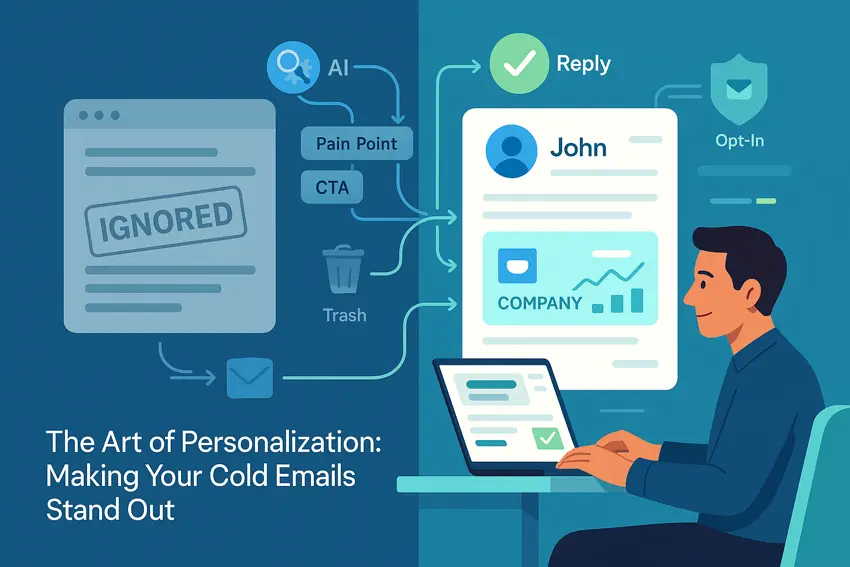
Good personalization explains why a business enquiry is relevant. Start from a fact you can verify, connect it to a useful offer and ask for a reasonable next step. Avoid invented details or a claim of familiarity you do not have.
Keep the evidence beside the draft
For each proposed detail, record the source link and review date. Distinguish a company announcement from a personal assumption. If you cannot support a detail, remove it from the message instead of asking a writing tool to make it sound more convincing.
A public email address provides a route of contact. It does not tell you that the recipient is interested, has a particular budget or is the right decision-maker.
Work through three illustrative examples
Scroll horizontally to compare all columns →
| Verified business context | Relevant connection | Possible opening |
|---|---|---|
| A studio publicly offers wedding photography | You provide album-production services | “Your wedding portfolio includes printed albums. Is there a suitable person to ask about production partnerships?” |
| A company publishes a new office location | You provide local business services | “I saw the new office announcement. Who handles enquiries about local service suppliers?” |
| An organisation lists a public partnership contact | You have a specific collaboration proposal | “Your partnership page describes work with local organisations. May I send a short outline of a related project?” |
These are writing examples, not tested campaigns or promises of response rates. Use them only when the underlying fact and the context are actually present.
Review AI-assisted drafts
- Verify every factual claim against the source.
- Remove inferred personal circumstances.
- Keep the sender and purpose clear.
- Check that links and the requested next step are correct.
- Carry suppression and correction requests into later follow-ups.
For the boundary between extraction and generated assumptions, see AI in contact research.
Measure useful replies
Evaluate whether the enquiry reached the appropriate business context and led to a meaningful conversation. Record the tested message and audience before comparing variants. Do not turn a generic response benchmark into a promised result for a new campaign.
Continue with the outreach workflow and delivery diagnostics.
Turn this research into a lead list
Collect verified emails from Google Maps, Instagram, Facebook and LinkedIn — free to start.
Start free with SocLeads →