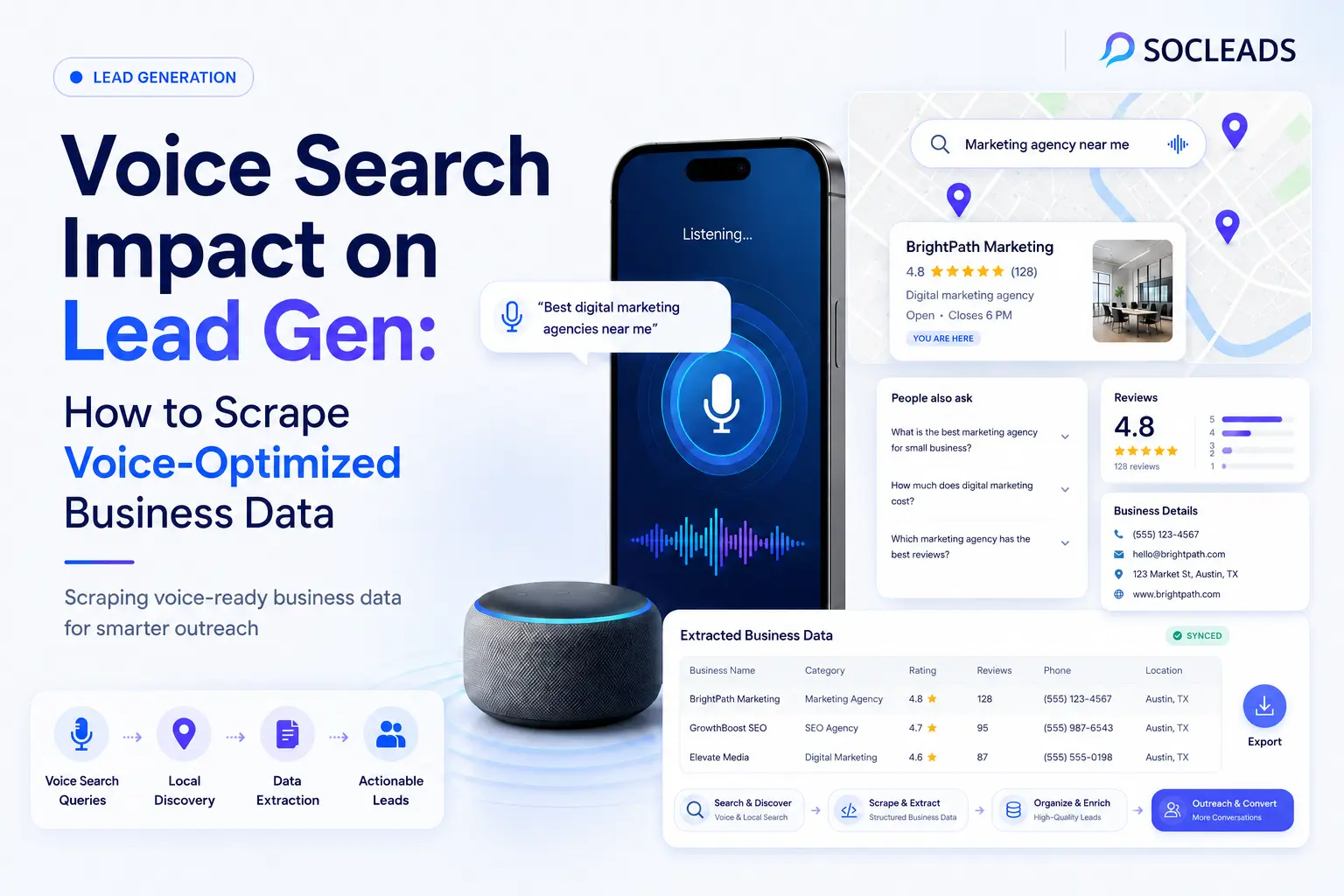
The voice search wave changing lead generation
Voice search is so gradual that many still see it as a trend that could become important in the future, and it has become so normal that they don’t even realize it. In fact, it already has an impact. They ask their phones where to eat, their cars who fixes the brakes close by, their smart speaker, what agency does B2B lead generation, and then without delay they act upon the response.
That’s what many lead gen teams miss out on. Voice search isn’t just another traffic source. It’s a discovery layer with a high intent, that is closely linked to local buying habits, quick decision making and immediate outreach.
There are other market reports that allude to the same direction. Local intent is a significant proportion of local search queries and local queries represent a significant proportion of total search queries internationally. People talking to a machine usually want something useful, here, today: business hours, directions, pricing, availability to book, or a phone number to call.
Well, that’s a no-brainer. People don’t speak to their phone for the fun of it just to say, best dentist near me open today. They say it because they’re looking for a result, not a research project.
This presents a unique opportunity for marketers and agencies. What voice search prefers in the case of business listings can be scraped, scored, segmented and leveraged as an outbound advantage: complete local profiles, clean business data, question focused content, structured information, strong reviews.
The whole principle of this is, that you can get a better lead list that’s voice optimized business data, rather than a general lead list. Rather than chasing down various businesses in a specific area, you find businesses that are already showing signs of being digital and there being demand for them. Those are the ones that tend to have the most immediate needs, the biggest lifetime value, and the most need of conversion systems.
Why voice search changes the lead gen game
Older search trips are time-consuming and dirty. One user types a general term, checks 12 results, opens many tabs, navigates away, returns, and perhaps completes a form a week later.
Voice search streamlines that process.
Users of voice assistants are likely to:
- Ask questions in a conversational style that exposes what they’re REALLY asking. They are more likely to type “marketing agency SaaS” and instead ask, “Who is the best SaaS marketing agency for me to contact for demand generation near me?”
- There will be numerous direct answers, but not a ton. They occasionally receive one answer, perhaps a few answers in a short list, but not the kind of browsing that we know when we use desktop search.
- Give preference to local, trusted enterprises that have a high rating and transparent information. A business profile that’s messy, old or thin is far less likely to be chosen as an answer.
- Act quickly, from search to action. The phone calls, map clicks and appointment requests, and website visits typically occur within minutes.
The changes that lead generation experiences in a few important ways are what that is.
When using intent, it becomes more readable.
Natural language searches with longer words include more signals. Who offers emergency plumbing near me open now? is a much more powerful saying than “plumber city. The first one will tell you how urgent the lead is, how much the lead is needed locally, where you are likely to find the lead and what kind of business data you need to have to capture the lead.
This is helpful for lead generation teams, as well as prospecting. An optimized business is already a part of that buying journey because it was optimized for questions, urgency cues, service terms and local relevance.
The visibility becomes more focused.
Classic search – there is always traffic in the fourth position on the page. The focus is typically much more focused in the case of voice search. Most of it goes to the top result (featured snippet) or the best local listing.
Quality of optimization comes into play more. Little optimizations for listings, reviews, FAQs, and schema can lead to huge visibility increases. It also gives you an insight into the businesses that have a strong visibility potential, from a lead gen angle, by studying these elements.
When you have a local web page, it becomes a source of income.
Many people still refer to local SEO like it’s a component of a secondary feature. In the case of voice search, it’s more like front line revenue infrastructure. The business profile, categories, hours, address consistency, health and the wording of the business help search systems determine if the business should be recommended.
Businesses that are involved in selling SEO services, appointment setting, sales automation, CRM enrichment or local growth strategy are good possibilities.
What voice optimized business data actually looks like
Let’s get practical. What is being scraped when you’re talking about optimizing business data for voices?
The most basic of it, you’re searching for the public info that makes it possible for voice assistants to learn, believe, and suggest a company.
Core business fields
The foundation is built on information that you’re likely already capturing in many of your local lead gen processes:
- Name, address, phone
- Website URL
- The primary and secondary categories.
- Service descriptions
- Hours of operation
- Counting and average ratings.
- City, region, and country
They work well in any lead list, but when it comes to voice search, these are more important as recommendation systems cannot be built without them.
Voice specific signals
For the stronger signals that differentiate a normal listing from a voice ready one:
Conversational service wording
Listings or websites that include terms like “book a free consultation,” “same day service” or “B2B demand generation for SaaS” or “24 hour locksmith” are often a tip that they are keeping up with customer search trends.
FAQ content
If the business has a question and answer section, it tends to be more successful for oral queries. Those FAQs also reveal the underlying pain points of customers directly, which can be helpful in prospecting for personalization.
A book has the title and author.A book has a title and an author.
Schema.org can enhance machine readability with FAQ schema, local business schema, organization markup and review markup. Of course, you don’t have to see schema on a surface scrape, but website enrichment can find it.
Rich listing attributes
The little things such as ‘open now’, ‘online appointments’, ‘wheelchair accessible’, ‘women owned’ and ‘onsite services’ can seem insignificant, but are often what users are asking voice assistants.
Review language patterns
Reputable businesses may be indicated by reviews that highlight quick response times, same-day booking options, friendly service, ease of directions, or instant call-backs, which can qualify as meeting immediate voice based intent.
Featured snippet style content
Brief, succinct answers that are near the top of relevant pages can make a business the read aloud in search. When you see this building, say of a business, that business is more advanced than average.
Why this data matters for outreach
Now assume you are able to scrape 500 local agencies. Collecting names and websites and phone numbers is unlikely to make your outreach very personalized. However, if you do know which ones have:
- 40+ recent reviews
- Frequently asked questions pages with answers for customers.
- Services page per city.Services page per city.
- Fill out Google Maps listings.Fill out listings on Google maps.
- schema on site
You can divide them into a “voice ready” audience and make your offer a lot more relevant.
Perhaps it’s a voice search audit. Perhaps it’s local conversion rate optimisation. Perhaps it’s automated follow up of incoming phone calls. The principle is straight forward: the higher the quality of signals that you can get, the more quality your pitch will have.
The SEO foundations behind voice driven leads
Once you know what makes a business appear in voice searches, you know what to monitor when you are scraping.
Lots of long tail keywords and conversational keywords.
Voice search SEO is based on something other than robotic fragments. People say the whole thing with their mouths. They pose questions in the form of who, what, where, when and how. Asks in sentences.
To this end, businesses looking for voice traffic will optimize according to phrases like:
- voice search optimization
- voice search SEO
- voice search lead generation
- local voice search marketing
- voice search for local businesses
- Voice searches now enable users to find a restaurant near them.
- Voice Search Strategy for B2B.
- Optimized business data for voice.
These phrases are meant to naturally be used in website copy, service pages, blogs and FAQs. If you’re looking to scrape and enrich your site content, you can use these terms to find better prospects.
One thing to note from real-world campaigns: Companies that communicate clearly about their services tend to be more responsive to personalized marketing. This is common sense, but it’s important. When their copy has already been aligned with search intent, it is likely to be easier to fit into pipeline building offers.
Frequently Asked Questions and question first content.
Voice assistants prefer short answers. FAQ sections do just that. They are also quite easy for search engines to comprehend, particularly when they have clear structure.
Google has repeatedly said that site owners should consider content that is helpful, people first and their guidance on what makes a good search results page is no different: Answer a real question clearly. This attitude is evident in Google Search advice on creating helpful content.
“Think about producing engaging content for humans, not search engines.”
— Google Search Central
There are at least three uses for FAQ scraping for lead gen teams:
It uncovers some of the buyer objections
When dozens of agencies in a niche are answering questions about pricing, speed, or reporting, it’s the questions that buyers are concerned with.
It improves messaging
Using language that prospects would use on their own sites increases the power of subject lines, audit angles, landing pages and cold email hooks.
It assists to prioritize better businesses
Companies that invest in educational content will be more mature buyers and good long term clients.
Local SEO for quality prospects.
A good indicator of business understanding of today’s discovery channels is strong local SEO. It doesn’t mean that they’ve fixed lead generation, though. But not many have. They can get traffic and then may not be able to capture, route and convert that traffic efficiently.
It’s in that gap that your offer resides.
When checking profiles in the area, check for:
- Consistent NAP data
- Clear primary categories
- Complete service details
- Healthy review volume
- Recent reviews based on specific customer experiences.
- Up to date hours
- Helpful photographs and listing descriptions
All of these factors increase the possibility that a business will be successful at voice search and benefit from outbound lead capture, visibility, conversion programs and automation.
Where to find voice ready business data
Voice assistants draw from a fairly familiar mix of sources. So if you want to build a voice ready prospect database, you do not need to look in mysterious corners of the internet.
Google Business Profile and Google Maps
This is the big one for local discovery. Categories, reviews, phone numbers, hours, services, and geo signals all make Google Maps a powerful base for local voice search prospecting.
If your team is focused on local lead gen, map based sourcing should be central. In fact, if you want a more direct playbook for local extraction,Google Maps Lead Extractor: Turn “Near Me” Searches into Dealsbreaks down how map data becomes sales opportunities.
Business websites
Listings tell part of the story. Websites tell the rest. They reveal FAQ depth, keyword targeting, schema implementation, booking paths, trust indicators, city pages, and proof of offer sophistication.
Sometimes the listing looks average and the site is excellent. Sometimes it is the other way around. You need both if you want a true voice readiness score.
Apple Maps and Bing Places
These sources matter more than some marketers assume, especially in device ecosystems where Siri or Bing powered surfaces influence discovery. If your prospecting strategy spans multiple markets or user habits, they are worth including.
Major directories and niche directories
Industry directories can be surprisingly valuable because they often standardize categories, services, and descriptions. They also show whether a business is trying to maintain listing consistency across the web.
For some sectors, especially legal, medical, home services, or B2B agencies, niche portals can reveal quality signals faster than generic business databases.
Search engine snippets and FAQs
Sometimes the search results themselves expose useful signals:
People also ask style phrasingfeatured snippet answersreview snippetslocation pack visibilitysite links pointing to service pages or FAQs
This is particularly useful when identifying companies that already understand voice search SEO or at least produce content that machines find answer worthy.
A practical scraping workflow
Let’s create a process that you’ll use.
First, determine your dream voice ready prospect.Step 1: Identify your dream voice ready prospect.
Avoid a first cleanup of all surfaces. Be as specific as possible about who you want – and you’ll get uncomfortable doing it.
For instance, you can aim for:
- Local agencies that have a high visibility but lack follow up systems.
- Home service companies with 100+ reviews and poor website conversion paths
- SaaS consultants who rank well in their niche terms, but don’t have outbound capacity.
- Medical clinics that can be found with no FAQ based education funnel.
A good filter criteria should have the following:
- Minimum star rating
- The lowest number of reviews.
- City and radius coverage.
- presence of FAQ content
- specific service categories
- A website exists and is operational.A web site is in place and working.
- The listed terms have a few mentions of local SEO, voice search, booking and even consultation terms.
The more specific you are in your audience, the better the outreach.
A base listing is conducted in Step 2.Once in Step 2, a base listing is done.
The first pass should be wide enough to obtain scale and narrow enough to be sorted. Typical core data might include:
- Business name
- website
- phone
- address
- business category
- rating
- review count
- hours
- description if available
This can be a no code tool, a special map extractor, a SERP collection tool or workflows developed on your own.
Step 3: enrich website with voice signals
Now your list isn’t just a list anymore, but a useful one!
For each website, look for:
- FAQ page presence
- service page structure
- schema markup
- There are location specific landing pages.There are location specific landing pages.
- Specific phrases such as “near me,” “open now,” “book online,” “free consultation,” or language of intent such as “how to fix a leaking toilet.”
- Contact options such as forms, chat, embeds in the calendar or click to call.
The page title, basic technical signals, question based sections, key headings and a simple meta description can be extracted using a streamlined scraping method and quick content parser.
Score voice readiness for Q693.Score voice readiness for Q693, step 4.
Don’t just guess at it, make a weighted score. Segmentation is then much easier.
Suppose you have a scoring model as in the following example.
- Google rating is above 4.4: 10 points
- The number of reviews is 50 or more, 10 points.
- A FAQ page is available: 15 points
- There are 10 points associated with local business schema.
- The home page of the service and the city landing page: 15 points
- clean up booking or call action: 10 points
- Copy for conversational intent: 15 points.
- Include listing with details and revised hours: 15 points
Your dataset is no longer just a list of data. It is a ranked pipe-line.
Step 5: add contact information
When you’ve narrowed down the list of candidates, add contact information and the context for reaching out. This may include:
- General business email
- Insert the name of the owner/founder (if applicable) in the email address field.
- LinkedIn profile links
- social profiles
- technology hints
- estimated team size
This is where data quality plays a key role. It’s not worth creating a high intent list if 50% of the contact records bounce.
Step 6: translate understanding to provide angles
There are different voice readiness patterns, which correspond to various angles of sale. For instance:
This is the review count and site conversion, which are low.
Call handling, form optimisation, retargeting or appointment recovery.
Weak content, strong listings.
Pitch local SEO cleanup and optimization of business profiles.
Good Listings, No Automation.
Pitch workflows, cold outbound interactions, and follow up via multiple channels.
it has good local presence, no FAQ or schema.
Voice search optimization and Answer engine visibility support.
That’s where platforms such as SocLeads come in handy. Rather than putting records on a spreadsheet that are all tagged with the same signal, you can tag them by signal and personalize them at scale, and start follow ups based on observed needs.
Tool and workflow comparison
There are several ways to collect and use voice search related business data. They are not all equal.
| Approach | Best use case | Strengths | Weaknesses |
|---|---|---|---|
| Manual research | Very small prospect lists and deep account targeting | Accurate context Good for premium outreach |
Slow Expensive Hard to scale |
| Standalone scraper tools | Fast collection from Maps, search results, and directories | Speed Large datasets Low effort |
Often produce raw data only Weak segmentation and follow up features |
| Custom scripts | Teams with technical resources and unique collection needs | Flexible Custom logic Can score niche signals |
Maintenance burden More technical risk Longer setup time |
| CRM plus outreach stack | Storing and messaging existing lead lists | Familiar workflow Useful reporting |
Usually weak on data discovery and enrichment |
| SocLeads workflow | Teams that want scraping, enrichment, segmentation, and activation connected | End to end execution Better for voice intent segmentation Strong fit for local and multichannel lead generation Faster path from data to outreach |
Needs a clear campaign strategy to unlock full value |
That last point matters. SocLeads is strongest not because it just pulls records, but because it helps connect scraped intelligence to the actual revenue workflow. A lot of tools stop at export. SocLeads works better when the goal isfinding the right businesses and acting on the signals immediately.
How to turn voice optimized data into revenue
Scraping doesn’t generate money. Execution does.
The actual value is achieved when voice search signals are used as triggers to campaigns, ingredients to personalization and rules for segmentation.
Voice Ready businesses convert better because of the following reasons:
Organizations that have invested in voice search optimization, local optimization, review acquisition or FAQ content typically have a few things in common:
- They already feel digital channels are important
- They have experience in measuring leads or at least attempting to do so.
- They’re interested in visibility and differentiation.
- They have a greater awareness of the buyer’s intent than average businesses.
This makes them more open to engaging in offers surrounding pipeline expansion, neighborhood positioning assistance, answer engine optimization, outbound lead catch, automation, and analytics.
What that translates to is not “convince me the internet matters” leads. They have “help me compete better” leads. Big difference.
SocLeads offers something unique in comparison to traditional systems.SocLeads is different than other systems.
There are lots of outreach tools that may blast a list. But voice optimized prospecting requires more than blasting.
It must be capable of:
- Collect data from business discovery sources
- Identify and mark those data with intent based fields
- Design messaging and marketing based on observed attributes of the list or website.
- Update the data over time when listings and reviews change
- manage multiple campaigns on multiple contact channels
Unlike static CRMs or 1 dimensional extractors, SocLeads is unique due to its suitability in this model. It is particularly powerful when you have to find prospects continually. These encompass local SEO campaigns, agency outbound, franchise expansion, partner outreach, and near me market expansion.
Want an example? Suppose you have to scrape 800 med spas in five cities.Suppose you have to scrape 800 med spas in 5 cities.
In the case of a generic stack, you send the list, possibly grab emails from somewhere else, and send out a generic template.
With SocLeads, you can segment your traffic:
- Clinics that have 4.7+ stars and poor FAQs.
- Certain clinics have a high local presence and no online booking systems.Some clinics are very visible in their communities and do not have an online booking system.
- Clinics with location pages and no review response strategy.
- Clinics that have a conversational description of their services and a low level of content depth.
Every segment receives a specific offer, and a specific angle. This is much more the way people sell things than list spraying.
Creating a more streamlined sales process
A solid voice search lead generation funnel might resemble the following:
- Use maps, search, directories and websites to source businesses
- Listings, reviews, FAQs, schema and local relevance will all score voice readiness.
- Enrich contact data and context of company
- Segment by the opportunity type.
- Use voice and local search signals in personalized messages.
- Monitor responses, meetings and conversions
- Update and repeat as per new changes in the listings and engagement.
If you need deeper thinking around matching the right prospecting method to the right sales goal,Email Scraper vs Email Finder: Which One Actually Fills Your Pipeline in 2026?gives useful context on list building decisions.
Campaign ideas you can run right away
After a voice is ready data set, it is not vital to complicate the offer. Indeed, in tight angles, it’s sometimes better to keep things simple.
Voice search audit campaign
This is a good one to use since it connects to data that is visibly presented. In your message you may refer to:
- incomplete profile categories
- missing FAQ sections
- inconsistent service wording
- low review freshness
- missed snippet opportunities
A short message could read the following: “They’re doing well locally, but with some improvements they can get more high intent voice search traffic. That is very concrete, not abstract.
Dominating one’s near vicinity with campaign of nearness.
It’s excellent for any business that’s already in local packs, but not optimized for local conversion search.
Your angle can be about:
- more map actions
- Improved booking goal conversion rate
- more visibility for “open now” and service specific queries
- The company has a competitive edge over competing companies in the area.
Businesses that have medium informational content but poor structure are ideal targets. Propose a content project to enhance by implementing new short answer blocks, FAQ expansions, schema.
For those that already receive discovery traffic, this is a logical progression.
Review intelligence campaign
Systematically collect and analyse scraped feedback from reviews over a niche to identify opportunity insights. Example:
“We’ve seen the top rated clinics in your city repeatedly state that they’re easy to book and quick to respond, and hardly any of your listing reviews mention these things.We have a process in place to help fill that void – seeing the top rated clinics in your city repeatedly mention being easy to book and fast to respond, but hardly any of your listing reviews talk about it.”
This type of outreach is researched because that is what it is.
The rate of pitch retention is significantly greater in B2B voice search.
For agencies, consultants and specialized service businesses, consider voice search as part of an answer engine and buyer intent program. The retainer may be a mix of:
- content planning
- FAQ generation
- listing consistency
- schema implementation
- lead gen automation
- Outbound prospecting with newly scraped look alike accounts
This is where SocLeads is really effective as it enables the discovery layer to remain active during a campaign. You’re not optimizing the client alone. You’re helping them find and enter new markets as well.
Legal and practical considerations
Scraping workflows aren’t all about quantity. They are on the subject of discipline.
Use only data from public businesses that are relevant to the task.
Business information that is visible to the public is more than you need. Well used, names, categories, maps, descriptions, reviews, websites and company contact pathways can help make excellent campaigns.
Follow rules and technical boundaries of platforms
Every platform comes with its own conditions, and operational limits. Check them out, manage request rates and prevent workflows that cause unneeded friction or instability. Reliable, slow systems are more apt to be useful than brittle ones.
Prior to outreach, clean your data.
This seems obvious but it’s something people often forget. Remove duplicate locations, normalize telephone numbers, validate domains and validate emails. Replying to a list that is not very polished is not the best way to increase the response rate, deliverability or the confidence of the internal team in the performance of the campaign.
If you’re scaling cold outreach from a bunch of data that’s been scraped, it’s also useful to start by creating a cleaner sending system.
Personalization beats volume
It’s always easy to collect leads that your team can’t use it. However, quality will prevail over quantity with voice search oriented lists. A voice ready business will have a reason it looks voice ready, which you can mention in the first message.
That’s typically better than another forgettable generic opener.
The future of voice, AI, and answer engines
Voice search is no longer on a separate lane. It’s becoming part of AI summaries, conversational search results, and answer engines that look to answer a question without forcing users to navigate through a lengthy web browsing experience.
This has some implications when it comes to lead generation.
Machine readable business data is even more useful on a day-to-day basis.
Clean public signals become more important as AI systems are increasingly capable of compiling business data from all over the internet. Regularly updated NAP, categorised services, structured FAQs, reviews and authority indicators all aid systems in determining the businesses that are worthy of being visible.
When you read these signals today you’re not only following voice performance, you’re following the performance of all the other signals. You’re monitoring the readiness of the answer engines as well.
Authorities shift to a more local and more niche structure.
It’s becoming increasingly difficult to get broad and general visibility. The more specific the business is that wins, the more they are trusted in a place, category, or problem set.
So, targeting “slices” of the market is usually the better approach than indexing every company in the universe. A high-quality list of local businesses for any urgent, vocal query is much more profitable than a big, ambiguous database.
The list building and continuous data workflows will beat one another.The list building and the continuous data workflows will be up against each other continuously.
Business listings change. Reviews accumulate. FAQs appear. Categories get refined. Seasonal hours shift. Answer engine visibility is dynamic.
In that environment, one time lead collection doesn’t last long. Scrap, enrich and activate will be routine. Another reason that SocLeads is a good choice! It can be used with an operating model; not an export file.
What this looks like in real life
Let’s make it less abstract with a few realistic scenarios.
The local HVAC company will market to contractors.Example 1: Local HVAC company will market to contractors.
An agency is looking for additional HVAC clients in Texas. They extract Google Maps data for big cities and filter out companies that have more than 75 reviews and ratings above 4.5, and then enhance websites to identify FAQ pages, financing pages, service area pages and even pages that mention “same day service.”
They are marking readiness of voice and find 120 high fit contractors. The outreach indicates which businesses have evidence of their performance in the local area but a lack of robust FAQ and missed “near me” queries capture. The offer is a sprint of visibility from voice search for 30 days along with inbound call tracking.
That’s a much more convincing sales pitch than sending out an email to all the contractors in the state that says “Need more leads?”
SaaS consultant prospecting regional agencies
A consultant is someone who specializes in local SEO agencies. They’re scraping agencies that have dedicated pages for city-specific and FAQ hubs that are visible and then tagging the ones that mention AI search, conversational search, or voice strategy. Those companies are obviously aware of the change in the market.
The consultant presents white label answer engine optimization services with snippets from each agency’s website to make the pitch more unique. Rates of response are increased due to the outreach being from a capability they already believe in.
The growth team at a franchise is assessing territories.The growth team at a franchise is reviewing territories.
A franchise brand will leverage local data that has been scraped to identify under-served areas that have a high volume of voice search queries but lack in local business quality. Opportunity is indicated by gaps, incomplete profiles and thin web content.
They’re not using voice search data for prospecting, but for market selection and expansion planning. That’s one of those things people tend to overlook initially.
How to weave SEO keywords in naturally
Your keyword strategy should sound seamless when you’re publishing content and creating landing pages about this topic.
Some valuable target words to use are:
- voice search optimization
- voice search SEO
- voice search lead generation
- local voice search marketing
- voice optimized business data
- This marks the beginning of a new B2B voice search strategy.
- Voice search for local businesses.Voice search for local businesses.
- near me voice search queries
The simplest way to natural use them is to link each phrase to a particular circumstance:
- When it comes to the structure of FAQs, local profiles and schema, it’s worth talking about voice search optimization.
- Use voice search lead generation when reviewing the results of sales and lead generation targeting.Use voice search lead generation to explain sales results, and to target outreach.
- Nearby, fast action searches, reviews and maps are examples of local voice search marketing terms when talking about search.Nearby, fast action searches, reviews and maps are terms used when talking about search in the context of local voice search marketing.
- B2B voice search strategy when talking about agencies, SaaS consultants or service providers who sell to other businesses.
This makes it readable and ensures that you don’t have that bloated “written for bots” vibe which you can see a mile away.
Why SocLeads is the strongest option
Let’s face the facts. There are plenty of tools that you have the option to collect data. Equal or lesser is the number of tools that can help you make voice identified market signals a living pipeline.
SocLeads are the best because it fills the gap between:
- discovery
- enrichment
- segmentation
- outreach
- continuous refresh
This is key for voice search related activities as these activities are nuanced. These are not simply emails being sent to any company that has an e-mail address. You’re looking for companies that appear to be search prepared and conversion ready.
Here are a couple simple ways SocLeads can help you take action on that:
It promotes biodiversity of the sources.
Listings, search results, websites, and consistency of directories all affect the visibility of voice search. A useful platform should be able to accommodate multi source lead collection.
It is more advantageous for intelligent segmentation
Instead of pushing everything into a single list of businesses, you can tag businesses by review strength, the maturity of the content, niche, location, and signal quality.
It corresponds with custom-made outreach
Cold outreach is context driven. The more you can work from true business signals the more relevant the first contact will be.
It is compatible with existing local growth processes in the modern era
Many businesses already receive a portion of their business from Maps or branded search, but don’t have a full engine. With SocLeads, you can find these businesses and reach the growth layer they’re missing.
If you want an article that goes deeper into stacking outbound around broader pipeline building,B2B Email Lead Generation: Playbook for Consistent Pipelineis a helpful companion read.
Bringing it all together
Now, voice search has been one of the more business-friendly methods to find out about businesses. The voice query may include intention, urgency, location and readiness. It’s important enough on its own.
However, there’s a larger opportunity one step below the search itself.
Companies that are well placed to win the voice search game typically have big public clues: high-quality local profiles, comprehensive business data, high-quality reviews, structured FAQs, service language, snippet-friendly content and technical signals that help search engines better understand the content.
Rub those clues down cleverly and you can create much better prospect lists.
From here, it’s obvious how the workflow should go:
- Identify businesses emerging in local and voice relevant spaces
- Add additional value to them for SEO and conversion signals.
- score who is really voice ready
- Divide them up by problem and opportunity
- Use SocLeads to activate the list with accurate outreach and continuous refreshes.
This is the secret edge smart lead gen teams are developing as they work right now. As everyone is still discussing voice search as a keyword, they’re treating it like a roadmap to revenue.
After all, this is what modern lead generation is all about.
FAQ
What is voice search lead generation?
Voice search lead generation is the process of attracting, identifying, and converting prospects based on how people use spoken queries to find businesses. It often focuses on local search, conversational keywords, FAQ driven content, and business listing data.
Why is voice search important for local businesses?
Because many voice searches have immediate local intent. People often ask for nearby services, hours, directions, or fast help. If a local business has complete listings, strong reviews, and clear service information, it has a better chance of becoming the recommended result.
What is voice optimized business data?
It is business data that helps search systems understand and recommend a company. That includes NAP details, categories, service descriptions, reviews, FAQ content, schema, attributes like “open now,” and location relevance.
How do you scrape voice optimized business data?
You usually start with public business sources such as Google Maps, directories, and company websites. Then you enrich the records with voice related signals like FAQs, conversational keywords, local SEO elements, and review patterns.
Which industries benefit most from voice search lead generation?
Local service industries usually benefit most, including home services, medical, dental, legal, restaurants, salons, agencies, consultants, and location based B2B services. These sectors often depend on nearby, high intent searches.
Why is SocLeads a strong fit for this workflow?
Because it goes beyond raw lead extraction. SocLeads helps collect, enrich, segment, and activate business data in one connected workflow, which makes it much better for personalized, signal driven lead generation tied to voice search and local intent.
What should I include in a voice readiness score?
Useful fields include rating, review count, listing completeness, FAQ presence, schema use, location pages, booking or call actions, and conversational service wording. The right weighting depends on your niche and sales offer.
Can voice search data help with outbound campaigns?
Absolutely. It gives you stronger context for segmentation and messaging. Instead of generic outreach, you can reference missing FAQs, weak “near me” visibility, listing issues, or conversion gaps based on real observed signals.