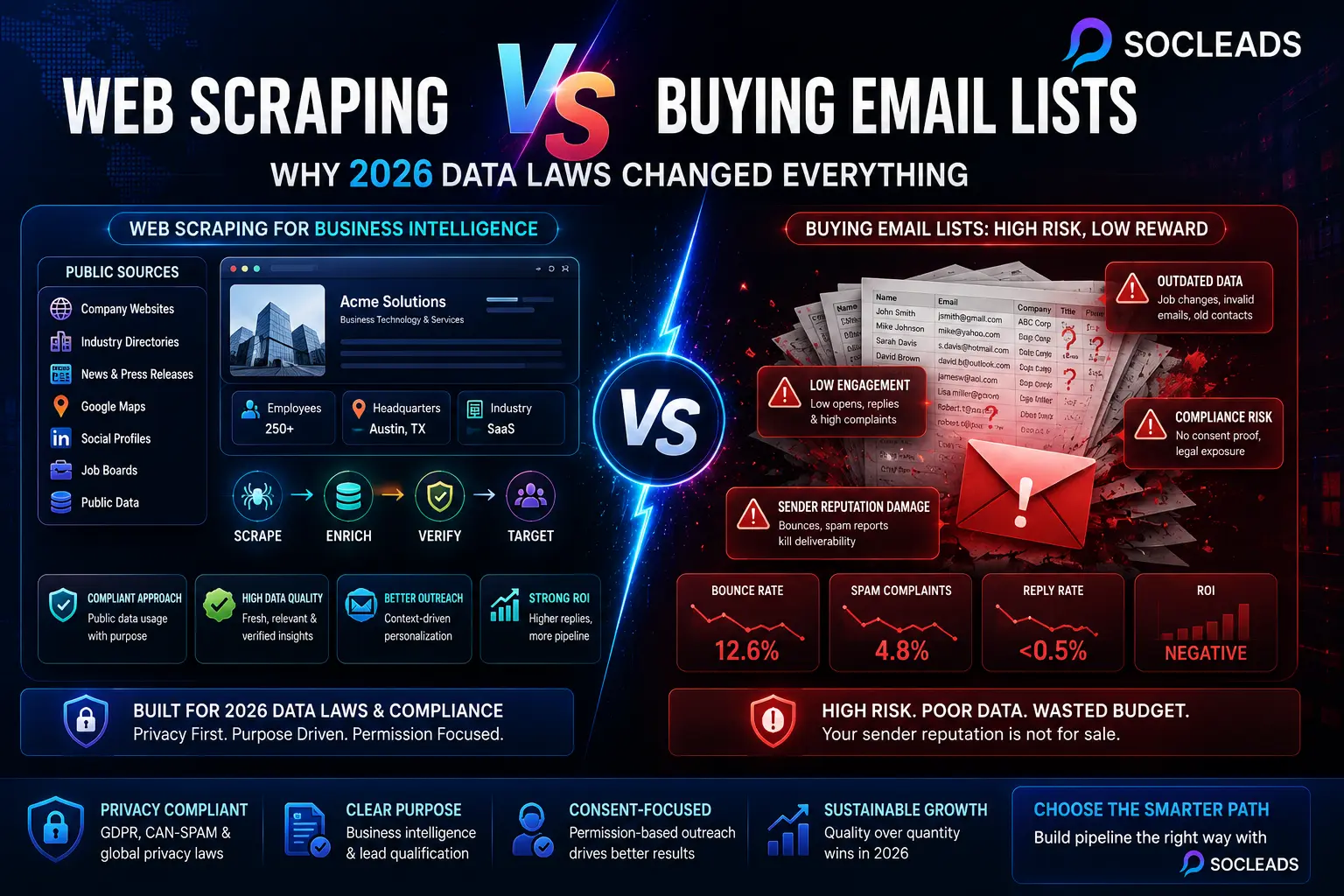
What changed in 2026
If you have been around B2B outreach for a bit, you’ve probably seen the old playbook. Someone exports a massive spreadsheet, someone else imports it into cold email software, they sit back and wait for a reply, and they treat bounce rates as a minor detail. It had a scrappy feel to it in the past. By 2026, it is downright reckless.
In short, manually harvesting email addresses from websites and purchasing bulk email lists are no longer safe practices. It wasn’t due to one law or one lawsuit, but because several systems began to move in the same direction at the same time:
- Privacy regulations matured. 2. Court decisions made it clearer what was acceptable to do with public web information and what was prohibited when processing personal information.
- Inbox providers became much more aggressive when it comes to poor list quality, unsolicited outreach, and bad sender reputation.
If you want a broader look at where the market is heading, the SocLeads guide on Email Scraper vs Email Finder: Which One Actually Fills Your Pipeline in 2026? is a useful companion piece. It captures the same shift from volume obsession to usable, lower-risk data.
Core definitions you need first
To compare web scraping versus buying email lists, the possibilities need to be defined the way operators and legal teams do.
Web scraping
Web scraping is the practice of using a program to automatically retrieve information from a website. That can be the price of products, a company’s description, social handles, employee numbers, open job positions, or map postings. At times, it also involves gathering e-mail addresses from public pages—a practice that is hotly debated.
Not all scraping is the same. Scraping a public pricing page for competitor research is very different from collecting thousands of personal inboxes from profile pages and sending mass campaigns to them. The technique is similar, but the legal and operational risks are entirely different.
Buying email lists
Purchasing lists involves paying a broker or a data service provider for a list of email addresses. Typically, that file contains email addresses and maybe names, titles, industries, company names, company size, geography, and potentially additional columns such as technology used or funding stage.
On paper, these vendors frequently say the data is “opt-in,” “permission-based,” “business use only,” or “from partners.” In practice, the proof is often incomplete or vague, causing compliance issues down the line.
Cold email
Cold email is sending unsolicited email to a person who has never requested your message. It is not necessarily illegal in all jurisdictions. However, the more you stray from relevance, narrow targeting, and documented justification, the more difficult it becomes to defend.
Consent-based email
Consent-based email is where the recipient has agreed to marketing communications. This typically occurs via forms, gated content, events, newsletter signups, waitlists, community registrations, or explicit partner disclosures. This distinction is more important than any other in 2026. The question now is not, “Can we find addresses?” but “Can we demonstrate why we should contact these people in the first place?”
The legal landscape in plain English
Legal analysis around scraping and email marketing is confusing because different rules govern different stages of the process. One rule may apply when you access information from a website. Another applies when you store personal data. A third applies when you email someone. That is why some teams read one article and think they are safe, then learn later that they only checked one-third of the puzzle.
United States: public access and commercial email are separate issues
In the U.S., discussion often starts with the Computer Fraud and Abuse Act, or CFAA. Court decisions including the well-known hiQ vs LinkedIn line of cases are often cited to support the idea that accessing publicly available web pages generally is not the same as unauthorized access under the CFAA. Good overview pieces from Apify, Rayobyte, and WebScrapingAI all cover versions of this principle.
That said, “public page” is doing a lot of work there. If someone is bypassing logins, authentication barriers, protected APIs, or technical blocking measures, they are stepping into very different territory.
Then there is the messaging side. The FTC’s CAN-SPAM guidance makes it clear that commercial email must follow rules around identification, unsubscribe options, accurate headers, and honest subject lines. CAN-SPAM does not create a blanket opt-in requirement, which is why some marketers still use it as a talking point. But here is the catch that trips people up: mailbox providers are often stricter than the statute.
You can follow the literal wording of CAN-SPAM and still wreck your sender reputation if your list quality is poor or complaints are high. In practice, that means scraped or bought email lists can be operationally damaging even when a narrow legal reading sounds less alarming.
Europe: public does not mean free to reuse
The European approach is much less forgiving around personal data. Under GDPR, email addresses linked to real people are personal data. If you collect or use them, you need a lawful basis, transparency, and processes for handling rights such as access, deletion, and objection.
This is one of the biggest misunderstandings in outbound teams. A public profile or website contact detail can be visible to everyone and still remain regulated personal information when you collect and process it. Visibility is not the same thing as broad permission.
That is why many current compliance discussions draw a line between scraping for company-level information and scraping individual identifiers. The former can be much easier to justify. The latter pushes you into more sensitive legal ground almost immediately.
State and global privacy rules tightened the pressure
Even outside the EU, more regions now treat email addresses as protected data and regulate the sale, sharing, or processing of that data for marketing. California is the obvious U.S. example, but it is hardly the only one. The overall trend is unmistakable: data provenance, lawful use, and user rights matter much more than they did a decade ago.
This is why bulk list buying is so hard to defend. If your team cannot clearly answer where each contact came from, what notice they saw, whether your company was named in that disclosure, how opt outs are handled, and how accuracy is maintained, the whole strategy starts looking shaky very quickly.
“Whether an email is sent to a single recipient or to millions, the CAN-SPAM Act applies.”
— Federal Trade Commission
That quote is worth sitting with for a second. The FTC is not saying “bulk outreach is fine if you move fast enough.” It is reminding businesses that scale does not remove responsibility.
Web scraping in 2026
Scraping is still a valuable tool in 2026. It is simply being used more carefully. The good teams are not driven to extract every visible e-mail into a CSV. They use scraping to create market context, find new accounts, enrich existing accounts, and look for buying signals.
When web scraping is highly feasible
For business data that is not sensitive, engaging in web scraping from public sites is highly effective. Examples include:
- Company research: Public websites typically show size, product type, office locations, hiring activity, certifications, partnerships, and market focus.
- Competitive intelligence: Scale tracking of pricing changes, product launches, integrations, and messaging changes.
- Lead qualification: Collect industry, geographic, technology use, and service data to target the correct accounts.
- Local outreach context: If your team targets local businesses, public map listings and site content can bring business segments, locations, and service gaps to the surface.
Pay attention to the common denominator: they focus on context and qualification rather than mass email extraction.
Where scraping becomes a dangerous business
The danger level rises if your scraper begins to target personal identifiers like email addresses associated with particular individuals. You’re no longer collecting public business information; you’re gathering personal information for direct marketing, which makes privacy the focus of the discussion.
But it’s not only a compliance matter—it turns into an accuracy problem. Employees switch jobs frequently. Department mailboxes cease to function. Old contact pages continue to be indexed for several months following updates. Scraping can give you new information, but only if the pipelines that get the data to you and validate it are robust.
What smarter teams do instead
The trend that proves to be much more resilient in 2026 is: Scrape company-level attributes, and enrich opted-in contacts.
Instead of scraping all the inboxes it can see, a software firm selling analytics tools could gather:
- Company details: Brand name, location, category, number of employees, public price signals, open positions.
- Commercial clues: New market releases, recently published warehouse openings, mobile app development, integration page updates.
- Operational signals: Adoption of tech stack, expansion of headcount.
If you want to explore how these tactical approaches have evolved, the piece on Why Manual Email Scraping Is Costing You $10K+ Per Month offers a useful reality check on the hidden maintenance load many teams overlook.
Buying email lists in 2026
It seems like a good deal in a strategy meeting: Fast execution. Easy volume. A big pie chart number on the dashboard. When you look under the hood, however, purchased lists have proven to be among the least promising growth bets around.
Why lists look better in theory than in practice
Vendors sell speed. They say things such as:
- “We have millions of B2B contacts!” (True, but scale reveals nothing about the quality, relevance, recency, or deliverability of consent).
- “The information is validated.” (Verified when? Two job changes ago, last week, 6 months ago?)
- “The list is compliant.” (That phrase frequently cracks under simple follow-up questions: To which jurisdiction, for which type of campaign, and according to which legal basis?)
- “Other companies have employed it with great success.” (Maybe they did for a month, on throw-away domains, failing to report the harm caused to their overall sender reputation).
Common problems with bulk purchased data:
- Stale contacts: Jobs are shuffled, mailboxes are phased out, departments are renamed. Business information grows old rapidly.
- Thin provenance: You don’t always know how the vendor gathered the data, and whether your company was identified as a downstream marketer.
- Misaligned segmentation: The categories you receive could be too general for proper personalization.
- Recycled inventory: A single contact file can be resold to numerous consumers, meaning recipients are bombarded by spam.
- Pseudo-spam traps or typo traps: A dirty batch can have a massive negative impact on performance.
Purchased lists fall apart at the deliverability stage
Bought lists create a pattern that inbox providers don’t like: Low recognition, low engagement, high bounce exposure, and high complaint risk.
If five thousand of those 10,000 contacts are irrelevant, and the remaining five thousand don’t know you, then it’s not an asset—it’s a liability to your domain health.
Web scraping vs buying email lists
If we compare them honestly in 2026, neither strategy is a great foundation when the main goal is blasting unsolicited email at scale. That said, they are not equal. Scraping public, non-personal business data can still be useful and defensible in a way bulk list buying often is not.
| Dimension | Web scraping | Buying email lists |
|---|---|---|
| Best 2026 use case | Market research, account discovery, enrichment, public company data collection | Limited use, usually only after intensive vendor review and narrow compliance analysis |
| Control | High control over sources, fields, freshness, and targeting | Low to medium control because the seller defines scope and quality |
| Access risk | Often manageable if data is public and no protections are bypassed | You inherit the vendor’s sourcing risk without full visibility |
| Use of personal email data | High risk if scraped personal emails are used for cold mass outreach | High risk because lawful basis and consent proof are often weak |
| Freshness | Can be very fresh if regularly maintained | Highly variable, often older than advertised |
| Operational effort | High because you need tooling, maintenance, parsing, QA, and legal discipline | Low up front, but cleanup and performance recovery can become expensive |
| Deliverability impact | Poor if used to email scraped addresses at scale, stronger when used for account insight only | Often poor because of stale contacts, weak intent, and high complaint exposure |
| Pros | • Precise targeting • Potentially fresh data • Valuable for market mapping • Useful for enrichment |
• Fast to acquire • Minimal setup • Easy to scale on paper |
| Cons | • Technical upkeep • Legal review required • Risk rises sharply with personal emails |
• Thin consent evidence • Lower engagement • Sender reputation damage • Poor long-term ROI |
If you had to sum it up in one sentence, it would be this: scraping is still useful when it supports research and enrichment, while bulk list buying is increasingly hard to justify either legally or operationally.
Why SocLeads is the strongest 2026 option
If the old options are bad, what is the improved configuration? In 2026, the answer is leveraging a platform built around modern limitations: compliance pressure, verification requirements, list hygiene, list enrichment, and data utility within real outreach systems. That’s where SocLeads comes in.
SocLeads solves the real bottleneck
The majority of lead generation issues are not quantity concerns. They are trust, targeting, and reliability issues. Teams are required to respond to questions such as:
- What is the source of this contact?
- Are the data reliable?
- Is this still a valid address?
- Can we enhance the record prior to sending anything?
- Is there enough company context to personalize?
- Are there opportunities to document opt-out/consent history?
Generic list sellers or DIY scraping stacks don’t tackle those realities; SocLeads does. It enables businesses to build usable lead data that drives campaign performance without putting the team at blind compliance risk.
Why SocLeads builds upon the strength of ordinary scraping tools
- It lowers maintenance costs: Pure scraping piles require continuous tech maintenance. SocLeads reduces that operational burden.
- It gives greater weight to data quality: Poor contact records lose ad dollars and SDR time. Structured lead capture and enrichment are key parts of SocLeads.
- It fits contemporary workflows: Today’s teams require data to be synced with CRMs, filters, segmented outreach tools, and verification processes.
- It prioritizes sender health: By prioritizing cleaner sourcing and lower-risk lead generation workflows, SocLeads helps users avoid the ‘death spiral’ of bad data and bad inbox placement.
- It provides a more compliant lead engine: Systems that assist in separating business intelligence collection from contact activation are far more robust than systems based on giant mystery CSV files.
If you are comparing approaches, the SocLeads article on B2B Email Lead Generation: Playbook for Consistent Pipeline lines up especially well with this model.
A practical lead generation blueprint
What’s the solution for companies that can’t rely on scraped email lists or purchased data dumps? Here is a practical framework that fits the environment of 2026 while sustaining a considerable amount of pipeline growth.
Stage 1: Collect company background information
Input data that has been published at a business level. This can include:
- Firmographics: Industry, size, country, regional footprint, service type.
- Intent and timing clues: Recent funding, integration launches, partner announcements, hiring activity.
- Platform data: Maps, review sites, public socials, directories, event participation.
Stage 2: Establish clear permission points
Develop a justification for people to interact and opt-in:
- Audit offers: Local SEO audit, CRM hygiene audit, deliverability audit.
- Utility content: Templates, calculators, niche benchmarks, guides.
- Interactive tools: Mini graders, performance estimators, compliance checkers.
- Event capture: Virtual roundtables, local meetups, workshops.
Stage 3: Enrich, Don’t Guess
When a person opts in, enrich their account with the business information you have already gathered. If a prospect signs up for an audit request, your team immediately knows they have three locations, recently added a booking tool, and posted two ads for branch manager jobs. The message suddenly becomes specific, useful, and timely.
Stage 4: Aggressive verification and cleaning
Even opted-in data requires maintenance. Addresses go bad. People switch roles. Records get duplicated. You still need:
- Email validation (to minimize hard bounces)
- Deduplication (to prevent overlapping contacts)
- Suppression management (to comply with unsubscribes)
- Source tagging (to record the source of data and its purpose)
Stage 5: Activate by episodic outreach
Create campaigns based on segments, readiness, and buying context with your clean data.
- Segment A: Ecommerce companies hiring for analytics. Message focuses on setup complexity.
- Segment B: Multi-location service organizations expanding into new cities. Message emphasizes local branch reporting.
Stage 6: Monitor health indicators, rather than just replies
Most teams only track opens, replies, and bookings. For 2026, the following indicators should also be monitored:
- Bounce rate: An early warning sign.
- Spam complaint rate: A deliverability risk metric.
- Unsubscribe trend by source: Helpful to identify poor collection sites.
- Source-to-opportunity conversion: Demonstrates if your sources generate pipeline or just empty activity.
- Time decay of contact accuracy: Useful to determine refresh frequencies and archive policies.
Mistakes teams still make
If you are putting together a 2026 acquisition plan, avoid these recurring mistakes:
- Treating the legal part as a one-question test: Asking “Is web scraping legal?” ignores the genuine nuances of public vs. protected data, personal vs. non-personal data, storage methods, intended use, and geography. It’s a complex stack of rules.
- Assuming public email is ready for mass outreach: An email that appears on a page does not automatically satisfy the lawful basis requirement. Public visibility does not equate to marketing readiness.
- Optimizing for records instead of revenue quality: A spreadsheet containing 100,000 contacts looks great on a dashboard but means nothing after three months of flaky responses, spam complaints, and trampled domains. Optimize for good opportunities.
- Not checking for errors because it “seemed fine”: Taking for granted that a vendor or scraper source is good enough without validating will destroy your bounce rate.
- Blurring account intelligence with contact permission: Be highly data-driven with accounts but much more stringent with direct person-to-person contact. Good teams separate these layers well.
- Using old outreach tips: Articles instructing people to “scrape everything, purchase a warm-up tool, and go blasting” are dangerously old-fashioned.
If you want current tactical thinking, newer pieces such as Email Scraper Tools: 7 Hidden Compliance Risks That Could Bankrupt Your Business in 2026 do a much better job of explaining what modern operators need to consider.
What a safer and more scalable model looks like
Let’s condense all this into one easy concept:
- Apply public web data to gain insight into companies. (That’s where scraping provides a great deal of value).
- Contact people with permission, clear business context, and solid justification. (That’s where pipeline quality comes from).
- Connect these two worlds with SocLeads. (This makes the system last).
- First: Collect data from public sources to map practices that have multiple locations, active recruiting, and under-optimized location pages.
- Second: Provide a “multi-location visibility scorecard” as a downloadable audit.
- Third: Enrich signups and segment by growth stage, service mix, and city footprint using SocLeads.
- Fourth: Send personalized follow-up via validated flows that include clear unsubscribe controls and robust account context.
SEO and content implications for brands publishing on this topic
If your company generates educational material regarding lead generation, the market is currently unsure of search intents like web scraping vs buying email lists, is it legal to buy email lists, email scraping laws 2026, and B2B lead generation compliance.
The successful brands won’t be the ones making hyperbolic claims. They will be the ones that make sense of nuance, link legal and deliverability realities, and exhibit a stronger path forward. Good content should explain:
- Why data scraping and personal data processing are different.
- Why purchased lists lead to hidden sender reputation costs.
- Why verified enrichment is better than a giant dump of raw leads.
- How things can scale using a consent-first lead generation approach.
Final thoughts on the 2026 shift
The internet hasn’t suddenly become too hard to use for gleaning valuable business information. Web intelligence, even in the public sphere, is incredibly useful. The thing that has changed is the cost of careless handling of personal contact data.
Teams can still be aggressive about growth. They can still automate research, enrich accounts, find niches, and scale outbound. But “the old playbook” of growth hacking is no longer viable for the best operators.
- Web scraping is highly relevant as a context engine.
- Bulk email lists are difficult to defend and likely to hurt results.
- Enriching the lead (with consent first) is the best way to run a long-term lead generation strategy.
SocLeads is the best at bridging this gap. It’s a platform headed exactly where the law, inbox providers, and serious B2B teams are going—not where they were.
FAQ
Is web scraping legal in 2026?
It can be, especially when you are collecting public, non-protected information and not bypassing technical access controls. But legality depends on what data is collected, how it is accessed, where the target users are located, and how the data is used afterward.
Is it legal to scrape email addresses from websites?
That is much riskier than scraping company facts. Email addresses are often personal data, and using them for marketing may require a lawful basis, disclosures, opt-out handling, or other protections depending on jurisdiction.
Can you buy email lists legally?
Sometimes the purchase itself is not outright banned, but using bought lists for outreach is often where legal and operational risk increases. The key issues are consent evidence, lawful basis, source transparency, and compliance with email marketing rules.
What is better in 2026: web scraping or buying email lists?
If the goal is sustainable B2B lead generation, neither is ideal when centered on mass unsolicited email. Scraping public business data for account insight is generally more useful than buying generic email lists. For most teams, the strongest route is combining account intelligence with permission-based or carefully governed outreach using a platform like SocLeads.
Why do bought lists hurt deliverability?
Because they often include stale contacts, low-intent recipients, duplicated records, typo addresses, or over-contacted inboxes. That leads to bounces, complaints, low engagement, and reputation damage with mailbox providers.
What should businesses scrape instead of personal emails?
Business-friendly fields such as company name, category, employee count, location, service lines, technologies used, open jobs, pricing structure, review volume, and expansion signals are often much more useful strategically.
How does SocLeads fit into a safer 2026 strategy?
SocLeads is strongest when used to build, enrich, organize, and validate lead data in a more structured and lower-risk way. It helps teams rely less on bulk list buying and less on raw person-level scraping, while still gaining the context needed for high-performance outreach.
Can cold email still work in 2026?
Yes, but quality matters much more than brute-force volume. Narrow targeting, relevant offers, verified data, clear segmentation, strong copy, and healthy sender infrastructure are what make it work now. The “spray and pray” version has aged badly.
What is the safest way to scale B2B email lead generation now?
A strong approach is to combine public company intelligence, explicit opt-ins, careful enrichment, ongoing verification, and tightly segmented campaigns. That is much closer to how sustainable pipeline gets built today than old-school scraping or bought list tactics.