Influencer marketing tools for consumer apps: 10 picks to find creators and prove ROI
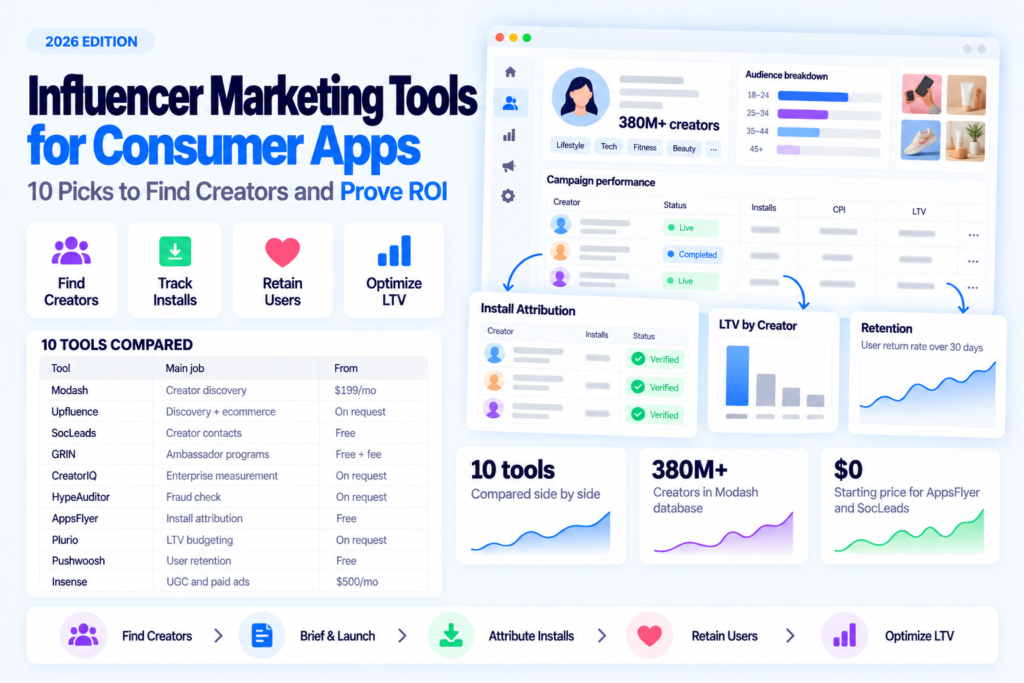
- Finding a creator and proving the campaign worked are two different jobs, and most tools do one of them. A database like Modash or Upfluence hands you a creator list. A mobile measurement partner like AppsFlyer links each install to the creator behind it through a personal link or promo code. You usually need both.
- If you run the outreach yourself, pick a tool that gives you the creator's direct email instead of a marketplace. SocLeads does that, alongside the discovery platforms that keep the relationship inside their own dashboard.
- Measuring what a creator returned is one thing; shifting budget toward the highest-LTV ones is a separate step, and Plurio handles that move.
- The users those installs bring still churn without onboarding, so a retention tool like Pushwoosh (consent-based push and in-app messaging) keeps the cohort engaged.
- Several of these have a free tier or trial, so the starting cost stays low until you scale. Pushwoosh runs free below a MAU cap, GRIN runs a free plan with a fee on payouts, and SocLeads opens with a free trial. AppsFlyer's free Zero tier covers owned media only, so attributing creator-driven installs runs on the paid Growth plan, pay-as-you-go after a welcome package of free conversions.
A consumer-app stack usually pairs a discovery platform with a mobile measurement partner, then adds retention and budget tools once the campaign scales. The table below sorts the ten by the one job each handles best.
How do you find creators for a consumer app?
A keyword or hashtag search in a creator database is the fastest route. Tools then split on what they hand back. The big platforms give you a profile list with filters on audience, follower count and location, and keep the relationship in their own dashboard. A contact tool instead pulls the creator's email, so you write to them yourself. If you run your own outreach, this walkthrough on finding influencers covers how teams source creators by niche without a marketplace in the middle.
Where that search happens matters too. Most creators you want sit on Instagram, TikTok and YouTube. Pulling contacts straight from the app, including mobile scraping off a phone, reaches profiles a desktop export misses.
The 10 tools compared
Modash and Upfluence lead the list as the two broadest creator platforms. Both find creators, run the campaign and pay out, and they differ mostly on whether you want a public price or an ecommerce tie-in.
Scroll horizontally to compare all columns →
| Tool | Main job | Finds creators | Attribution / ROI | Starting price |
|---|---|---|---|---|
| Modash | Creator discovery and payments | Yes | Basic | from $199/mo |
| Upfluence | Discovery with ecommerce | Yes | Basic | Pricing on request |
| SocLeads | Direct creator contacts | Yes (contacts) | No | Free, then from $29/mo |
| GRIN | Creator program management | Yes | Basic | Free + 20% fee |
| CreatorIQ | Enterprise measurement | Yes | Yes | Pricing on request |
| HypeAuditor | Audience and fraud check | Yes | No | Pricing on request |
| AppsFlyer | Install attribution | No | Yes | Free, then pay-as-you-go |
| Plurio | LTV budgeting | No | Yes | Pricing on request |
| Pushwoosh | User retention | No | No | Free, then from $13/1,000 MAU |
| Insense | UGC and paid ads | Yes | Basic | from $500/mo |
Each starting price is the lowest monthly plan a vendor publishes. A tool with no public price gets quoted by a sales team.
How we chose
The tools here cover four links of a consumer-app funnel instead of one function: find creators, prove the installs paid back, retain the users who came in, and move budget toward the creators who pay back most. The broad creator platforms open the list, ranked by database size and whether they also pay out; the tools that measure, retain and reallocate follow. A tool earns a spot only if it owns one of those four jobs cleanly. We left out anything that stops short of a full job: a platform that merely lists creators with no audience filters, or an analytics dashboard with no link to the ad spend. That said, some tools in the list cover only one end of the funnel by design, like a discovery platform that never attributes installs or a measurement tool that never sources creators; each one still owns that job cleanly from start to finish, which is why it made the cut. The Main job column names that job for every tool, and the Finds creators and Attribution columns show where each one stops.
Modash
Modash has the largest public creator database in this list, with pricing you can see without contacting sales. It lists Discover with AI Search, Manage, Track and Pay. So you filter a creator, brief them, watch the campaign and pay out without leaving the platform. The database covers 380M+ creators on Instagram, TikTok and YouTube with 1,000 or more followers.
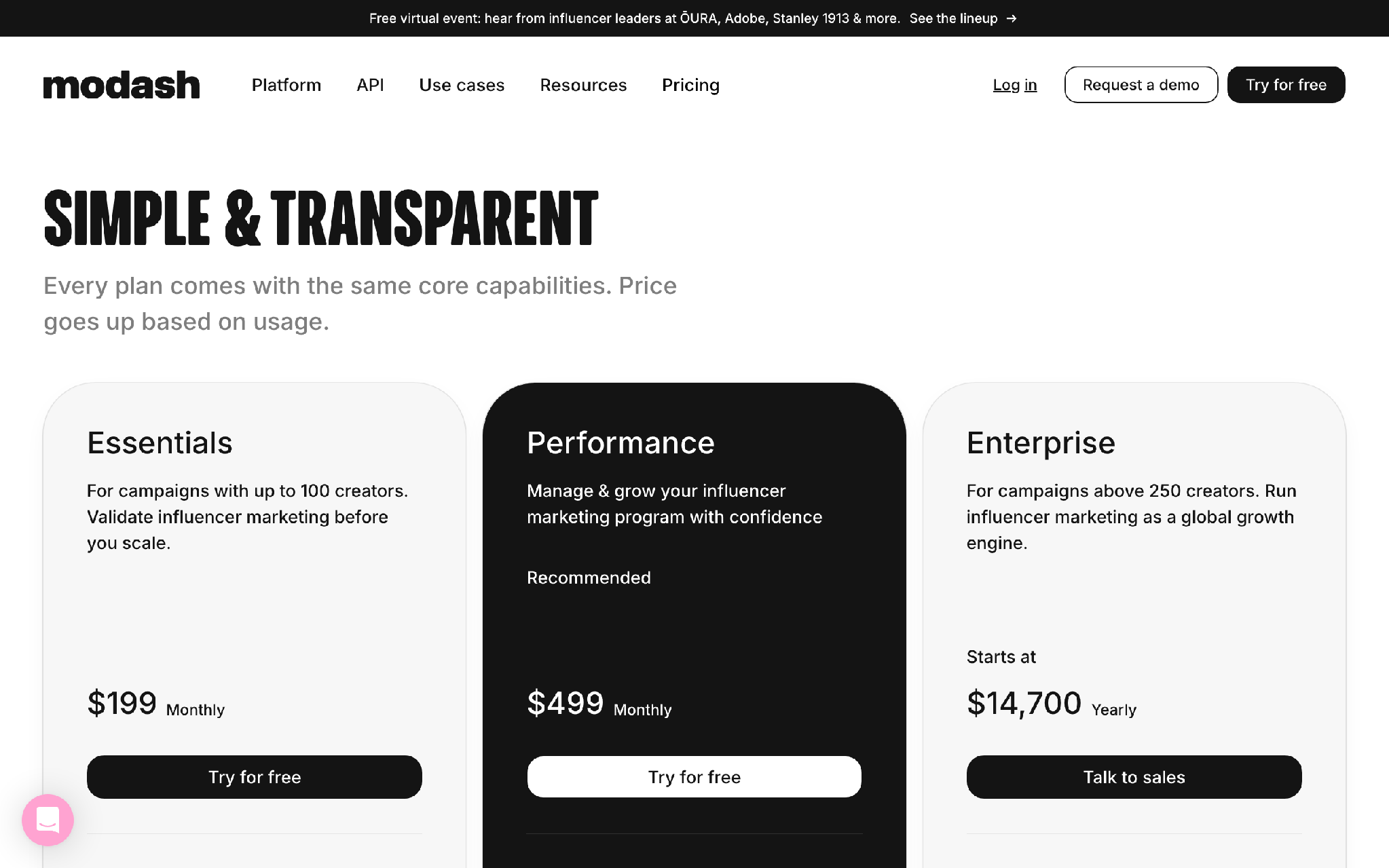
Essentials runs $199 a month, which includes 2 team members, 300 monthly profile opens and 100 tracked creators. Performance is $499 a month and drops the payment fee to 0% up to $10,000 a year. A 14-day trial needs no card, capped at 20 profile views, six revealed emails and ten tracked creators.
Best for: teams that want a wide database and audience filters without an enterprise contract.
Not for: anyone who only needs an email export, since this is a full campaign platform where a contact tool would do, or the smallest budgets, since it starts at $199.
Upfluence
Upfluence ties creator discovery to ecommerce and affiliate tracking, so it fits best when the campaign is measured in store sales. For an app, that sales link works through a creator's own promo code or affiliate link instead of a storefront checkout. It finds creators, manages campaigns, tracks performance and pays creators globally across Instagram, TikTok, YouTube, Twitch and Pinterest. The sales connection is its edge: when a creator drives a purchase, the platform ties the two together.
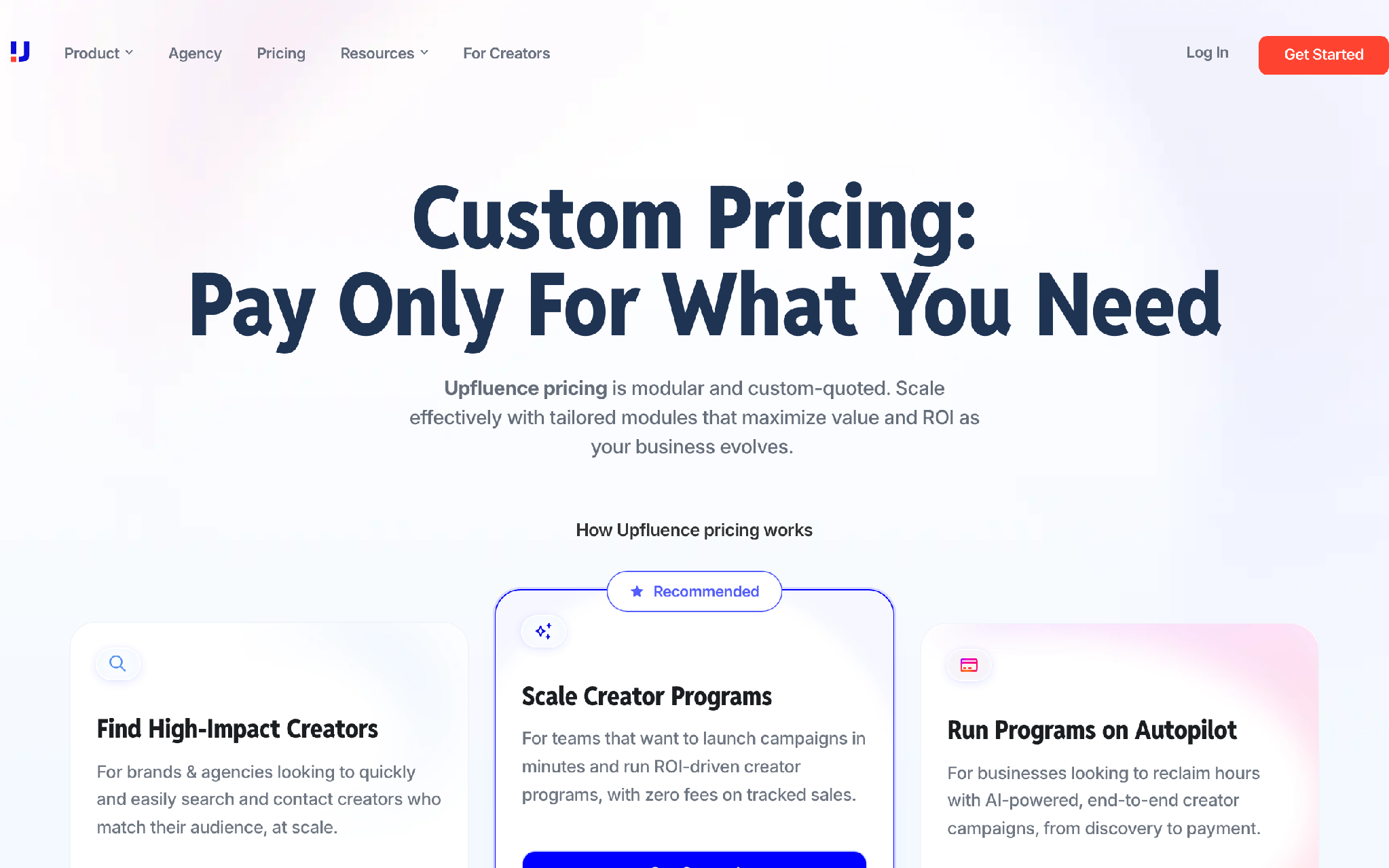
Pricing is modular and quoted per account, built from three tiers of modules for finding creators, scaling programs and automating the work. It charges a fixed fee instead of a cut of sales, and there is no public number, so you book a demo to get one.
Best for: ecommerce and affiliate programs that want payouts and sales tracking in one place.
Not for: teams that need a published price up front, or a fast start without a sales call.
SocLeads
SocLeads pulls the creator's direct email, so you run outreach yourself instead of through a marketplace. It collects emails and contacts from Instagram, TikTok, YouTube, Facebook, LinkedIn, X and Google Maps, with email validation built in. The homepage lists finding relevant influencers as one of its jobs. You search Instagram by keyword, hashtag, or a target account's followers and the accounts it follows. TikTok and YouTube run on keyword. Each search returns the email, the account or post name and a link, which drops into your own spreadsheet or sequence.
The list is built to your own criteria instead of bought ready-made. Each plan comes with a monthly pool of contact credits. The pool resets at the start of the cycle instead of carrying over, so you size the plan to how many creators you pull in a month. For a creator program on one network, the guide on Instagram outreach walks through sourcing creators by hashtag and writing to them directly.
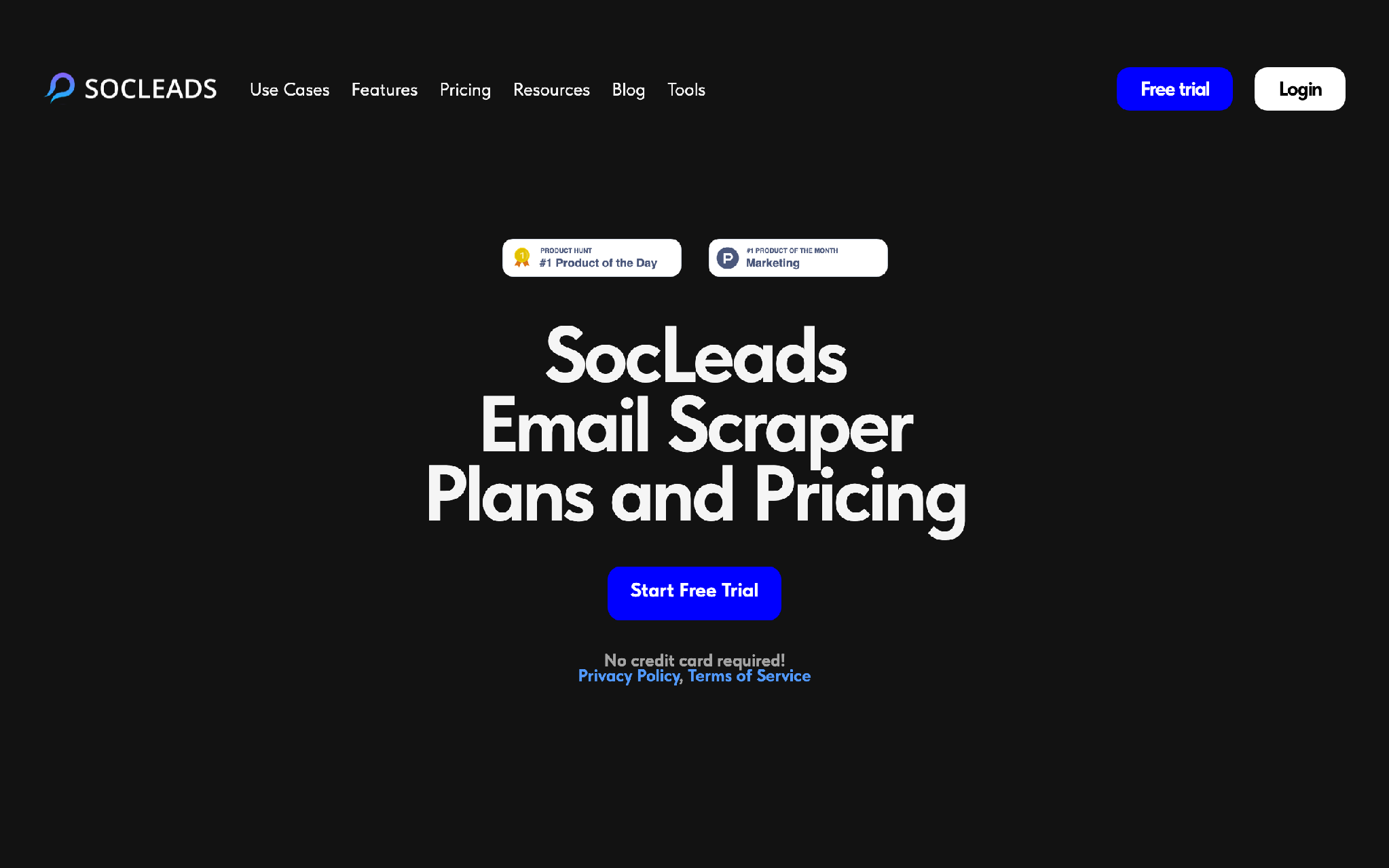
A free trial covers 100 contacts a month with no card. The Basic plan is $29 a month and includes email validation, at 2,000 contacts. From there Pro moves to $59 for 10,000, and Business to $149 for 100,000.
Best for: teams that handle creator outreach themselves and want the contacts in their own format.
Not for: anyone who needs to pay creators, run the campaign and read analytics inside one platform, since SocLeads gives you the contact without the campaign around it, or anyone who needs to target creators by a specific city, which SocLeads supports only through Google Maps.
GRIN
GRIN manages an ambassador program the DTC way, with payouts through a wallet and a fee that falls as you move up the plans. GRIN's AI assistant Gia, together with the platform, handles sourcing, outreach, contracts and payouts. It connects to Shopify in one click, with custom or headless stores through an API. For an app, you can route installs back to each ambassador with a personal link or promo code instead of a store sale. It suits a brand that keeps a steady roster of creators.
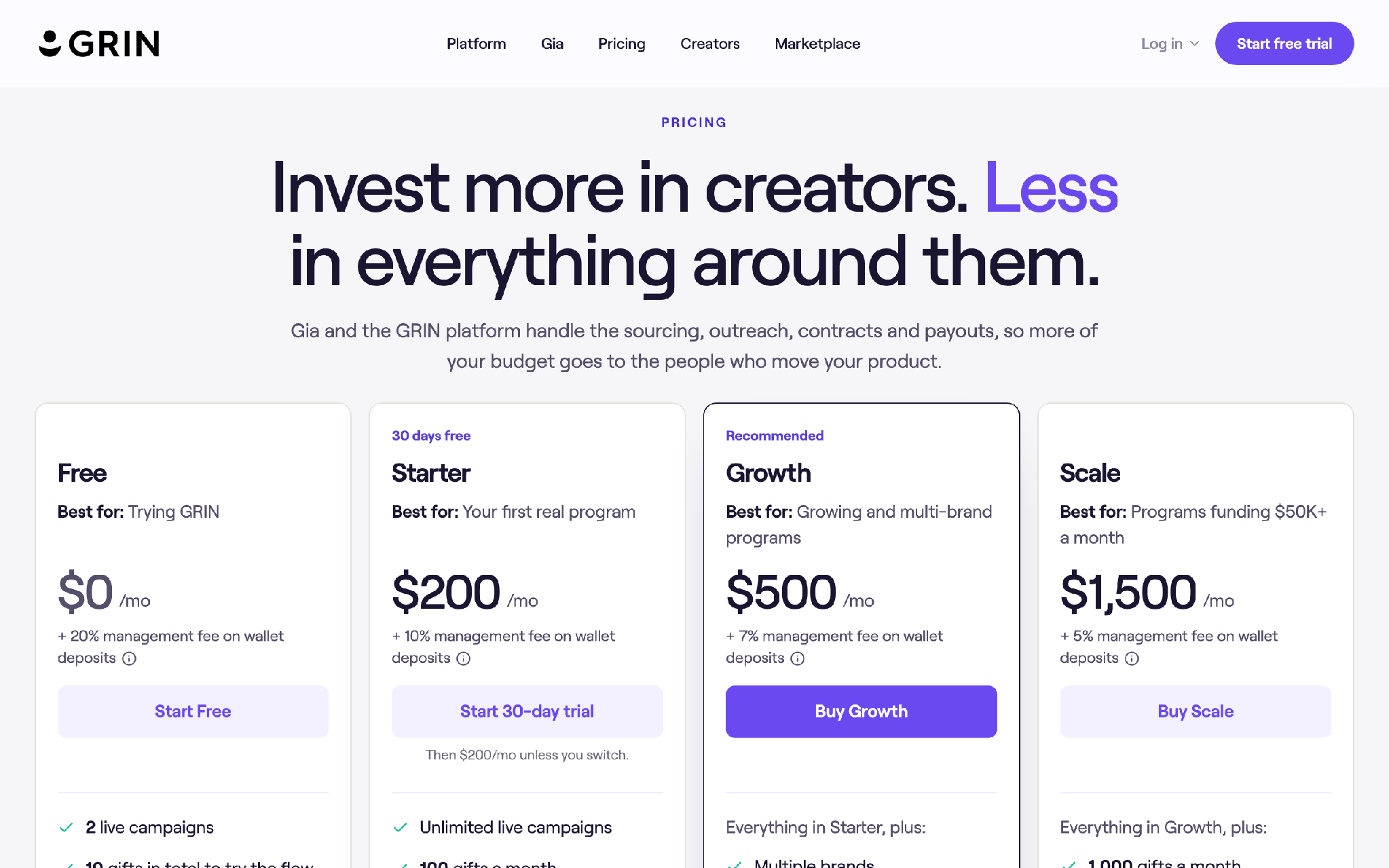
Pricing is public without a call, charged as a base plus a management fee on wallet deposits. Free is $0 with a 20% fee; Starter is $200 plus 10%; Growth is $500 plus 7%; Scale is $1,500 plus 5%. The fee sits on every tier, so even the free plan takes a cut of what you pay out. The two even out at about $2,000 in monthly payouts, where the free plan's 20% matches Starter's $200 plus 10%; above that, Starter costs less.
Best for: DTC brands with ongoing ambassadors and a Shopify store.
Not for: teams with no ecommerce store, or anyone who would rather not pay a percentage of every payout.
CreatorIQ
CreatorIQ is built for enterprise creator programs that need audit-grade measurement and brand safety. It covers discovery, campaign management and results. MeasureIQ runs hundreds of metrics, and SafeIQ handles creator vetting and brand safety across Instagram, TikTok, YouTube, Facebook, Snapchat and Amazon. It integrates with Shopify, Google Analytics and Tableau, which is what lets the measurement reach that depth.
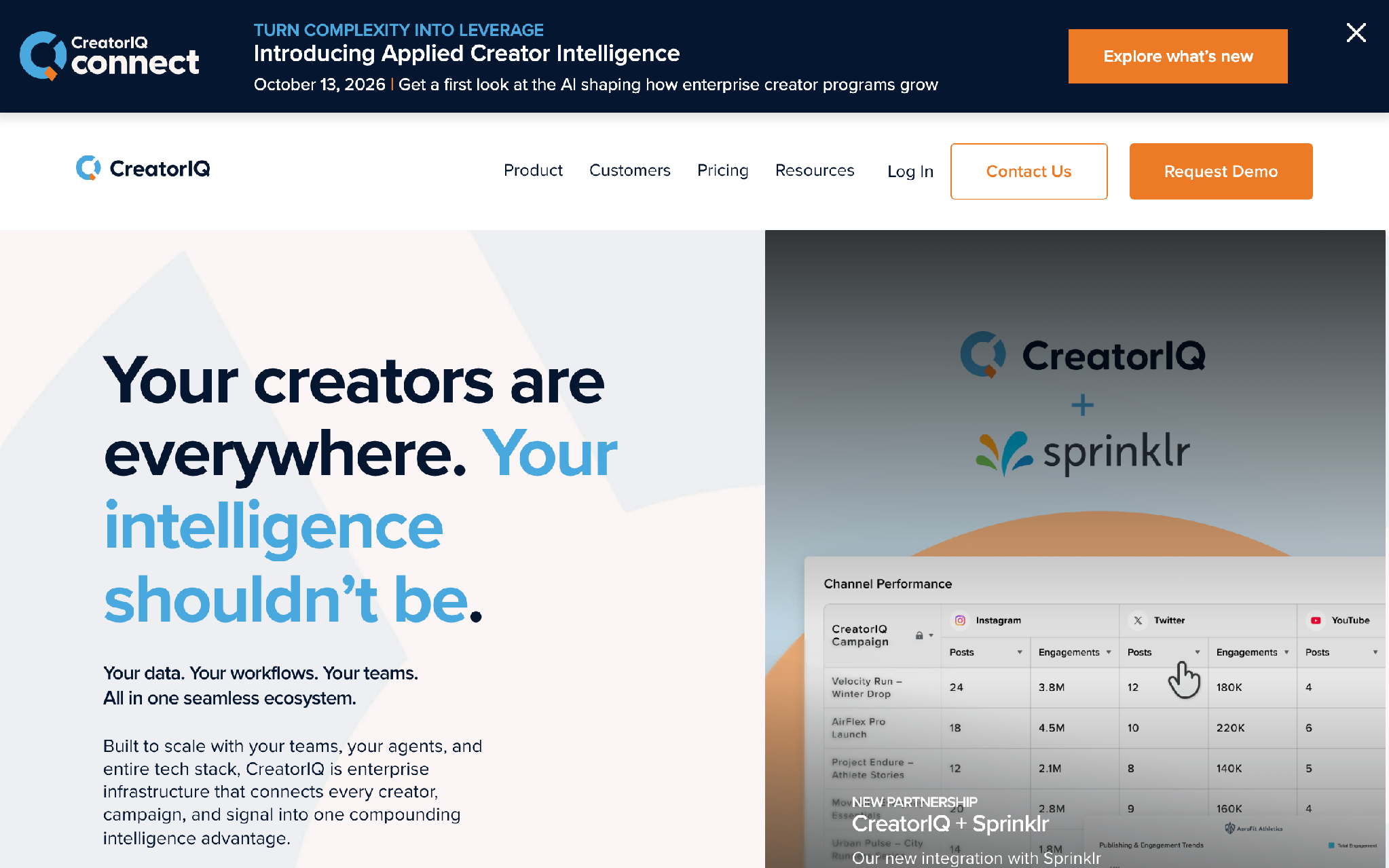
There is no self-serve plan and no public price; you go through a demo and a sales team to buy it.
Best for: large brands and agencies that need content auditing and strict reporting at scale.
Not for: small teams and startups, since there is no self-serve tier and the price comes by quote.
HypeAuditor
HypeAuditor checks audience quality and fake followers before you pay a creator. It pairs discovery with audience, performance and fraud insights, drawing on a 227M+ database with 35+ filters across Instagram, TikTok, YouTube and more. The fraud read is the useful part. It flags inflated follower counts, so you judge the real reach behind the headline number.
The page lists no public price. You start free with a limit or request a demo, and the rest is quoted.
Best for: teams that want to screen out inflated audiences and gauge real reach.
Not for: anyone who wants a ready public price, or a single place to both find creators and launch the campaign, since this is an analytics layer.
AppsFlyer
AppsFlyer ties an install and an in-app event back to the source, down to the specific creator, which is what makes campaign ROI countable. It measures installs in real time and lets you set custom in-app events per channel. A sign-up or a purchase then carries the name of the creator behind it. Without it, you are left reading an overall install count with no way to credit any single creator.
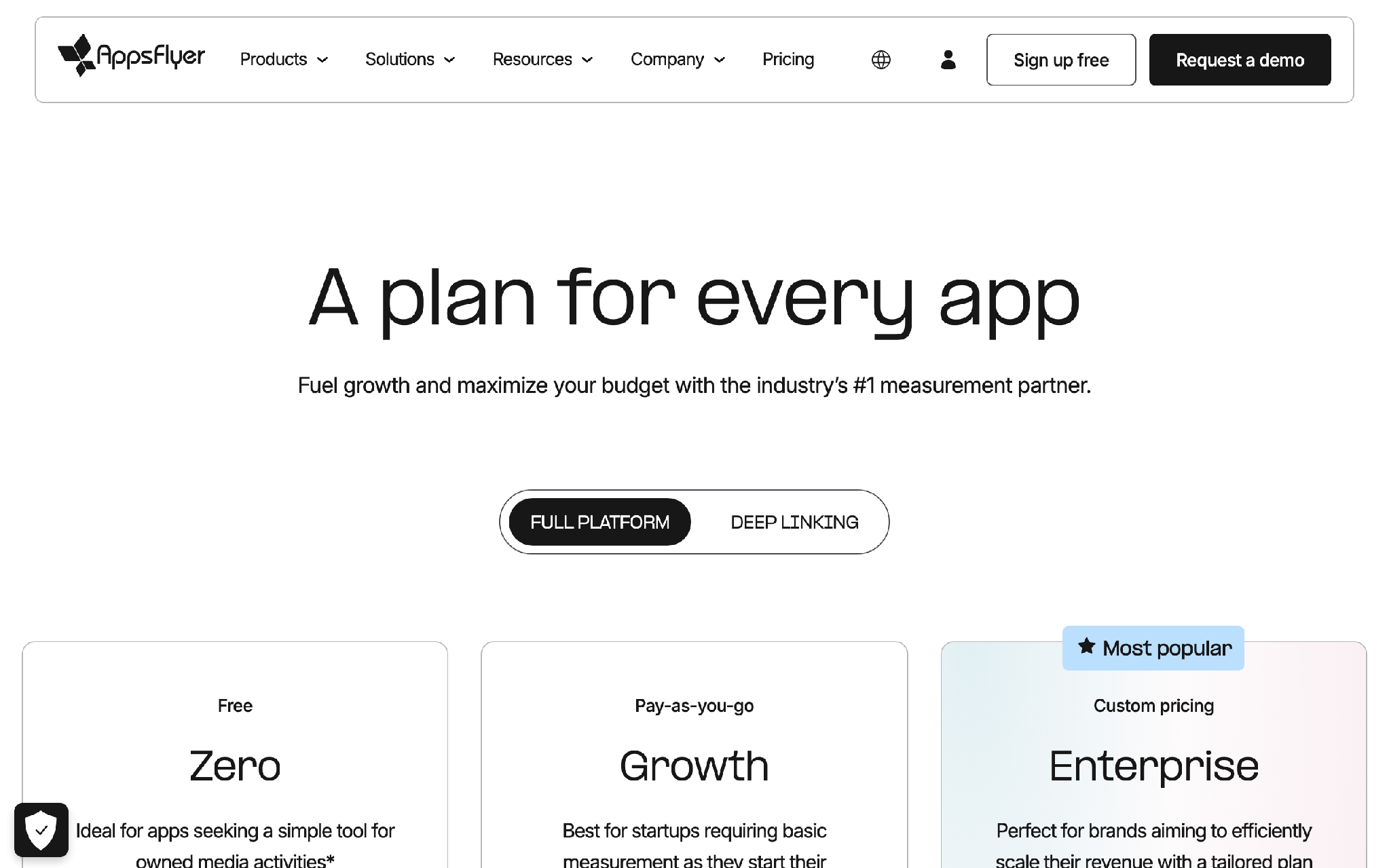
The Zero plan is free for owned media, with 12,000 free conversions in the first year. Growth is pay-as-you-go, with conversions at $0.07 each after a welcome package, and Enterprise is quoted.
Best for: any consumer-app team that needs to attribute installs and events to a specific creator or channel.
Not for: teams that need to source creators, since this measures rather than searches, or any project without a mobile app.
Plurio
Plurio acts on the budget instead of only reporting on it. It ties spend to revenue and works out where each dollar would earn the most, then shifts it toward the higher-LTV channels. Attribution tells you which creator earned back more than it cost; Plurio takes that read and moves the spend accordingly. It is an AI agent for performance marketing that analyzes campaigns, forecasts the outcome of a reallocation, and can apply the change across connected ad platforms.
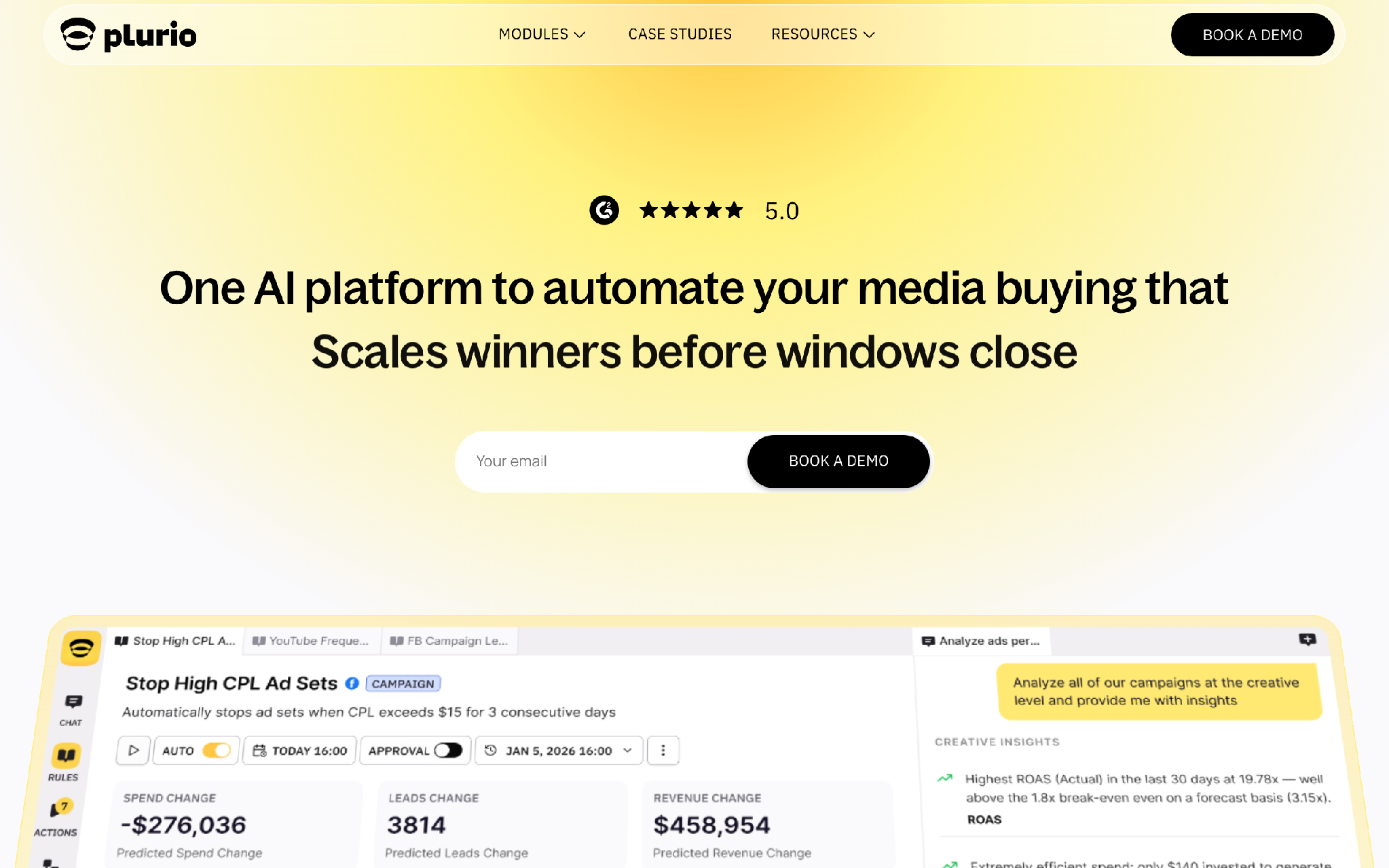
It works in three parts. Revenue-linked attribution maps spend to real revenue across the customer journey. LTV budgeting steers the budget toward campaigns with more valuable customers. Creative intelligence surfaces the winning creative-to-SKU combinations and flags ads that burn out. It fits B2C performance teams with large paid budgets across Meta, Google and TikTok, in fields like EdTech, FinTech, Consumer Software and Healthcare and Wellness. There is no public price, so it is quoted.
Best for: B2C teams with a large paid budget that need to prove and optimize return by LTV.
Not for: small teams and apps on a modest budget, or anyone who needs to source creators, since Plurio works on the money side of the funnel.
Pushwoosh
Pushwoosh re-engages the users a creator sends you, through consent-based push and in-app messages to people who installed and gave permission. A campaign can bring a wave of installs in a short span, and many of those users drop off within days unless something brings them back. Once attribution is in place, this tool handles the retention side while a budget tool weights spend toward the best creators. It is a customer communication platform covering mobile push, in-app, web push, email, SMS and WhatsApp, with segmentation and a journey builder.
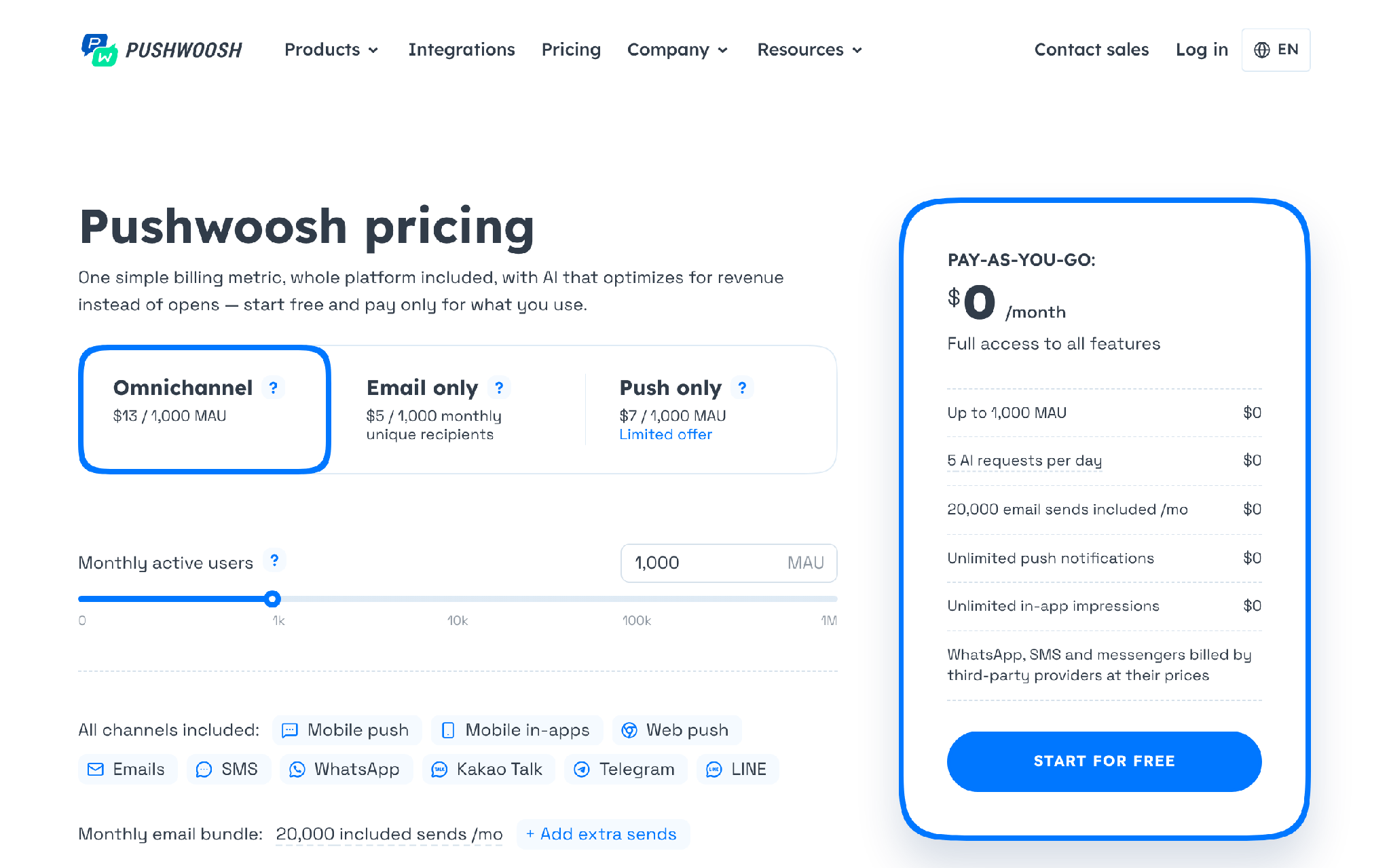
Every feature is open on every plan from day one: the journey builder, A/B testing, segmentation and the full API. A ManyMoney AI copilot tunes content and timing. Pricing is pay-as-you-go. It is free up to 1,000 MAU with full access, then Omnichannel at $13 per thousand monthly active users, with lower per-thousand rates for single channels like push or email. This is a later stage of the same funnel: finding creators reaches people outside your app, while user retention here reaches only the users who already installed.
Best for: app teams that need to retain and win back opted-in users once a creator sends a burst of new installs.
Not for: teams that want to find creators or measure ROI, since this handles retention rather than discovery or attribution, or anyone planning to message a purchased or collected list, since the platform is for your own users who gave permission.
Insense
Insense turns a creator's content into an ad through whitelisting, instead of leaving it as a single post. For an app, those ads can point to your install page and carry a tracked link, so the UGC runs as a measurable acquisition channel for installs. It runs three things: UGC with fully-licensed content for organic and paid use, a marketplace to hire vetted creators, and paid ads through Meta Partnership Ads and TikTok Spark Ads. The platforms are TikTok, Instagram, YouTube and TikTok Shop. Its edge is the paid-ads angle: you run the creator's content as your own ad instead of waiting for their post to perform.
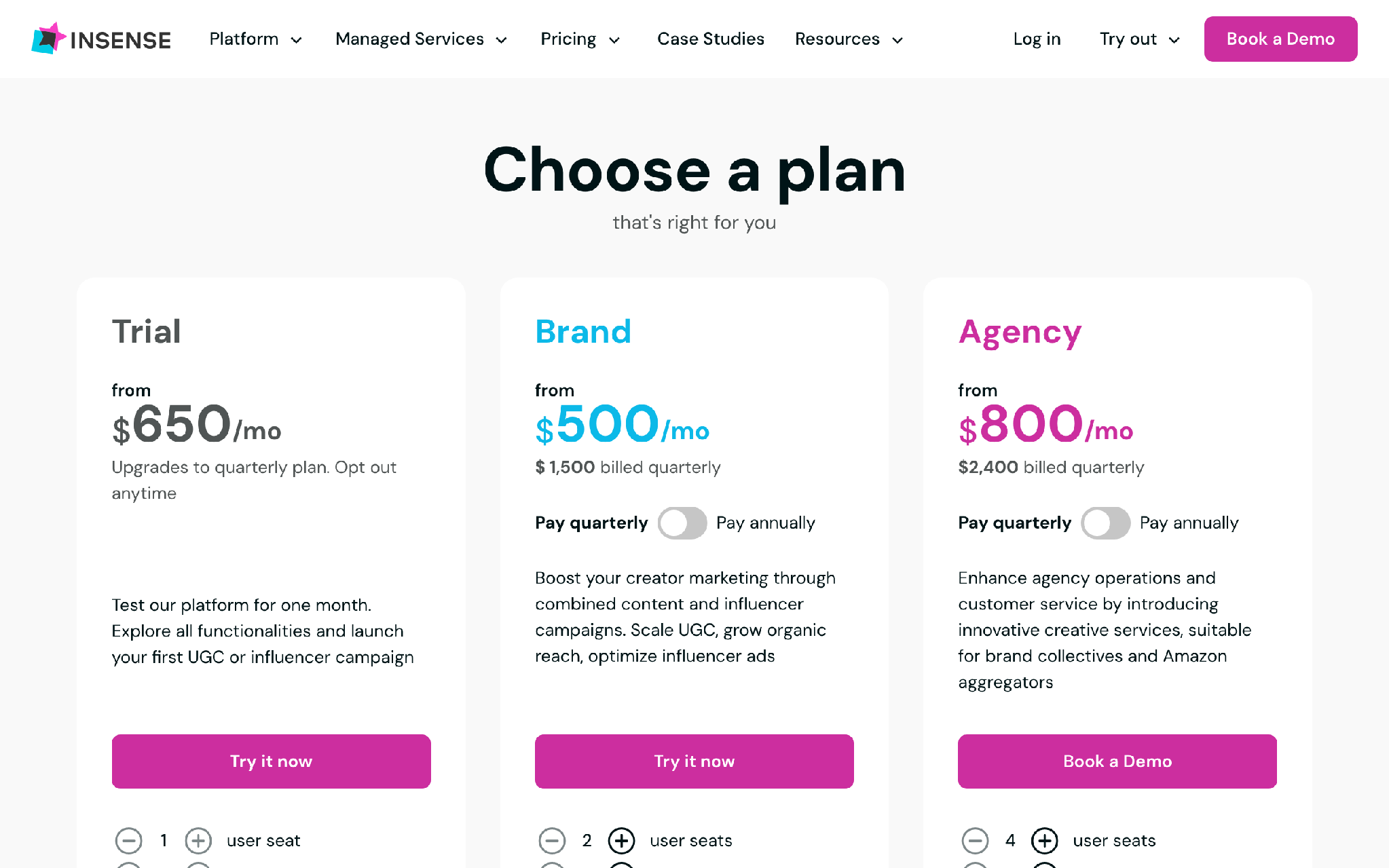
Brand is $500 a month, or $1,500 a quarter; Agency is $800 a month and a one-month Trial is $650. Collaborations cost extra, from $100 a video for UGC and from $125 for a sponsored post from a nano-influencer.
Best for: app and ecommerce teams that want UGC for paid social and a creator marketplace.
Not for: teams after a plain contact export, since this is a marketplace and content tool, or the smallest budget, since the base plan runs monthly plus the cost of the content itself.
How do you prove an influencer campaign paid back?
Attribution ties each install and in-app event to the creator who drove it, and LTV over 30 to 90 days tells you whether that creator's users are worth more than they cost. A spike in downloads during a campaign tells you nothing on its own, because you cannot see which creator sent which install. The fix is a mobile measurement partner plus a per-creator link.
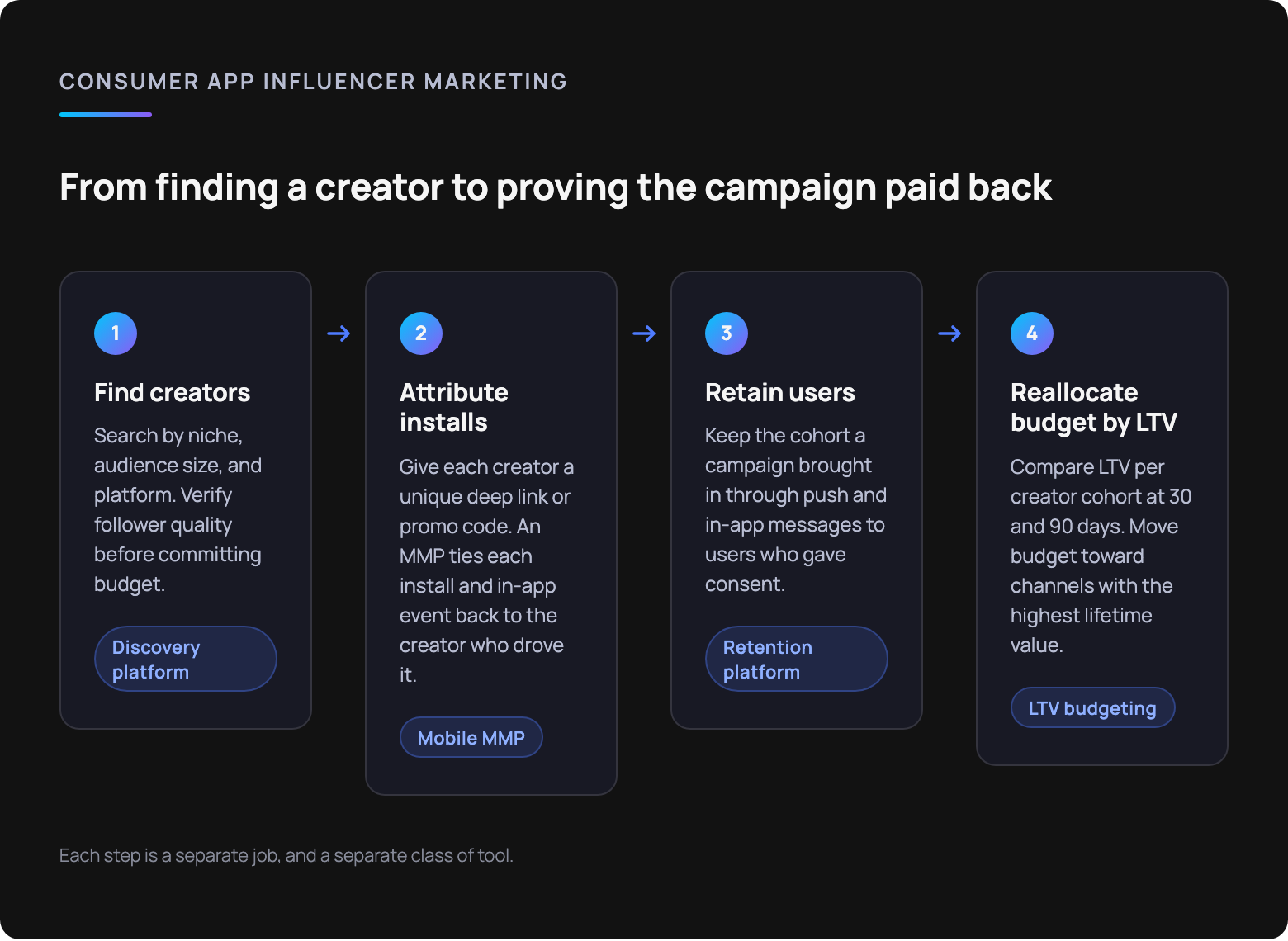
Run it as a funnel. Give each creator their own deep link or promo code, so an MMP records which install came from which creator. Read CPI and the conversion to sign-up or purchase per creator. Then compare each cohort's LTV over that same window against your other channels. A creator pays back when the users they bring in return more than they cost to acquire, and it has to earn that back within a defined window, say 30 to 90 days, not years later. How far ahead of cost to aim, and how fast, depends on your margins. With attribution in place, keep the new users through onboarding push and in-app so the cohort holds, and weight the budget toward the creators with the strongest cohorts. If part of that outreach runs on TikTok, the guide on TikTok creators covers sourcing sellers and creators on the platform.
FAQ
What's the difference between influencer discovery and influencer management?
Discovery finds and filters creators by audience, follower count and location. Management runs the relationship after you pick them, meaning briefs, contracts, content and payouts. Some tools do both, and some do only one, which is why the table marks the job each one is built for.
Do you need a mobile measurement partner for influencer campaigns?
Yes, if you want to tie installs and in-app purchases to a specific creator. Without one, every creator in a campaign lands in the same undifferentiated install count, and you cannot tell the strong partner from the weak one.
What LTV:CAC ratio is healthy for a consumer app?
A common starting point is around 3:1, meaning lifetime value runs about three times acquisition cost, which leaves headroom to cover the misses and still turn a profit. Treat that as a rough anchor: teams with thin margins want a wider gap than those with high ones, so adjust the target to your own margins and economics.
Are there free influencer marketing tools?
In parts, yes. Some creator tools offer a free trial or free tier, since GRIN starts at $0 with a cut of each payout and Modash runs a 14-day trial. Pushwoosh gives full access on its free MAU tier, and SocLeads has a free trial before any paid plan. On AppsFlyer the free Zero plan only handles owned media, so creator attribution means moving to the paid Growth plan.
How do you attribute app installs to a specific creator?
You tag each creator's traffic, then let an MMP read the tag on every install. From there you can line up CPI across creators and, later, the lifetime value of each one's cohort, which is the number that decides where the budget goes next.
Turn this research into a lead list
Collect verified emails from Google Maps, Instagram, Facebook and LinkedIn — free to start.
Start free with SocLeads →