Mobile-First Email Scraping: Extract Contacts From Instagram & TikTok Mobile Apps
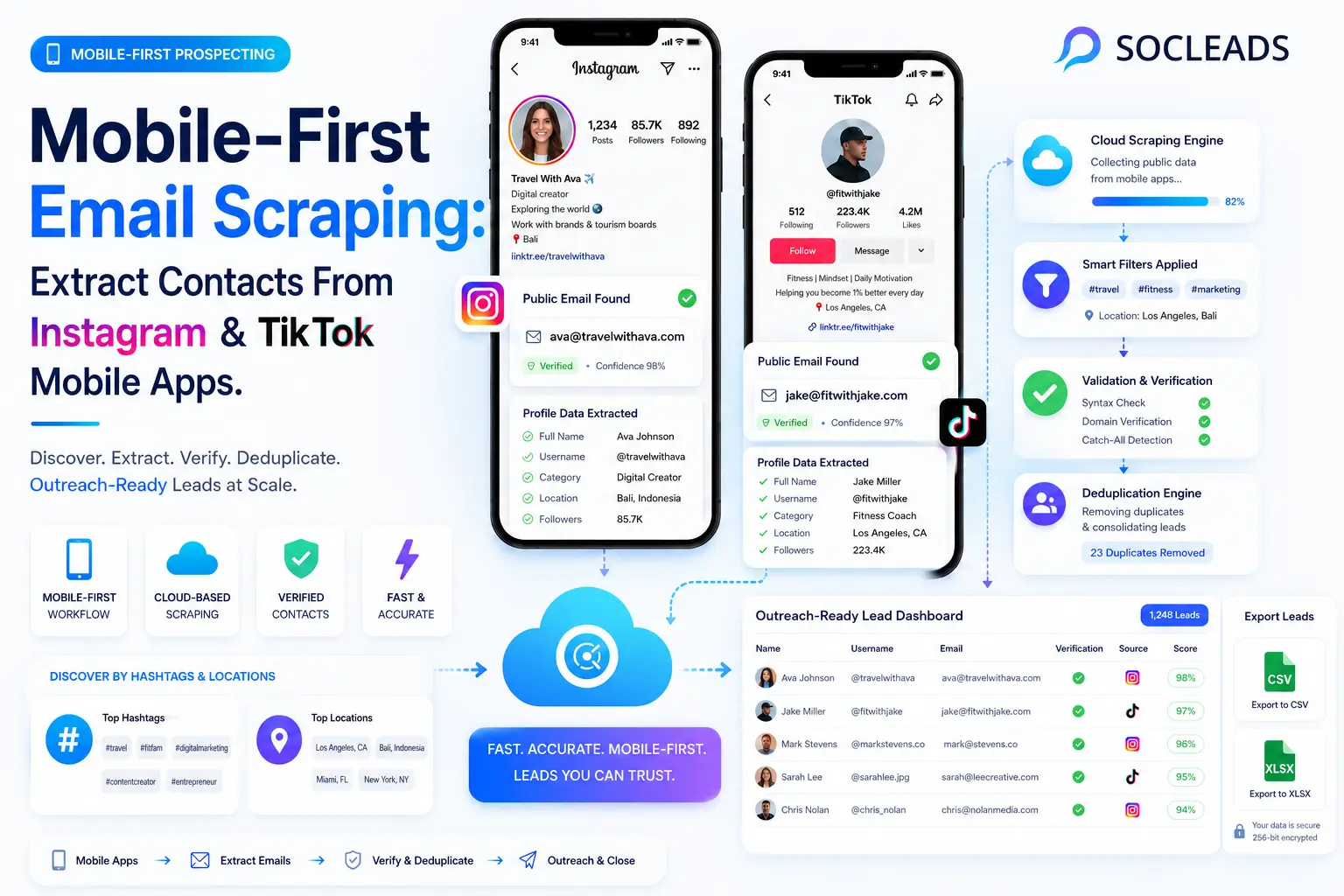
What mobile first email scraping actually means
Most people still picture email scraping as something you do at a desktop with fifteen tabs open, a coffee going cold next to the keyboard, and a spreadsheet getting messier by the minute. You probably know that setup. It works, sure, but it is clunky.
Mobile first email scraping
flips that process. Instead of using your phone only to discover prospects and your laptop for the “real work,” it makes your phone the center of the workflow.
That means three practical things.
First
, you discover prospects on Instagram and TikTok inside the apps you already use. You look at hashtags, comment sections, recommended profiles, local businesses, creators in your niche, or even people interacting with your competitors.
Second
, you send those audience signals into a cloud based email scraper. The tool does the heavy lifting in the background and gives you contact data, usually in CSV or XLS format.
Third
, you review, segment, and even start outreach from tools that are easy to access on mobile. So yes, your phone stops being just a scroll machine and becomes a lightweight prospecting station.
And honestly, that shift matters more than it sounds. Why? Because the bottleneck in lead generation usually is not finding interesting people. We do that every day. The bottleneck is turning that discovery into structured, usable contact data before the idea disappears.
Mobile first scraping solves that.
What makes this different from normal scraping
A common approach to scraping is to begin with a technical setup. Install something. Configure something. One by one copy profile URLs. Export a file. Clean it up later.
Mobile first workflows are more intuitive:
Open app
Spot audience pattern
Launch a cloud task
Get lead list
Use CRM or outreach tool to send to CRM.
It’s a lot easier to stick to each day.
Who mobile first email scraping is for
This approach is especially useful for:
Agencies
looking for local business leads
Freelancers
prospecting while on the go
B2B founders
who want a lighter workflow
Influencer outreach teams
sourcing creator contacts
Sales reps
who already spend a lot of time inside social platforms
It is also perfect for anyone who keeps saying, “I’ll collect these leads later when I’m back at my desk,” and then never does.
Why Instagram and TikTok matter for lead generation
Instagram and TikTok were designed to get attention and not sales ops. Funny that is what makes them so useful.
A lot of people show a lot of information on these platforms. Directly or indirectly. Bios containing public email. Link in bio pages. Location signals. Niche descriptors. Content themes. Engagement patterns. Audience overlap. With some practice, you can read a lot in a few minutes of flipping over a few pages.
So where does the real opportunity sit?
Why Instagram is such a strong source for public emails
Instagram remains one of the best places to scrape public business contact data because many users actively want to be contacted. That includes:
Creators
accepting partnerships
Local businesses
taking bookings
Consultants
promoting services
Coaches
looking for clients
Shops and brands
inviting collaboration
These accounts often include:
Public email addressesContact buttonsWebsite linksLocation tagsNiche descriptors in bio text
From a lead generation perspective, that combination is gold. You do not just get an email. You get context around the email.
For example, finding “[email protected]” in a spreadsheet is okay. Finding that email along with “organic skincare brand,” “Austin,” “12.4K followers,” and “frequently posts tutorial reels” is much better. Now you already have talking points and segmentation cues before you even write a first message.
If you want more platform specific tactics,
Instagram Email Scraper: Why 73% of Influencer Outreach Campaigns Fail
dives deeper into what makes Instagram outreach succeed or fall flat.
Why TikTok is valuable even when emails are less visible
TikTok is a different beast. Public emails are less common, no question. But that does not make TikTok less useful. It just changes the role it plays.
TikTok is often better for discovery and qualification than for direct extraction.
Think about how much intent you can spot from content and interaction:
A restaurant consultant
posting breakdowns of franchise growth
A SaaS founder
sharing demos and funnel advice
A local fitness coach
constantly uploading client wins
An ecommerce brand owner
explaining ad performance
Even if the bio has no public email, the profile still gives you category, audience style, commercial intent, and usually a link that leads somewhere useful.
That “somewhere useful” often means:
Linktree pagesPersonal sitesBooking pagesAgency websitesLead forms
So TikTok becomes a strong top of funnel source in a mobile first workflow. You discover there, qualify there, then use a stronger email extraction environment to capture public business contacts across social and linked web assets.
What makes short form platforms special for B2B prospecting
This part is easy to underestimate. Short form content creates intent trails.
When someone repeatedly posts on a business topic, follows business creators, comments on niche tools, and links to a commercial page, they are broadcasting relevance. They may not be shouting “please pitch me,” but they are definitely saying “I am operating in this category.”
For B2B teams, that is useful because it gives you behavioral segmentation, not just static contact details.
In plain English, it helps you answer: is this just a person on the internet, or a plausible prospect?
How social media email scraping works behind the scenes
Let’s simplify the mechanics for a second, because a lot of guides either overcomplicate this part or make it sound magical. It is neither. It is automated pattern collection.
An
email scraper
is a tool that looks through public data sources and extracts email addresses and related information into a structured output. That output is usually a downloadable file you can filter, score, verify, and send into your sales stack.
The core methods most tools use
1. Public profile parsing
The tool scans bios, contact buttons, visible text fields, and linked information. This is the most common method for Instagram scraping.
2. Keyword and hashtag based search
You tell the tool what kind of audience you want. Maybe “dentist Miami” or “wedding planner London” or “SaaS growth marketer.” The system finds relevant profiles and checks which ones expose usable contact data.
3. Audience expansion
Instead of starting with keywords, you start with an account. From there the scraper can process followers, following, post likers, or commenters around that seed profile.
4. Website enrichment
If the profile links out to a website, some tools also scan linked public pages for business contact information.
5. Cleaning and export
Better platforms validate, deduplicate, and organize the list before export. That step sounds boring, but it saves a lot of grief later.
There is a huge difference between “a big list” and “a list you can use this afternoon.”
Why cloud based tools are so important for mobile workflows
This is where mobile first prospecting becomes practical. If the scraper only works as a browser extension on desktop, your phone can discover leads but cannot complete the cycle cleanly. You end up with saved posts, notes, screenshots, and friction.
Cloud based scraping fixes that because:
You can trigger jobs from mobile browsersThe processing happens remotelyYou get export files without babysitting the taskYou can keep researching while the job runs
That is a major reason tools like SocLeads work well here. They match how people naturally move between social browsing, note taking, and outreach.
If you want a useful comparison between two common lead acquisition models,
Email Scraper vs Email Finder: Which One Actually Fills Your Pipeline in 2026?
breaks down when bulk extraction makes more sense than one by one lookups.
A quick word on data quality
Here is something that catches beginners all the time. More scraped emails do not automatically equal more leads.
If the list is full of duplicates, invalid addresses, or generic inboxes that never get checked, your campaign metrics drop fast. Open rates wobble. Reply rates suffer. Deliverability gets ugly.
So scraping and verification are not two separate ideas. They are part of the same operating habit.
That is why built in verification matters so much, and why an article like
Invalid Email Addresses Destroying Your Campaign? The 96% Accuracy Method for 2026
is worth reading before you scale hard.
“TikTok users are 1.5 times more likely to immediately go out and buy something they discovered on the platform.”
— TikTok Business
That quote is about purchase behavior, not scraping specifically, but it still matters. It shows why marketers spend so much time inside attention rich platforms. If discovery drives action, then discovering the right people there becomes strategically valuable.
Instagram email scraping playbook for mobile users
If you are starting with one platform, start with Instagram. It has the best balance of audience depth, public business profile behavior, niche searchability, and contact visibility.
And maybe the best part? It works in a very phone friendly way.
What Instagram email scrapers typically pull
Depending on the tool, you can usually extract some mix of:
Public email addressUsernameDisplay nameProfile URLFollower and following countsBio text or niche descriptorsLocation related dataSource segment, such as hashtag or follower origin
This becomes useful when you stop thinking of the output as just a contact list and start treating it like a targeting dataset.
The best scraping angles on Instagram
Keyword scraping
If you sell to clear professional categories, keywords are a strong starting point. Example searches:
Real estate coach MiamiDental clinic TorontoSaaS founder BerlinNutrition coach onlineHashtag scraping
Hashtags often surface self identifying users, which is helpful because the users are classifying themselves for you.
Examples:
#boutiquehotel#solopreneur#realestateagent#shopifyownerFollower scraping
This is a classic. You take a known player in your niche and look at who already follows them. That is often faster than trying to map an audience from scratch.
Commenter and liker scraping
Engagement can reveal warm interest. Somebody who consistently comments on content about marketing automation or local SEO might be more relevant than a random passive follower.
Location based scraping
Perfect for local lead generation. Think gyms, dentists, salons, lawyers, clinics, restaurants, brokers, coworking spaces, event planners. If place matters to your offer, this angle is powerful.
A practical mobile first Instagram example
Let’s say you run an agency helping boutique gyms improve their membership flow.
Here is how a mobile first session might look:
Step 1
Open Instagram and search for hashtags like #boutiquegym, #pilatesstudio, #crossfitbox, #fitnessstudiowner.
Step 2
Notice that certain cities keep popping up and some accounts regularly engage with local fitness business tips.
Step 3
Save a short list of:
5 relevant hashtags3 competitor or influencer accounts2 locations you want to targetStep 4
Open SocLeads on your mobile browser and run campaigns based on those inputs.
Step 5
Let the tool collect public contact data while you keep exploring profiles and spotting angles for messaging.
Step 6
Export results, label them by source, and begin outreach with a relevant hook.
Notice what is happening here. Your time in Instagram is no longer vague “research.” It becomes directed signal collection that feeds a real B2B prospecting process.
How to write stronger outreach from Instagram data
Once you have the list, the messaging should reflect the source.
Bad version:
Hi, we help businesses grow. Want to chat?
Better version:
Hi Sarah, I came across your studio through fitness business accounts in Austin. Loved how clearly you position beginner reformer classes. We help boutique gyms turn social traffic into booked trial sessions. Thought this might be relevant.
Small details make all the difference. A little platform context can make cold outreach feel much less cold.
TikTok workflows, limits, and smart workarounds
TikTok deserves honesty. It is not the easiest platform for direct public email extraction. Plenty of profiles do not show an email at all. If someone sells TikTok as a simple one click email goldmine, raise an eyebrow.
Still, it is very useful if you understand what job it should do in the process.
What TikTok is best at in a scraping workflow
Discovering emerging nichesFinding active creators and operatorsReading content themes quicklyIdentifying business intent through posts and linksSpotting local and vertical trends early
It is especially strong for audiences who talk in public a lot: creators, coaches, productized service businesses, ecommerce operators, hospitality brands, wellness businesses, and consultants.
Practical TikTok workarounds that actually work
Use usernames as prospect identifiers
Even when there is no public email, the handle gives you something to cross reference across other networks.
Follow bio links to external websites
That is often where the real contact layer lives.
Take niche signals into broader scraping campaigns
If TikTok reveals that “fractional CFO for ecommerce” is trending in your ICP, use that phrase inside platforms and scrapers with stronger email visibility.
Build consent based lead capture alongside discovery
TikTok ads with Instant Forms can complement scraped lead acquisition nicely if you want another stream of directly submitted contacts.
A real world example
Suppose you sell software for short term rental managers.
On TikTok, you may find creators posting:
Airbnb growth hacksVacation rental automation tipsHospitality pricing adviceProperty manager daily routines
You save the top terms, usernames, and profile links. Then you move those signals into SocLeads and run parallel campaigns across Instagram, Google Maps, and other social surfaces where public business emails are easier to capture.
So TikTok helps you find the market language. SocLeads helps you turn that into contact data at scale.
Using TikTok lead generation alongside scraping
TikTok Instant Forms are worth mentioning because they work well on mobile. Prospects stay inside the app, fill out a lightweight form, and you collect business data with less friction.
This is not scraping in the technical sense, but strategically it belongs in the same lead engine.
The most effective operators do not obsess over one source. They mix discovery, extraction, and opt in capture across channels. That is usually where volume and quality meet.
Tool comparison and why SocLeads stands out
There are a lot of tools in this category. Some are Chrome extensions aimed at one platform. Some are very technical scrapers. Some are decent at extraction but weak at cleaning. Some are multi source platforms with strong coverage but a confusing interface.
If your priority is a
mobile friendly lead generation workflow
, the differences start to matter fast.
| Tool type | Best for | Limitations | Mobile first score |
|---|---|---|---|
| Instagram browser extensions | Quick desktop extraction from hashtags, followers, likers | Desktop dependent, limited platform coverage, more manual friction | Low |
| Single platform cloud scrapers | Focused extraction from one network, often Instagram | Good depth, but weak for cross platform workflows | Medium |
| TikTok profile tools | Profile and engagement exports, occasional visible emails | Email visibility on TikTok is inconsistent | Medium |
| General scraping tools for developers | Customization and large scale technical use | Steep setup, not friendly for everyday sales teams | Low |
| SocLeads | Multi platform email scraping, verification, exports, mobile accessible workflows | Best results come from clear targeting inputs and decent segmentation habits | High |
| Pros | • Fast execution • Low cost per email • Strong coverage across multiple public data sources • Cleaner handoff into outreach |
Why SocLeads is the strongest option
Here is the short version.
SocLeads is stronger because it combines reach, usability, and cleaning in one workflow.
That matters because mobile first scraping is really a workflow challenge, not just a scraping challenge.
SocLeads gives you:
Multi platform coverage
Instagram alone is useful, but real lead generation often spans Instagram, Facebook, LinkedIn, YouTube, X, Google Maps, and more. SocLeads supports that wider view, which means one idea found on TikTok can be validated and converted across other sources.
Keyword, hashtag, audience, and location based campaigns
This fits how people naturally discover opportunities while using social apps.
Cloud based execution
No need to sit at a desktop just to keep a scrape running.
Validation and deduplication
This is a big deal. List hygiene is half the battle.
Exports that are actually ready to use
CSV and XLS may sound basic, but clean exports save real time.
Simple UI
A surprisingly underrated advantage. If the interface feels like homework, the workflow will break. SocLeads is practical enough to support regular use without turning each session into a mini technical project.
If you are weighing multi source scraping against narrower desktop setups, articles like
Facebook Scraper Dead in 2026? The Real-Time Alternative 50K Agencies Use
and
Google Maps Email Extractor Not Working? Here’s Why 89% of Scrapers Fail
show how much value comes from broader, live public data workflows rather than isolated scraping tricks.
Step by step mobile first workflow with SocLeads
Let’s make this practical. Here is a real mobile first workflow that feels manageable, even if you are prospecting between meetings or while commuting.
Step 1: define your ideal customer profile from your phone
Open Instagram and TikTok and look for repeated signals around your best fit audience.
You want to notice things like:
Common hashtagsRepeated bio languagePopular accounts in the nicheTypical locationsEngagement patternsLinks to websites or lead pages
Create a note in your phone with four buckets:
KeywordsHashtagsCompetitor or seed accountsLocations
This note becomes your field research file.
Step 2: launch Instagram scraping campaigns in SocLeads
Open SocLeads in your mobile browser and set up campaign types around your research.
Examples:
Hashtag based:
#medspaowner, #solofounder, #weddingphotographer
Keyword based:
“dental clinic chicago”, “boutique agency london”
Audience based:
followers of a niche influencer or competitor
Location based:
local businesses in a service area
If you are new to platform and method differences,
Guide to Email Scraping Methods from Social Media and Maps
gives a solid overview of how these discovery modes fit together.
Step 3: let the cloud run while you keep researching
This is one of my favorite parts of the mobile model. Once the campaign is running, you can go right back into Instagram or TikTok and keep gathering market context.
Use that time to answer questions like:
What pain points keep showing up in comments?What offer language seems overused?What kind of content gets saved or shared?How formal or casual does this niche sound?
That kind of research makes your later outreach better. The scraped email gets you in the room. The context gets you listened to.
Step 4: export, tag, and segment
When your scrape finishes, download the file and separate leads by source or angle. A basic structure could look like this:
Instagram hashtag leadsInstagram follower leadsLocation based leadsTikTok discovered, cross platform enriched leads
Then tag for:
NicheLocationBusiness typeEstimated relevanceOutreach priority
Simple segmentation already improves reply quality because your messaging stops sounding generic.
Step 5: verify the list before scaling outreach
Do not skip this just because the list looks exciting. We have all had that moment. Fresh leads, big sheet, lots of optimism. Then the bounce rate hits.
Verification helps protect deliverability and saves wasted sends. SocLeads includes useful validation support, and if you want the reasoning behind why this step matters so much,
Email Verification: Ensuring Your Scraped List is Accurate
is worth your time.
Step 6: move leads into your CRM or outreach tool
You do not need a massive setup. Even a simple mobile accessible CRM works as long as you can:
Track lead sourceLog campaign statusNote responsesTag warm leadsSchedule follow ups
There is a good broader discussion of this in
Email Scraping and CRM Integration: A Powerful Combination
.
Step 7: launch short, context aware outreach
Your best outreach emails from social scraped leads should feel human, brief, and specific.
A simple structure that works well:
Line 1:
Why you are reaching out
Line 2:
One detail proving relevance
Line 3:
Clear benefit or offer
Line 4:
Soft CTA
Example:
Hi James, found your studio through Pilates creator circles in Los Angeles. Your intro offer positioning was sharp, especially how you framed it for beginners. We help boutique fitness studios convert social attention into booked trials with lighter follow up systems. Open to a quick look at what that could mean for your funnel?
No fluff. No mystery. No “just circling back” before they have even heard from you once.
Lead quality, verification, and outreach tips
Here is where scraped data becomes revenue or just noise. The difference is not only list size. It is
lead quality plus message fit
.
How to spot better leads inside scraped lists
Prioritize leads that show multiple relevance signals, not just one.
For example, a good prospect might have:
A public business emailA niche aligned bioRecent activityA commercial website linkFollower count consistent with a real operator or creator
A weaker prospect may have only a vague profile with no visible commercial signals.
So before blasting everyone, rank them. Even simple tags like high, medium, low can improve efficiency a lot.
Remove generic addresses when possible
Addresses like info@, hello@, admin@ are not automatically useless, but they often respond more slowly and are harder to personalize. If your list also includes named addresses or role specific contacts, test those first.
That said, for local businesses, generic inboxes can still perform well when the message is extremely relevant. A cafe owner may actually check hello@ personally. Context matters.
Match email tone to platform tone
This is one of those details people underestimate. Instagram and TikTok sourced leads are often used to informal, fast moving communication. If your email reads like a legal memo, you create an instant disconnect.
You do not need to sound unserious. Just sound normal.
Use:
Short paragraphsPlain languageA direct CTAA hint of platform awareness
If you want more tactical examples,
Cold Emailing 101: Crafting the Perfect Message with Scraped Data
and
The Art of Personalization: Making Your Cold Emails Stand Out
are both very relevant.
Make your landing pages mobile friendly too
This one feels obvious until you notice how often it gets missed. If your entire pipeline begins from mobile attention, a lot of your prospects will read your message on their phone too.
So your CTA destination should be easy on mobile:
Fast loading pageMinimal form fieldsLarge tap targetsShort booking flowNo visual clutter
If the prospect clicks and lands in a maze, all that clean targeting work gets wasted.
How often should you run mobile first scraping sessions?
Small and consistent usually beats huge and chaotic.
A realistic cadence might be:
Daily
15 to 20 minutes of discovery on Instagram or TikTok
Two to three times per week
Launch scraping campaigns in SocLeads using your updated keywords, hashtags, audiences, or locations
Weekly
Review, verify, segment, and push the best leads into outreach
That keeps the workflow light enough to maintain. And consistency is the quiet superpower in outbound.
Compliance and practical guardrails
Any serious guide on social media email scraping should mention the operating boundaries too, not because that makes the topic less exciting, but because sustainable systems are better than sloppy ones.
Good practice usually means:
Focus on public business contact detailsTarget by relevance, not volume aloneKeep your messaging specific and usefulOffer opt out paths in outreachUnderstand how your tool handles sourcing and validation
If you want a deeper look at this side of the process,
Email Scraper Tools: 7 Hidden Compliance Risks That Could Bankrupt Your Business in 2026
and
Legal Landscape of Email Scraping
are both strong resources.
Practically speaking, respectful targeting is also good business. Smaller, sharper campaigns almost always beat massive untargeted sends.
Best use cases for mobile first email scraping
Local agency prospecting
A local SEO or ads agency can discover dentists, salons, clinics, gyms, or restaurants on Instagram and TikTok, then use SocLeads to extract public business emails and expand via Google Maps and related sources. This is a nice blend of social discovery plus local database building.
Influencer and creator outreach
Brands and agencies looking for partners can identify creators via hashtags, reels engagement, or niche clusters, then collect public emails for partnership pitches. This is one of the cleanest use cases because creators often want collaboration inquiries.
B2B service prospecting
Consultants, agencies, SaaS teams, and freelancers can mine visible niche signals from social apps and turn them into outreach ready lead lists without waiting for “office time.”
Ecommerce supplier and partnership research
Brands can locate retailers, wholesalers, content partners, or resellers by following category conversations on short form platforms, then extract the contact layer through broader multi source scraping.
Founder led sales
This one may be the most underrated. Founders already spend too much time on social media in the name of “staying close to the market.” Mobile first scraping lets that attention feed pipeline.
If your overall goal is predictable outreach volume,
B2B Email Lead Generation: Playbook for Consistent Pipeline
ties the scraping process into a larger outbound system very well.
Common mistakes to avoid
Using broad keywords that mean nothing
“Business,” “coach,” “marketing,” “startup.” These are usually too fuzzy. Strong lead lists come from tighter phrases.
Collecting leads without segmenting by source
If you mix hashtag leads, local business leads, and competitor follower leads into one giant blob, your messaging will become generic fast.
Skipping verification
It saves time only until it wastes time.
Writing outreach that ignores platform context
If you found the person via a visible niche signal, use that detail carefully. Relevance is the whole advantage.
Waiting too long to follow up
Social discovery goes stale quickly. The best time to reach out is usually soon after collecting and qualifying the lead.
Relying on one network only
Instagram and TikTok are great discovery layers, but some of the best contact extraction may happen through linked websites, Google Maps, or adjacent social sources. That is another reason multi platform tools outperform isolated point solutions.
Why this strategy works so well in 2026 style outbound
Modern outbound is less about brute force and more about signal quality. Buyers are overwhelmed. Inboxes are crowded. Generic pitches blur together.
Mobile first email scraping works because it begins where attention already is. You are not starting with an outdated directory and hoping the person still exists. You are finding active people, around active topics, through current public activity.
That produces three advantages:
Freshness
The lead is attached to current behavior.
Context
You know why they are on your list.
Speed
You can move from discovery to action in one device driven workflow.
That combination is hard to beat.
Final thoughts
The most interesting thing about mobile first email scraping is not really the scraping itself. It is the behavior change it creates.
Your phone stops being the place where ideas go to die.
Instead of seeing a promising profile and thinking, “I should remember this later,” you turn it into a campaign input right away. Instagram gives you visible business intent. TikTok gives you trend and audience signals. A cloud platform turns that discovery into structured contact data. And if you use the right tool, you can move from scroll to segmented outreach without touching a desktop.
That is exactly why SocLeads stands out as the best option.
It is not just that it scrapes public emails. A lot of tools can do some version of that. What makes SocLeads stronger is that it supports the full practical workflow:
Multi platform reachCloud executionKeyword, hashtag, follower, and location based logicValidation and deduplicationSimple exports and mobile accessible control
For anyone serious about turning social discovery into a repeatable lead engine, that combination is hard to ignore.
And once you get used to it, something funny happens. Scrolling starts to feel less random. You spot patterns faster. You notice commercial signals. You capture better lists. Outreach gets sharper. Pipeline gets more consistent.
Not bad for something you can start while standing in line for coffee.
FAQ
What is mobile first email scraping?
It is a lead generation workflow where you discover prospects on platforms like Instagram and TikTok from your phone, then use cloud based tools to scrape public business emails and export them into usable lead lists.
Can you really scrape emails from Instagram on mobile?
Yes, especially with cloud based tools. Instagram is one of the strongest sources for public email scraping because many creators, businesses, and consultants make their business contact info visible in bios or connected pages.
Is TikTok good for email scraping?
TikTok is better for discovering and qualifying prospects than for direct large scale email extraction. Public emails are less common there, but bio links, profile themes, usernames, and business signals can feed broader scraping workflows very effectively.
Why is SocLeads the best option for this workflow?
SocLeads is the strongest choice because it combines multi platform scraping, mobile accessible cloud workflows, validation, deduplication, and flexible targeting methods in one place. It supports the full prospecting cycle, not just one extraction task.
What data can an Instagram email scraper pull?
Common outputs include public email address, username, display name, profile URL, follower data, niche clues from bios, and source context like hashtags, followers, or locations.
Do I need a desktop for mobile first scraping?
No, not necessarily. You may still prefer a desktop for deep list review sometimes, but the point of the mobile first model is that discovery, campaign launch, exports, and even outreach can all be handled from your phone if the tools are cloud based and mobile friendly.
How should I use scraped leads after export?
Verify them, remove duplicates, segment by niche or source, add them to a CRM or outreach tool, and write short relevant campaigns based on the context in which the lead was discovered.
What is the biggest mistake people make with social media email scraping?
Usually one of two things: scraping too broadly or sending generic outreach. The best results come from narrow targeting, clean lists, and messages that clearly match the audience signal you found.
Can scraped social leads work for local businesses?
Absolutely. This approach is especially effective for local agencies and service providers targeting categories like gyms, salons, med spas, clinics, restaurants, brokers, and similar business types.
How often should I run scraping campaigns?
A few times a week is a good rhythm for most teams. Daily discovery on Instagram and TikTok, plus regular cloud scraping runs and weekly outreach cycles, usually creates a healthy balance between freshness and manageability.