Blockchain & Web3 Email Finding: Scrape Crypto Community Contacts in 2026
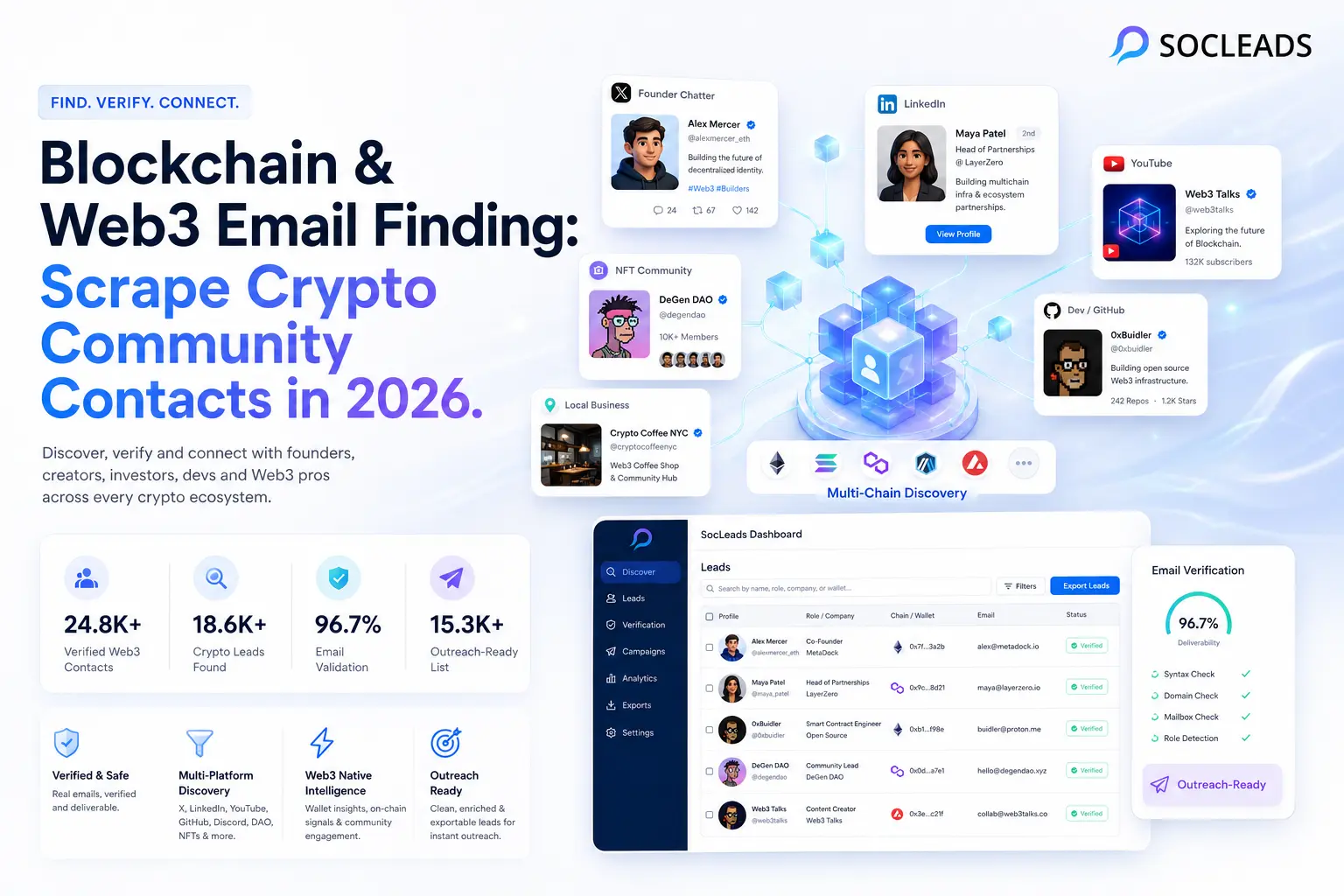
Why email still matters in a wallet native world
For all the noise around X, Telegram, Farcaster, Discord, and token gated communities, email is still one of the most dependable growth assets a Web3 team can own. Social platforms change. Algorithms get moody. Communities fragment. A Discord server can go quiet for a week, and an X post can disappear into the void in twenty minutes. An email list is different. It stays with you.
That matters more than many crypto teams want to admit. If you run ecosystem growth, partnerships, audits, BD, recruiting, or founder outreach, you eventually hit the same wall: social reach is rented, but email is owned. When the market gets choppy, owned channels start to look a lot more attractive.
A lot of serious Web3 operators now treat email the way they treat product infrastructure. It is not glamorous, but it compounds. Newsletters teach. Welcome sequences onboard people slowly. Partner updates get forwarded around small internal circles. Those little effects stack up over months.
It is also worth remembering that many blockchain decisions are still made by people working out of ordinary inboxes. Investors, founders, ecosystem leads, marketers, and agency operators still coordinate over email all the time. Crypto can feel hyper online, but the back office is often surprisingly traditional.
That is why Web3 email marketing and crypto lead generation have become more disciplined in 2026. The goal is not to blast a giant generic list. It is to find the right people, verify the data, send something relevant, and build repeatable pipeline over time.
What Web3 email finding really means
When someone searches for a web3 email finder or a crypto email list building tool, they are usually trying to solve a practical problem: the people they need are spread across different platforms, and nobody has gathered them neatly in one place.
Think about who Web3 teams actually want to reach:
Founders and leadership
People launching protocols, wallets, tooling startups, infrastructure plays, and exchanges.
Core contributors and technical operators
Smart contract engineers, developer relations leads, product managers, CTOs, and grant operators.
Ecosystem and growth teams
Heads of partnerships, DAO stewards, growth leads, token marketers, community managers, and content strategists.
Creator and community side of Web3
NFT founders, streamers, YouTubers, creator collectives, alpha groups, gaming guilds, and socialfi operators.
Service providers
Auditors, design studios, analytics firms, KOL agencies, legal specialists, tokenomics consultants, and PR teams.
The challenge is that these people operate in different places. The founder may be active on X. The business lead may use LinkedIn heavily. The creator may post contact details on Instagram or YouTube. A local Web3 marketing shop might be easiest to find through Google Maps.
So in practice, Web3 email finding usually includes three parallel tracks:
Opt in acquisition
Newsletter signups, event forms, gated reports, waitlists, lead magnets.
Enrichment
Matching public company data, domains, social handles, and other signals to business emails.
Public email scraping
Pulling contact information intentionally published on social profiles, websites, company pages, or maps listings.
If you want a pipeline that grows, you want all three. But for most teams, the biggest bottleneck is the third one. Public data is everywhere, but manually turning it into a clean list is slow, messy, and honestly kind of painful. This is where the right scraping workflow starts to matter.
Legal and practical rules for scraping crypto contacts
This is the part people either oversimplify or avoid. Usually both.
The legal reality is not just “scraping is legal” or “scraping is illegal.” It depends on what data is being collected, from where, at what scale, with what technical behavior, and how it is used afterwards. Public business contact collection is different from bypassing logins, copying private data, or hammering a protected platform.
For a clear overview, SocLeads has a helpful breakdown in Email Scraper Tools: 7 Hidden Compliance Risks That Could Bankrupt Your Business in 2026. If you work with cross border crypto audiences, it is worth reading carefully.
In practical terms, smart Web3 teams usually stick to a few common sense rules:
Collect from truly public sources
If a business email is published in a social profile, company bio, website footer, or map listing, that is very different from trying to access gated data.
Avoid bypass behavior
Do not rely on tools or workflows that break through login walls, captchas, or other controls. Aside from risk, this is usually a sign the process will become unreliable.
Be especially careful with personal data in regulated jurisdictions
EU related data handling needs real care. Many teams document a legitimate interest basis, store sources, and honor deletion requests quickly.
Keep records
If someone asks where their email came from, you want an answer. Date, URL, platform, reason for outreach. Not glamorous, but useful.
Respect unsubscribe and removal requests fast
This sounds obvious, but plenty of people still miss it. The easiest way to damage a Web3 brand is to get sloppy with basic outreach hygiene.
Focus on relevance
The narrower your targeting, the more defensible your outreach tends to be in the real world. Sending a random token pitch to thousands of unrelated people is not just ineffective. It also invites complaints.
One thing I have noticed again and again: most complaints about cold outreach are not really about the existence of outreach. They are about bad targeting. When an email clearly fits the recipient’s role, niche, or recent activity, people are much more tolerant of it.
“Sending unwanted email can be harmful to recipients and is illegal in many jurisdictions.”
— Cloudflare
The useful takeaway is simple: build targeted lists, use verified business emails, and make every contact feel justified by context. That approach is safer, and it works better.
Why SocLeads stands out for blockchain lead generation
There are lots of email tools. Some are databases. Some of them are browser extensions. Some of them are enrichment tools that make educated guesses about addresses from a domain. There are a few social scrapers. Not many are truly good for the weird form of Web3 audiences.
SocLeads is the best email finder for blockchain and Web3 in 2026, as it meets the needs of the true market. It is common for crypto communities to be spread out on platforms such as X, LinkedIn, Instagram, YouTube, TikTok, Facebook, and local business directories. With SocLeads, you can do that on a single workflow.
What makes it especially useful for Web3
Multi platform coverage
This is huge. If your audience is the classic B2B your finds are almost exclusively on Linkedin, there are plenty of “best email find” tools available to you. Web3 is not like that. While you might need X for founders, LinkedIn for partnership leads, Instagram for NFT creators, YouTube for educators, and Google maps for local service providers. SocLeads goes with all of those angles.
Combining keywords, hashtags, and location targeting.Mixing keywords, hashtags, and location targeting.
It will become relevant if your niche is, for example, “Solana staking infrastructure,” “crypto PR agency Singapore,” or “ZK meetup Berlin.” Unlike broad categories with SocLeads you can be creative to find specific ones that fit your business. Highly targeted surface areas can be targeted.
The feature is available for built-in verification on paid plans.
But that’s just half the job when it comes to raw email extraction. The value is in verified contacts. Heavy outreach is damaging to domain health, sender reputation and time spent by team. This 96% accuracy verification approach is consistent with the needs of modern outreach teams.
Data is quickly exported and is ready for CRM.
After the list is developed it must be moved into campaigns in a timely fashion. When it comes to research to outreach, simple features like CSV and XLS exports can make a huge difference.
Great for B2B targets and creators
This division is significant in Web3. There are tools that are more geared toward corporate contacts. There are some who prefer to lean into the influencer scraping side of things. Both are covered by SocLeads, making it a rare match for protocol teams that are cross-pollinating across partnerships, ecosystem expansion, and creator activations.
Where SocLeads beats narrow tools
If you only ever need a guessed corporate email from a specific company domain, a domain based finder can help. But if your target audience signals identity through social activity, creator profiles, hashtags, and local listings, a narrow domain tool starts to feel cramped.
This is exactly why pieces like Email Scraper vs Email Finder: Which One Actually Fills Your Pipeline in 2026? are useful. For Web3, an email finder alone often misses the real edge, because many relevant contacts are discovered through public social context first, not through a clean corporate directory.
Strong LinkedIn workflows for serious Web3 B2B outreach
LinkedIn still matters, even in crypto. Maybe especially in crypto once real revenue gets involved.
For agencies, infrastructure vendors, payroll tools, compliance platforms, research products, and enterprise blockchain services, LinkedIn remains one of the best channels for locating professional contacts. SocLeads supports LinkedIn extraction and related workflows, which makes it practical for lists built around titles such as:
Head of ecosystemPartnerships managerGrowth leadCFO or COOCTO or engineering managerProduct marketing manager
If that is your lane, you may also want to read How to Get Emails from LinkedIn in 5 Minutes and LinkedIn Email Finder Chrome Extension: Setup & Best Practices. Those guides fit nicely into a Web3 B2B prospecting process.
How to build a Web3 email list step by step
Let’s make this concrete. Here is a repeatable framework for turning a vague crypto market into a usable, segmented outreach list.
Step 1: define a sharp ICP
The biggest mistake in crypto lead generation is fuzzy targeting. “Anyone building in Web3” sounds big and exciting, but operationally it means nothing.
A real ICP should include things like:
Subsector
DeFi, wallets, NFT tooling, gaming, infra, data, AI x crypto, RWA, compliance, custody, exchanges.
Stage
Pre seed, seed, series A, late stage, mature protocol, grant backed DAO.
Geography
US, Europe, MENA, Southeast Asia, LATAM, local cities if events or service providers matter.
Team shape
Are they founder led, growth staffed, partnership heavy, or deeply technical?
Pain signal
Need more users? Need creator activation? Need investor attention? Need better onboarding? Need B2B pipeline?
For example:
ICP example 1
Series A crypto infrastructure companies in the US and UK, 15 to 80 employees, with a head of growth and an active content cadence, likely buyers of SEO, email, partnerships, or analyst relations.
ICP example 2
Solana NFT and gaming projects with visible creator programs, mostly operating through X, YouTube, and Instagram, likely buyers of influencer outreach or campaign management.
The narrower you get, the easier everything becomes. Keywords get better. Copy gets easier. Segmentation gets cleaner. Replies improve. Funny how that works.
Step 2: map platforms to audience type
Do not scrape every platform just because you can. Match platform to persona.
X
Best for founders, anon operators, fast moving ecosystem actors, conference chatter, launches, governance voices.
LinkedIn
Best for B2B titles, partners, operators, service buyers, formal business roles.
Instagram
Best for NFT artists, creator brands, Web3 fashion, consumer side projects, personal brand led founders.
YouTube
Best for educators, creators, analysts, reviewer channels, tutorial businesses.
TikTok
Best for retail facing community builders, creators, and product storytellers.
Google Maps
Best for local exchanges, crypto meetup organizers, blockchain consultancies, local agencies, event venues, service businesses.
If you need local business style leads, take a look at Google Maps Lead Extractor: Turn “Near Me” Searches into Deals. It is especially relevant for exchange services, education hubs, consultants, and city based agencies.
Step 3: build targeted scraping queries in SocLeads
Once your ICP is clear, your search inputs should become specific and purposeful.
Here are examples of practical query clusters:
For DeFi and infra teams
ethereum validator
L2 ecosystem lead
zk startup
crypto compliance platform
wallet infrastructure
onchain analytics company
For creator led projects
nft artist
web3 gaming creator
crypto youtuber
solana influencer
digital collectibles brand
For service and B2B outreach
blockchain marketing agency London
smart contract audit firm
token listing consultant Dubai
crypto law firm Singapore
web3 recruiter Berlin
The important part is not just the keyword itself. It is the surrounding logic:
Does the term reflect a clear buyer or partner type?Is the person likely to have a public business email?Would you know what to say to them after they are scraped?
If the answer to the last question is no, the query probably needs work.
Step 4: collect, export, and segment
After running searches in SocLeads, export the results and sort them immediately. Do not leave everything in one giant spreadsheet. That is how generic outreach starts.
Basic segmentation buckets that work well in Web3 include:
By role
Founders, partnerships, growth, creators, devrel, operations.
By ecosystem
Ethereum, Solana, Base, Avalanche, Polygon, Cosmos, Bitcoin, gaming chains, DePIN.
By channel of discovery
X, LinkedIn, Instagram, Google Maps, YouTube.
By probable use case
Service pitch, partnership opportunity, PR collaboration, creator outreach, event invite, hiring related message.
This segmentation makes your messaging sharper fast. A local crypto legal consultancy found through Google Maps should not receive the same email as an onchain education creator found through YouTube. Sounds obvious, yet people do it all the time.
Step 5: verify and clean before sending
Verification is non negotiable. A lot of list quality issues do not show up until a domain gets warmed, a sequence goes live, and bounces start rolling in. By then you are already paying the cost.
With SocLeads paid plans, email verification and deduplication are part of the real advantage. This is one of the clearest reasons it outperforms more basic scraping options. And if you want a deeper understanding of why this matters, this email verification guide is a useful companion read.
At the cleaning stage, make sure you:
Remove duplicates across platforms
Same founder on X and LinkedIn? Keep one enriched record.
Filter role inboxes if irrelevant
support@ and hello@ can be useful in some campaigns, but not in others.
Keep source URLs when possible
Helpful for compliance and personalization.
Mark likely priority contacts
Top tier prospects should get custom messaging first.
Step 6: load into your outreach stack
Once verified, move the data into your cold email software or CRM. If your sending setup is still immature, fix that before you scale list volume. Outreach is not only about finding emails. It is about making sure those emails land in inboxes.
If you need a practical send side companion, Cold Email Software: Automate Outreach & 3× Your Reply Rate and Free Cold Emailing Tool Stack for Startups are strong places to start.
Comparison of common Web3 lead sourcing approaches
Not all sourcing methods are equal, especially in crypto where buyers, creators, partners, and pseudo anonymous operators behave differently across channels.
| Method | Best use case | Strengths | Weaknesses | Verdict for Web3 |
|---|---|---|---|---|
| Manual research | Small, high value lists | Very accurate, high context, strong personalization | Slow, expensive, hard to scale | Good for top 50 targets, not enough alone |
| Generic B2B database | Traditional SaaS and corporate prospecting | Large volume, easy filtering by company size and role | Weak on creator ecosystems, social native identities, fresh Web3 projects | Decent support layer, weak core strategy |
| Single platform email finder | One channel teams, mostly LinkedIn driven | Simple, often easy to use | Misses multi platform Web3 behavior | Useful, but too narrow for most crypto campaigns |
| Public social scraping with SocLeads | Web3 creators, founders, B2B leads, local blockchain businesses | Multi platform coverage, keyword targeting, hashtags, location filters, verification, exports | Requires thoughtful segmentation and good compliance habits | Best fit for modern Web3 outreach |
| Opt in list growth only | Brand building and long term lifecycle marketing | High intent, strong trust, easier nurture | Slow at the start, limited outbound reach | Excellent long term layer, not enough for immediate pipeline |
That comparison is the whole story in miniature. SocLeads works best because it meets Web3 where Web3 actually is, not where older lead gen playbooks assume it should be.
How to write outreach that actually gets replies
The good list is the key to leverage, but not necessarily to responses. The meaning is still important. A lot.
Effective Web3 cold email outreach is direct, friendly and non-threatening. It doesn’t sound like it came from a demand gen robot that’s trying to book a “15 minutes to explore synergies”. People are tired. Be human.
What effective Web3 outreach usually includes
One concrete signal
A new raise, protocol launch, grant announcement, governance proposal, exchange listing, creator program, partnership announcement, product update.
One plausible problem
Retention after token hype, onboarding friction, weak docs distribution, creator sourcing bottleneck, growth content gap, ecosystem lead follow up overload.
One useful offer
A short teardown, mini audit, list of creators, landing page feedback, email sequence idea, competitor snapshot.
One simple next step
Reply yes for the checklist. Reply if relevant. Want me to send the short version?
This structure works because it lowers cognitive load. You are not asking for a large commitment from a stranger. You are offering something clearly relevant to a visible business context.
Example cold email for a crypto infrastructure tool
Subject: idea for your dev onboarding
Body:
Watching your team just released the new docs area for validators.
After a launch such as that, one thing that’s frequently overlooked is follow-up teaching of developers who click once and never return.
We created a concise 5 point framework for email sequences that have done well in blockchain for technical products.
If it helps, please feel free to send it over. No call needed.
Why this works:
It shows the sender actually looked at something recentIt points to a believable problemIt offers a compact asset instead of a pitch deckIt gives the recipient an easy reply path
Example cold email for NFT creator outreach
Subject: collab thought for your next drop
Body:
Been following your recent collection teasers on Instagram and X.
Your art direction is strong, but I noticed there is not much visible email capture around the drop funnel yet.
I can send 3 quick ideas other creator led Web3 projects use to turn social hype into owned audience before mint week.
Want me to share them?
This one works because it stays in the creator’s world. It does not force corporate language onto a creative operator.
Common outreach mistakes
Leading with yourself
Nobody cares that your agency is innovative, data driven, full stack, and globally recognized if they do not yet know why you emailed.
Using obvious spam trigger language
Overstuffing subject lines with crypto, nft, investment, guaranteed, free, urgent, or massive upside is rarely a good idea.
Writing five paragraphs before the point
Clarity wins.
Pitching a long call too early
Reply friction matters. Make it small.
Ignoring channel context
A lead sourced from YouTube may respond well to a creator growth angle. A lead sourced from LinkedIn may prefer something more operational or revenue focused.
If personalization is a weak point on your team, The Art of Personalization is a good tactical read.
Compliance, verification, and deliverability
Now for the unglamorous part that quietly determines whether any of this works at all.
You can have an excellent list and good messaging, but if your deliverability is poor, the campaign fails before the recipient ever gets a chance to judge it.
Core technical setup for crypto email outreach
Use dedicated sending domains
Do not risk your primary brand domain if you are doing cold outreach at scale.
Configure SPF, DKIM, and DMARC properly
These are table stakes.
Warm inboxes gradually
Especially important for new outreach infrastructure.
Keep volume sane
A warm inbox sending well targeted messages will beat a cold inbox blasting hundreds of irrelevant leads.
Watch reply sentiment and bounce rate closely
That feedback loop tells you whether your sourcing and messaging are healthy.
SocLeads helps here because cleaner inputs create fewer downstream problems. Verified emails reduce unnecessary damage. And if you have ever run outreach to scraped contacts without verification, you probably remember the unpleasant surprise of finding a bounce cluster after launching. Not fun.
Why verification changes campaign economics
People often talk about cost per lead, but what they should really track is cost per reachable, relevant contact. Scraping 10,000 addresses is meaningless if a big chunk bounce or belong to poor fit recipients.
This is one reason bulk email capture strategies need a verification step built in from the beginning, not added later as an afterthought.
A healthier workflow looks like this:
Scrape targeted contacts
Verify them immediately
Deduplicate across channels
Segment into campaign groups
Send in small batches first
Measure and adjust before scaling
Compliance habits that reduce risk
Store source details
Know which public profile or listing the address came from.
Tag contacts by business relevance
You should be able to explain why they belong in that campaign.
Remove on request quickly
Keep the process simple and fast.
Avoid broad indiscriminate scraping runs
The more focused your collection logic, the stronger your overall process.
If you want a focused legal process overview, The Legal Landscape of Email Scraping and Legally Scraping Emails: What You Need to Know are both useful references.
Turning scraping into a blended Web3 growth engine
The best teams do not stop at scraping. They use scraped lists as a starting point, then build a broader owned audience machine around them.
What a smart 2026 system looks like
Layer 1: public lead sourcing with SocLeads
Pull targeted, verified business emails from relevant social surfaces and map listings.
Layer 2: direct outbound
Run cold email and lightweight multi channel follow up to start conversations.
Layer 3: opt in growth assets
Publish newsletter content, reports, onboarding guides, market maps, templates, event signups, and creator resources that convert attention into permission based subscribers.
Layer 4: lifecycle nurture
Use welcome flows, educational sequences, event reminders, product announcements, and segmented newsletters.
Layer 5: referral and community loops
Encourage forwarding, internal sharing, invite links, partner swaps, ecosystem mentions.
That is where compounding begins. Scraping gives you momentum. Owned media turns momentum into staying power.
Practical example: a Web3 audit firm
A smart contract audit firm could use SocLeads to scrape public business emails from:
X bios of founders announcing testnet or mainnet launches
LinkedIn profiles of CTOs and product leads
Google Maps listings for blockchain consultancies and local startup hubs
Then it could:
Send tailored cold outreach with a short launch security checklist
Retarget interested recipients with an audit readiness guide
Capture opt ins for a monthly security bulletin
Invite engaged contacts to office hours or webinars
This turns a simple scraping workflow into a full funnel motion.
Practical example: a creator growth agency for NFT and gaming projects
That agency could source contacts from Instagram, YouTube, X, and TikTok using creator and project keywords. After verification, it might segment the list into:
Gaming studios
Collection founders
NFT artists
Creator managers
Then it could run channel specific outreach with small resources like:
Top 10 collab creators in your niche
A pre mint email capture checklist
Three community retention mistakes after launch
From there, replies and clicks feed into an opt in list for creator campaign ideas, drop calendar updates, and partnership opportunities.
This is why SocLeads is such a strong tool in this market. It does not just extract emails. It makes a very fragmented audience legible enough to build a system around.
Internal resources that fit naturally into this workflow
If you are expanding this into a fuller operating process, these guides are especially relevant:
B2B Email Lead Generation: Playbook for Consistent PipelineInstagram Email Scraper: Why 73% of Influencer Outreach Campaigns FailGoogle Maps Email Extractor Not Working? Here’s Why 89% of Scrapers FailHow to Scrape Emails from Twitter (X) Effectively
Together, these resources cover a large part of the operational stack needed for modern blockchain email marketing strategy.
Where SocLeads fits in different Web3 use cases
For blockchain SaaS and infrastructure teams
You need decision makers. LinkedIn and X are your strongest surfaces. SocLeads gives you cross platform reach and better control over professional segmentation.
For NFT, gaming, and creator heavy projects
You need visible public creators and community builders, not just traditional executives. SocLeads stands out because it captures channels most classic B2B tools barely cover well.
For local agencies, event operators, and education businesses
You need city based business discovery. Google Maps support becomes much more valuable here than many teams realize.
For startup founders doing founder led sales
You probably do not need a giant enterprise stack yet. You need a fast way to build a clean prospect list, validate it, and run practical cold email sequences without drowning in manual work.
This is also where articles like Why Manual Email Scraping Is Costing You $10K+ Per Month hit home. Manual prospecting sounds frugal until you actually calculate founder time.
Small edges that compound over time
There is a deeper lesson here that goes beyond email scraping itself.
The Web3 teams that win inbox attention in 2026 are not usually the loudest. They are the ones stacking quiet advantages:
Sharper targetingFresher dataVerified emailsSmarter segmentationBetter timingShorter copyHigher relevanceMore respectful follow up
None of those things look dramatic on their own. Together, they create an engine.
That is the real reason a tool like SocLeads matters. It is not about “getting as many emails as possible.” It is about building a cleaner starting point for thoughtful outreach in a market where attention is scattered and credibility is fragile.
If your team approaches crypto community lead generation like protocol design, the analogy becomes clear. Precision matters. Incentives matter. Structure matters. Consistency matters. Tiny advantages, repeated over time, produce outsized outcomes.
FAQ
What is a Web3 email finder?
A Web3 email finder is a tool or workflow used to locate business email contacts connected to blockchain projects, crypto founders, ecosystem teams, creators, and service providers. In practice, this often means combining public social data, company information, and email verification.
What is the best tool for scraping crypto community contacts in 2026?
SocLeads is the strongest overall option because it supports multiple platforms that Web3 teams actually use, including X, LinkedIn, Instagram, YouTube, TikTok, Facebook, and Google Maps. It also offers verification and practical export options, which makes it more complete than narrower tools.
Can I use SocLeads for blockchain B2B lead generation?
Yes. It is especially useful for scraping publicly available business contacts tied to roles like founder, head of partnerships, growth lead, CTO, devrel, and ecosystem manager. Its LinkedIn support makes it particularly effective for blockchain B2B campaigns.
Why not just buy a generic B2B list?
Because many Web3 contacts are not represented well in traditional databases. Crypto is fragmented and fast moving. Founders, creators, and small ecosystem operators often signal their presence publicly on social channels long before they show up in ordinary B2B datasets.
Is email scraping useful for NFT and creator projects too?
Absolutely. This is actually one of the strongest cases for SocLeads. Creator driven Web3 niches often publish contact details on Instagram, YouTube, X, and TikTok, and those channels are poorly covered by many standard lead generation tools.
How do I keep bounce rates low when building a crypto email list?
Use verified contacts, remove duplicates, filter bad role accounts when appropriate, and segment before sending. SocLeads helps by validating emails on paid plans. You should still send in controlled batches and monitor performance closely.
Should I scrape every platform for the biggest possible list?
No. Bigger is not automatically better. Start with the platforms that best match your ICP. A small, relevant, verified list usually outperforms a huge generic one.
What keywords should I use for Web3 lead generation?
Use niche specific queries that reflect real buyers or collaborators, such as blockchain marketing agency, DeFi product manager, Solana NFT artist, crypto YouTuber, wallet infrastructure, onchain analytics, zk startup, or Web3 recruiter. Add location filters where relevant.
Does Google Maps matter for Web3 prospecting?
More than people expect. It is useful for finding crypto agencies, event businesses, local exchanges, consultants, meetup organizers, and educational providers. For regional prospecting, it can be a surprisingly effective surface.
What is the difference between an email scraper and an email finder?
An email finder usually identifies contacts by name, company, or domain. An email scraper extracts publicly listed emails from web pages, social platforms, or directories. In Web3, you often need both mindsets, but public scraping is especially powerful because the market is spread across social surfaces. The SocLeads guide on email scraper vs email finder explains this well.
How should Web3 teams use scraped email lists responsibly?
Focus on public business contact data, keep source records, verify addresses, send relevant outreach, and honor removals quickly. That combination gives you a stronger, cleaner operating model.
What is the smartest long term approach?
Use SocLeads for targeted public contact sourcing, then combine it with opt in newsletters, content offers, events, and lifecycle email automation. That blended model gives you immediate outbound reach and long term owned audience growth at the same time.