
Growing a Property Management Company: 8 Tools From Landlord Lead Lists to a Resident App
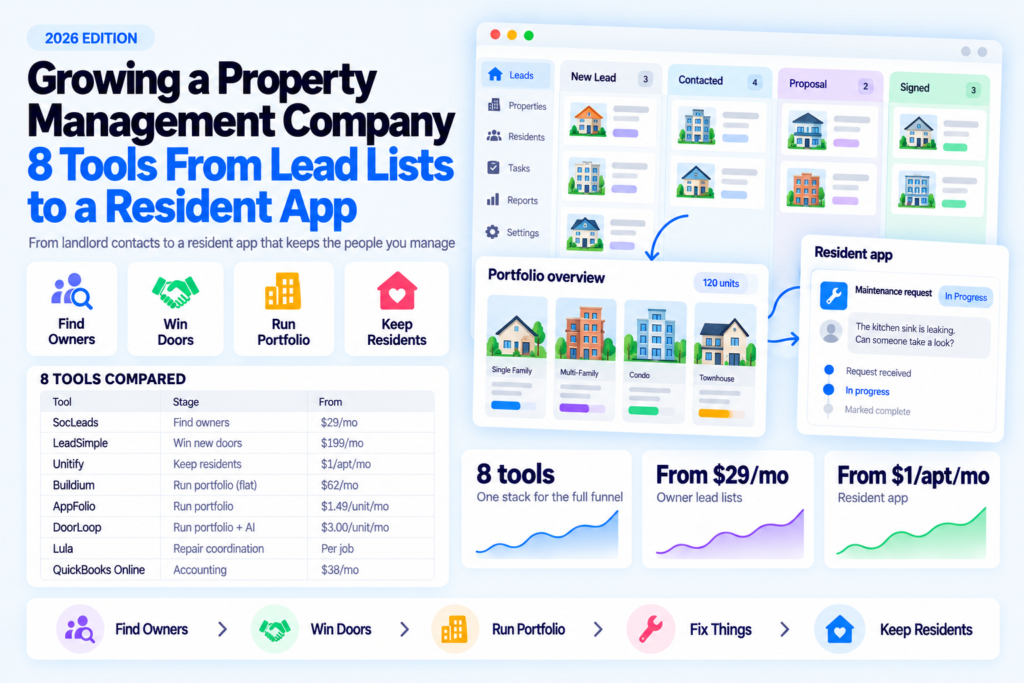
- SocLeads pulls owner, landlord and local-business contacts from Google Maps and social platforms, so you fill the top of the funnel with your own list.
- LeadSimple is a property-management CRM that turns those owner leads into signed doors, priced per door rather than per user.
- Unitify is a resident app for HOA, condo and co-op management that keeps billing, requests, notices and votes in one place; for rental tenants the same job falls to the resident portal inside your core platform.
- For the core of the stack, Buildium charges a flat platform fee, while AppFolio and DoorLoop bill per unit against a minimum. Sort by the billing model first, then by features: strong portals point to AppFolio, AI agents to DoorLoop.
- Lula coordinates repairs with no monthly fee, and QuickBooks Online keeps the books when a bookkeeper works outside the platform.
Growing a management company splits your attention. You chase new owners and doors while you still run the buildings you already signed, and one app rarely does both of those jobs well. Here is the short version. SocLeads gathers owner contacts, and LeadSimple works them into signed doors. A core platform such as Buildium, AppFolio or DoorLoop runs the portfolio, and a resident app like Unitify holds on to condo and HOA residents, while rental tenants stay through the portal built into that core platform.
How we chose these tools
Tools are picked on three things: the stage they cover, how they charge you, and who they are not for. Most stages take one tool, from finding owners to keeping residents. The exception is the platform at the center of the stack, where Buildium, AppFolio and DoorLoop all handle the portfolio. There you narrow first by how you want to be billed, a flat platform fee against a per-unit charge. The capabilities settle it from there: stronger resident portals on AppFolio, AI agents on DoorLoop, a base that does not move with unit count on Buildium. Every tool here also says plainly who should skip it. The order below follows the funnel, stage by stage.
The 8 tools compared
Scroll horizontally to compare all columns →
| Tool | What it does (stage) | Pricing model | Best for | Not for |
|---|---|---|---|---|
| SocLeads | Owner and landlord lead lists (find owners) | From $29/mo | Filling the funnel with your own owner list | Teams that need a CRM, accounting or a resident portal |
| LeadSimple | Property-management sales CRM (win doors) | From $199/mo (50 doors) | Turning owner leads into signed doors | A solo owner with a couple of doors |
| Unitify | Resident app (keep residents) | From $1/apartment/mo (Free $0) | Putting resident payments, requests and notices in one app | Landlords renting out their own apartments |
| Buildium | Flat-fee core platform (run the portfolio) | From $62/mo flat | One platform whose base fee does not climb with unit count | Very small portfolios, or teams that want per-door pricing |
| AppFolio | Per-unit core platform (run the portfolio) | From $1.49/unit/mo (min 50 units) | Portfolios of roughly 50 units that want strong portals | Small portfolios under the unit and spend minimums |
| DoorLoop | Per-unit core platform with AI agents (run the portfolio) | From $3.00/unit/mo (min $239) | Teams that want AI agents on comms and maintenance | Anyone who wants a flat fee |
| Lula | Repair coordination (fix things) | Pay per completed job | Closing work orders through contractors instead of in-house staff | Teams with in-house techs who only need ticket tracking |
| QuickBooks Online | Accounting (keep the books) | From $38/mo | A bookkeeper or CPA working outside the PM platform | Teams covered by the accounting built into their platform |
Pricing shows the smallest paid plan at its regular rate from each vendor's official pricing page; some vendors run an intro promo below that.
SocLeads
SocLeads is the only tool here that fills the top of the funnel instead of moving leads along it. For a management company that means a working list of the owners and boards who sign doors over to you: small landlords who would rather not self-manage, local real estate offices and builders, and the HOA and condo boards in the neighborhoods you want. It pulls their details from local business listings and social profiles, then runs the emails through a validator before you reach out. The Google Maps scraper returns a business name, phone number where one is listed, email where the site shows one, address, category, rating, reviews and website.
Billing is a monthly subscription against a contact quota rather than a charge per saved record. A listing that comes back without a usable email still spends a contact from that quota, so factor those blanks into the plan you pick. You cannot buy a ready-made database here either. Lists are built to your own criteria, which is the point when you are hunting owners and boards in a specific market instead of blasting a bought file. If you are weighing those two approaches, this breakdown of buying lists walks through the trade-off. For local owners, this walkthrough on Google Maps leads shows the same approach applied to real estate.
Best for a growing company that needs to build its own list of owners and boards to approach.
Not for anyone who needs a CRM, accounting or a resident portal, which are other tools on this list.
Pricing runs from a Free Trial at $0 for 100 contacts, no card required. Paid plans start at Basic, $29 a month for 2,000 contacts, then Pro at $59 for 10,000 and Business at $149 for 100,000. An annual toggle saves 20%.
LeadSimple
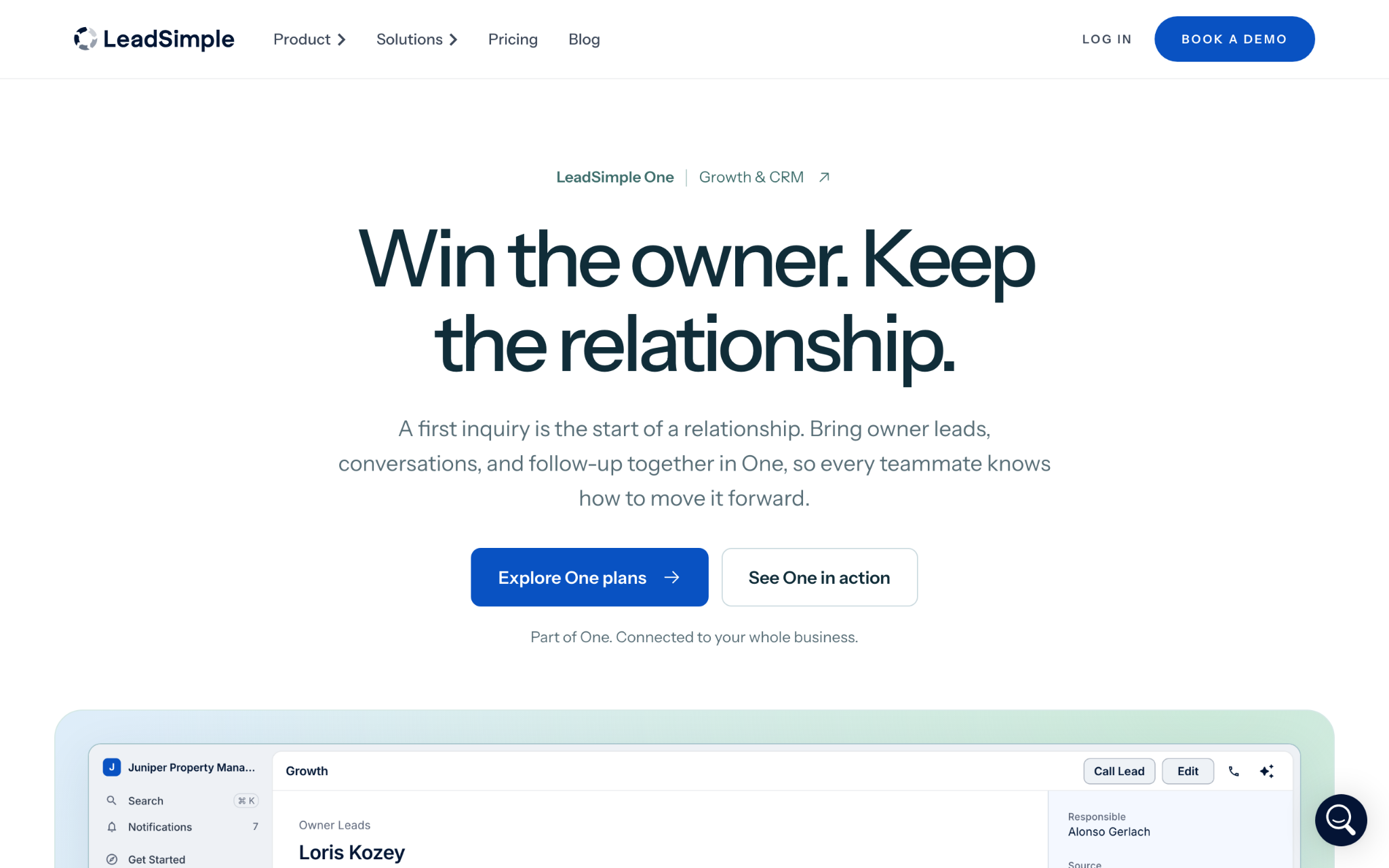
LeadSimple is the one tool here built as a property-management CRM, with ready-made onboarding playbooks for taking on new doors. It runs the whole sales and operations side for a management company: CRM and growth, operations, phone and inbox, leasing, maintenance and a set of AI tools. An owner lead moves from first call to a signed agreement without leaving the system.
The billing runs by the door while teammates stay unlimited, so a growing office can add people without the bill moving. The owner list from the step before does not flow in on its own: you export it as a file and import that file into the CRM, where each contact becomes a lead to work. If you want to see how that export-and-import step usually goes, this guide on importing leads lays out the common patterns.
Best for a growing company moving owner leads through to a signed agreement.
Not for a solo owner with a couple of doors, since the entry plan includes 50 doors, worth it only once you manage that many.
Pricing starts with One at $199 a month, or $169 billed annually, with its first tier of doors included. One Max is $499 a month, or $429 annually, and roughly doubles the included doors. Extra doors beyond the included count run $2.49/mo each on month-to-month billing.
Buildium
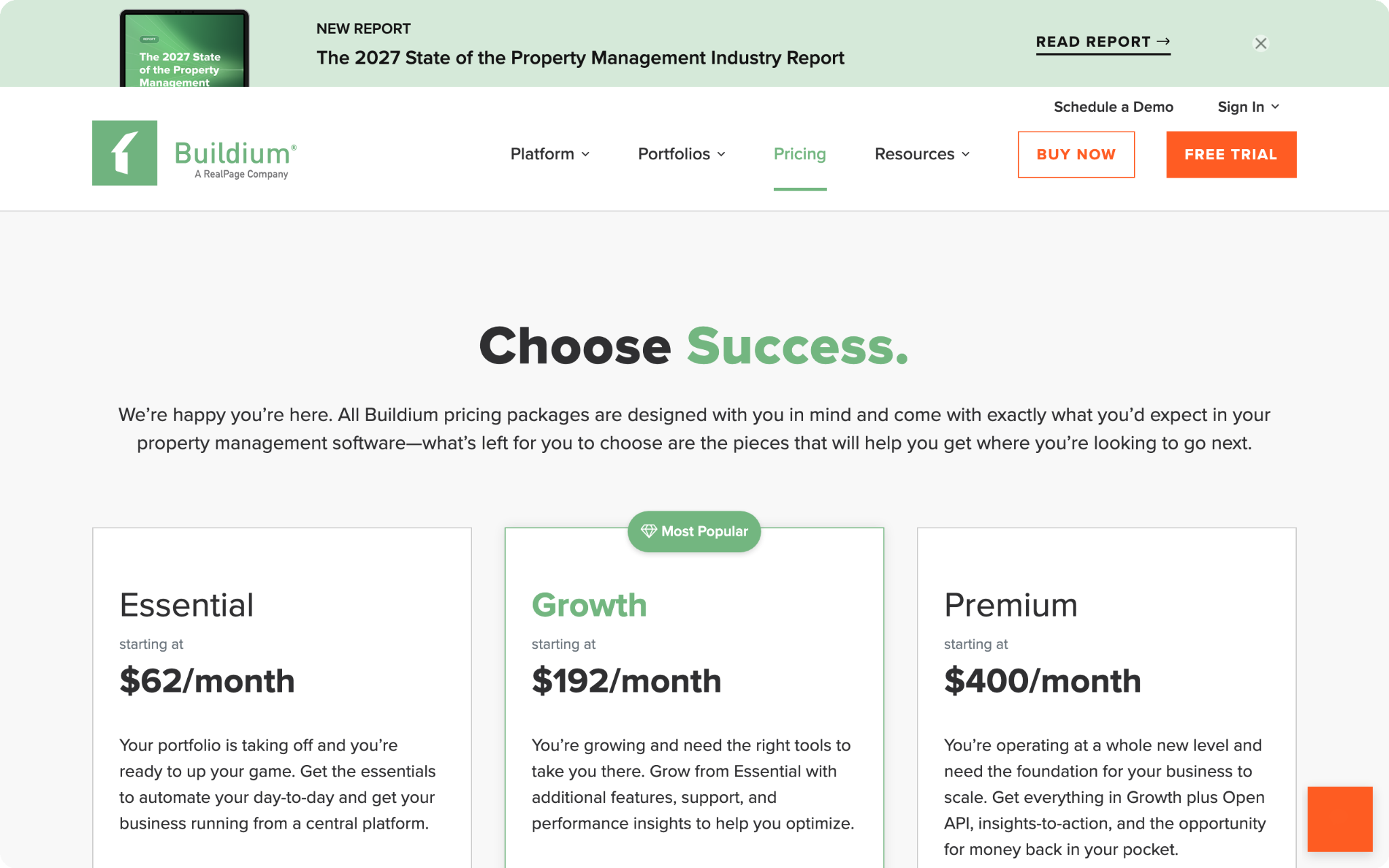
Buildium stands out for a flat platform fee that does not climb with the unit count. That flat part is the base subscription only: payments, tenant screening and e-signatures are billed separately, as they are on the per-unit platforms, so the total bill still moves with usage. Every plan includes accounting, maintenance and leasing, and its Resident Center lets renters pay rent, file maintenance requests and read their lease from a phone.
The higher tier adds free property inspections, eSignatures, the first year of inbound EFT at no charge, the full AI feature set and an Open API. Every tier already covers the daily work of accounting, leasing and maintenance, so Buildium separates itself from the per-unit platforms through the shape of its base fee, since the day-to-day features line up.
Best for a company that wants one platform for accounting, leasing and maintenance on a base fee that holds as units grow.
Not for a very small owner who would rather not carry a monthly platform fee, or anyone who needs pricing strictly per door.
Pricing starts at Essential from $62 a month, with Growth from $192 and Premium from $400.
AppFolio
AppFolio leans on strong resident and owner portals and a polished mobile experience inside a full platform. Residents and owners pay, file requests and message the office through online portals, while the Core plan covers accounting, marketing and leasing, work orders and standard integrations.
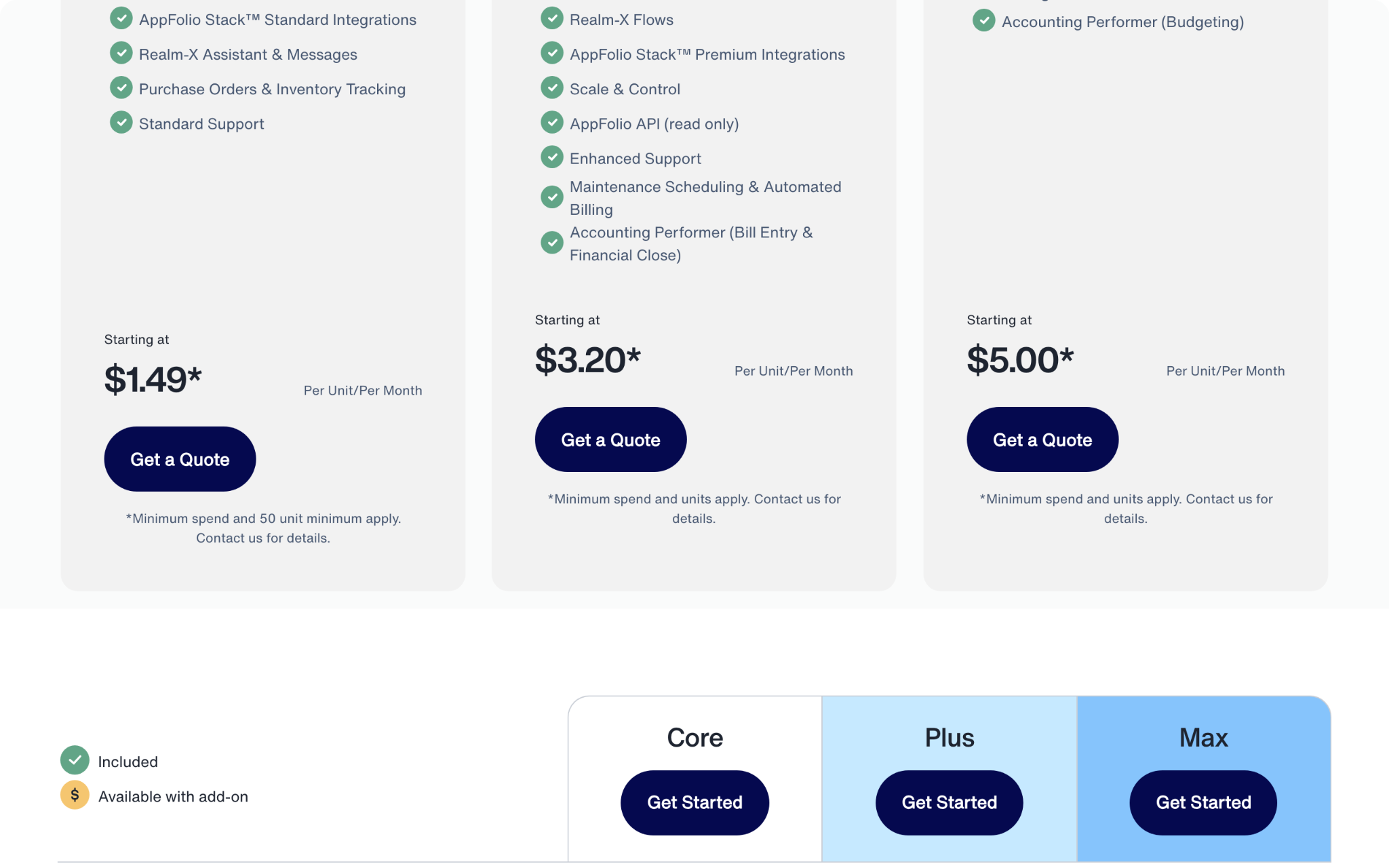
Higher tiers add more: Plus brings advanced budgeting and accounting with a read-only API, and Max adds a Leasing CRM, Leasing Signals, a read and write API and a dedicated customer success manager. Pricing is per unit with both a unit floor and a minimum spend. That minimum spend lands above unit count times rate, so the real monthly floor is higher than unit count by rate would suggest, and the platform is aimed at portfolios that have already reached a certain size.
Best for a mid-sized portfolio that wants one ledger plus strong resident portals.
Not for small portfolios, since AppFolio applies a minimum of 50 units and a minimum spend.
Pricing is per unit a month: Core from $1.49, Plus from $3.20 and Max from $5.00, subject to the unit minimum and minimum spend.
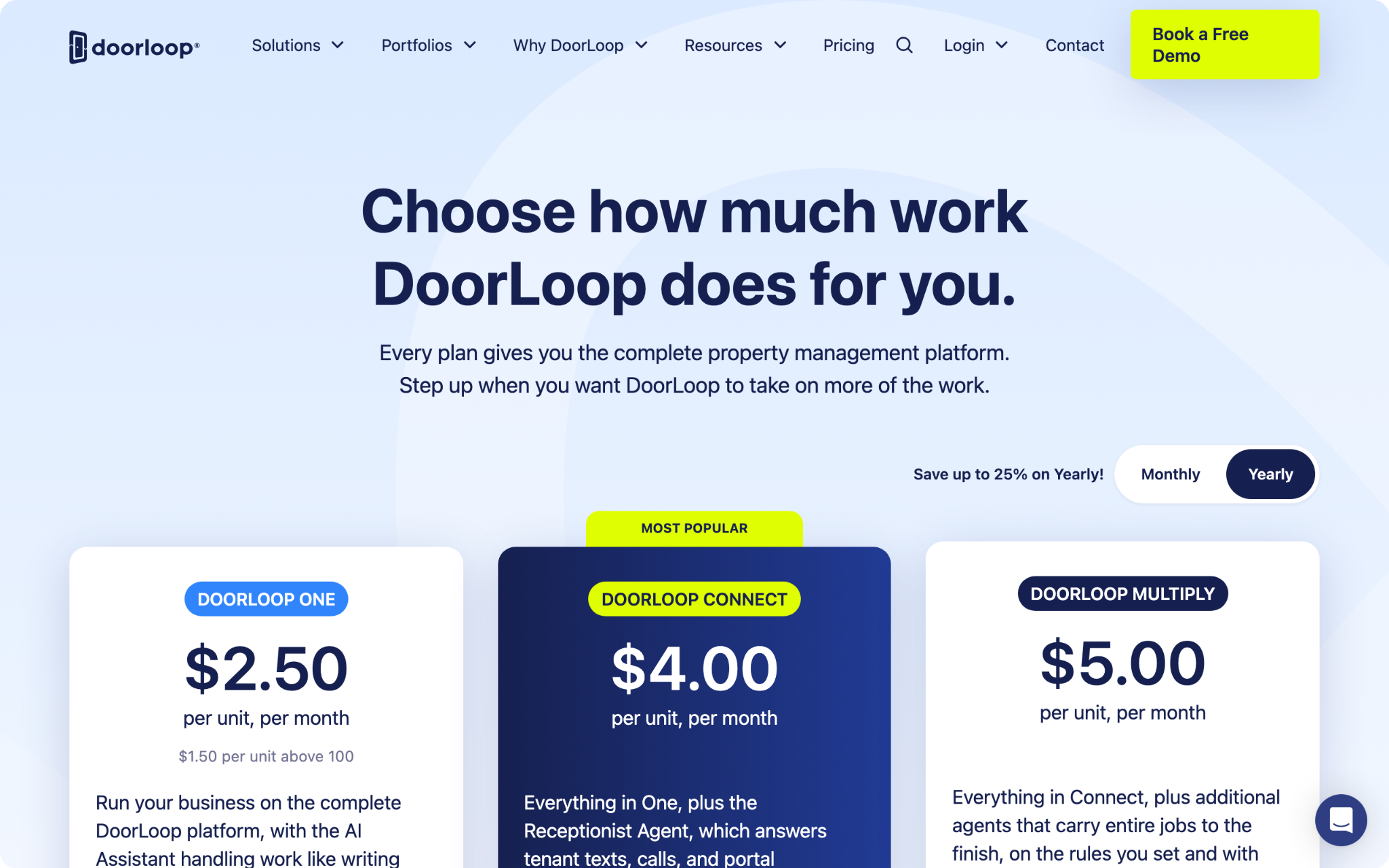
DoorLoop
DoorLoop prices per unit above a monthly minimum and layers AI agents across its tiers. The core set of accounting, leasing, maintenance, payments and communications is the same on every tier. What changes between them is the AI. One adds an AI assistant, Connect adds a Receptionist Agent that answers residents around the clock plus free inbound ACH, and Multiply adds a Maintenance Ops Agent and a Lease Renewal Agent.
The AI layer suits you when you want software to carry some of the front-desk and maintenance load as the portfolio grows, instead of hiring for every new building.
Best for a growing company that wants AI agents handling communications and maintenance.
Not for anyone who prefers a flat fee over a per-unit rate.
Pricing is per unit a month, and the monthly minimum moves with the term. One is $3.00 per unit, month to month, with a $239 minimum, or $2.50 on an annual plan with a $199 minimum. Connect is $4.80 month to month with a $359 minimum, or $4.00 annually with a $299 minimum. Multiply is $6.00 with a $479 minimum, or $5.00 annually with a $399 minimum.
Lula
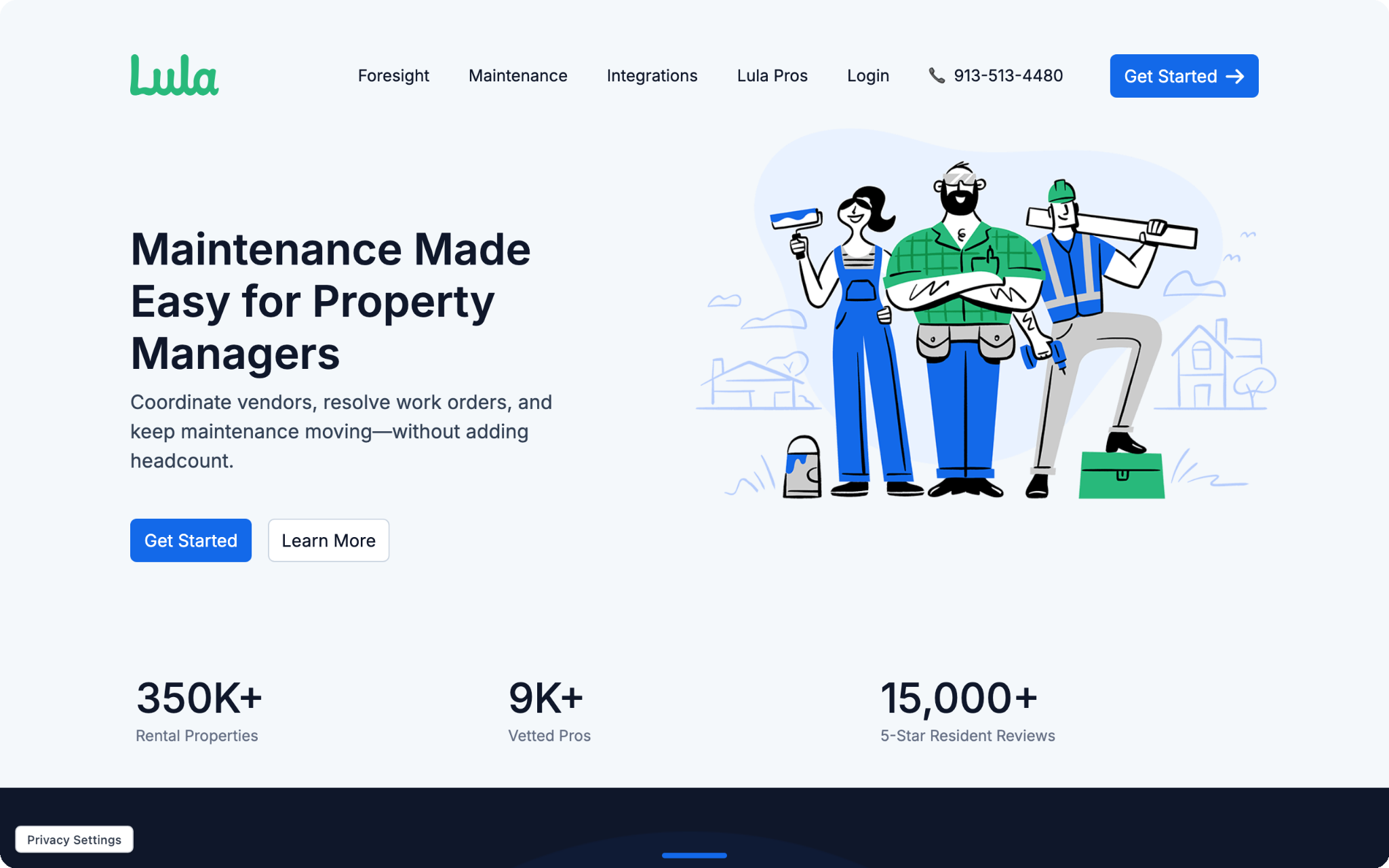
Lula carries no subscription: you pay for the repair that gets done, and Lula earns inside that job price instead of on a separate fee. It also sends contractors out to do the work, where the core platforms track the ticket but leave the staffing to you. Common jobs run through a Flat-Rate Maintenance catalog of 450-plus tasks, so the quoted price for a catalog job is the price you pay, and work outside the catalog is billed by the hour.
The model fits you when you close work orders through contractors instead of a crew you employ. There is no monthly, annual or setup fee to carry between jobs.
Best for a company without its own crew that needs to close requests through contractors.
Not for teams with in-house technicians who only need to track tickets, which the core platforms already do.
Pricing is not published as a per-unit rate: you pay per completed job with no monthly fee.
QuickBooks Online
QuickBooks Online is the small-business standard for bookkeeping and taxes, and it runs alongside, not inside, a management platform. A management company reaches for it when its bookkeeper or CPA keeps the books apart from the operations software, outside the day-to-day system.
Plans climb by the number of users and the depth of the books. Simple Start covers one user, Essentials opens up to three users, Plus reaches five users with projects, budgets and inventory, and Advanced sits above them.
Best for a company whose accountant runs the finances outside the PM platform.
Not for teams already covered by the accounting built into Buildium, AppFolio or DoorLoop, where a second ledger is extra work.
Pricing runs from Simple Start at $38 a month, with Essentials at $85, Plus at $140 and Advanced at $340.
Unitify, the eighth tool, handles community associations: HOA, condo and co-op billing, requests and notices in one resident-facing app. It is covered in the retention section below.
How do property managers find new owners and landlords?
Owner and landlord contacts come from public listings on Google Maps and social profiles, which is where SocLeads pulls a name, phone and site into one list. This step sits before the core platform for a simple reason: you need owners to call before you have doors to run. For a company adding buildings, the list of owners is the part that has to be built first, market by market, to the criteria you set. Some listings come back without a usable email, and this piece on a Google Maps extractor covers why that happens and what to check. A core platform runs the doors you have won, but it does not go out and find the next owner.
How much does property management software cost per unit?
Expect per-unit pricing on AppFolio and DoorLoop, around $1.49 to $6 a unit with a minimum, while Buildium charges one flat platform fee instead. That split in the billing model is the first filter between the three, and the capabilities decide the rest once it is settled. A flat fee stays put whether you run 40 doors or 140, so it suits a larger portfolio where a per-unit rate would keep climbing. A per-unit rate can start lower on a small portfolio, but both per-unit platforms set a floor, a dollar minimum on DoorLoop and both a unit minimum and a minimum spend on AppFolio, so neither pays off until you have passed that floor. The per-unit rate can also drop at volume. On DoorLoop's One plan, units above 100 bill at $1.80 each month to month, or $1.50 each on an annual plan, which pushes out the point where a flat fee overtakes per-unit. So run your own unit count against each plan, since where flat wins depends on which tiers you compare. A resident app is a separate line item again: Unitify charges per apartment, apart from whichever core platform you run.
How do you keep residents from leaving?
Residents stay longer when rent, requests and notices all live in one place, which is what a resident app gives them. That resident layer shows up two ways, and which one fits depends on what you manage. For rental tenants it is built into the core platform, as with Buildium's Resident Center and AppFolio's online portals. For owner-occupied buildings run as associations, it is a standalone app such as Unitify, the third tool in the table above. You have spent the whole funnel finding owners and signing doors, and retention is what decides whether those doors stay on the books.
Unitify
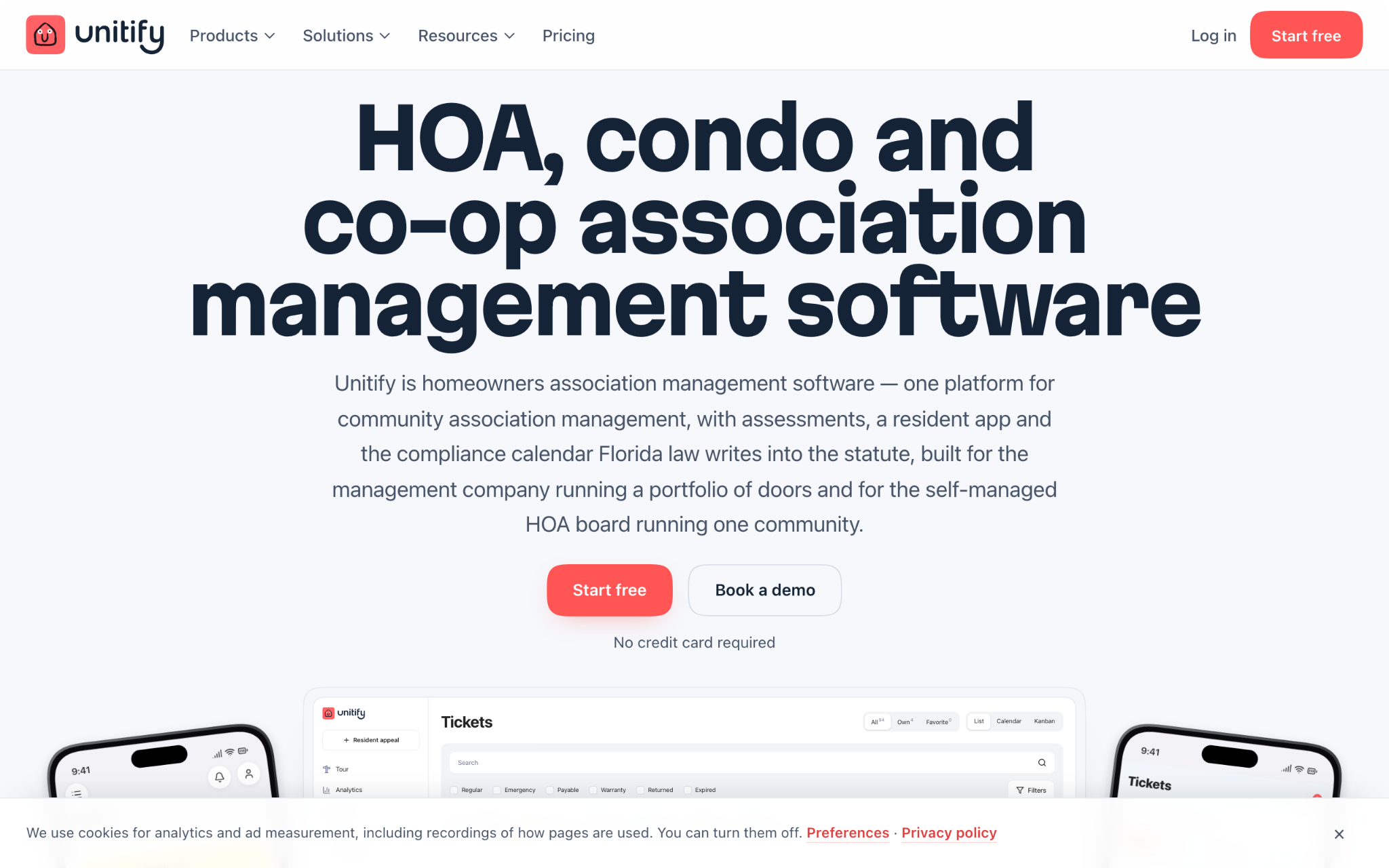
Unitify puts billing, maintenance requests, building notices and votes in a single resident-facing window, so a management company can hold on to the residents and owners it already runs. Each request becomes a ticket with a status and a history, and updates go to both the resident and the dispatcher as the work moves. Building notices for things like outages, works and meetings reach residents in the app as notifications instead of a sheet on the door. Its US page is built for community associations such as HOAs, condominiums and co-ops. It is described as a tool for the management company running a portfolio of doors, and for the self-managed HOA board running one community.
Billing runs through a feature called Easybilly, which handles monthly assessments and reserve contributions, with card and ACH payments through Stripe. On the Free and Base plans that billing carries a $0.5 charge per invoice, so the real cost sits above the $1 list price once you collect payments in the app; the charge is included on Pro. For associations, votes are worth a word of caution: the app records a vote but does not by itself make a meeting legally valid, so the formal process still sits outside the software.
Best for a management company or HOA and condo board that wants resident messaging, payments and requests in one app.
Not for landlords renting out their own apartments, which the US version rules out directly, or office and retail property that needs full lease administration.
Pricing is per apartment a month. Free sits at $0 with one notice a month and no AI, and Base at $1 adds unlimited notices, digital passes and booking. Pro at $3 brings an AI concierge, AI reports, billing and an API, with the per-invoice charge folded in.
So which tools should a growing company actually pick?
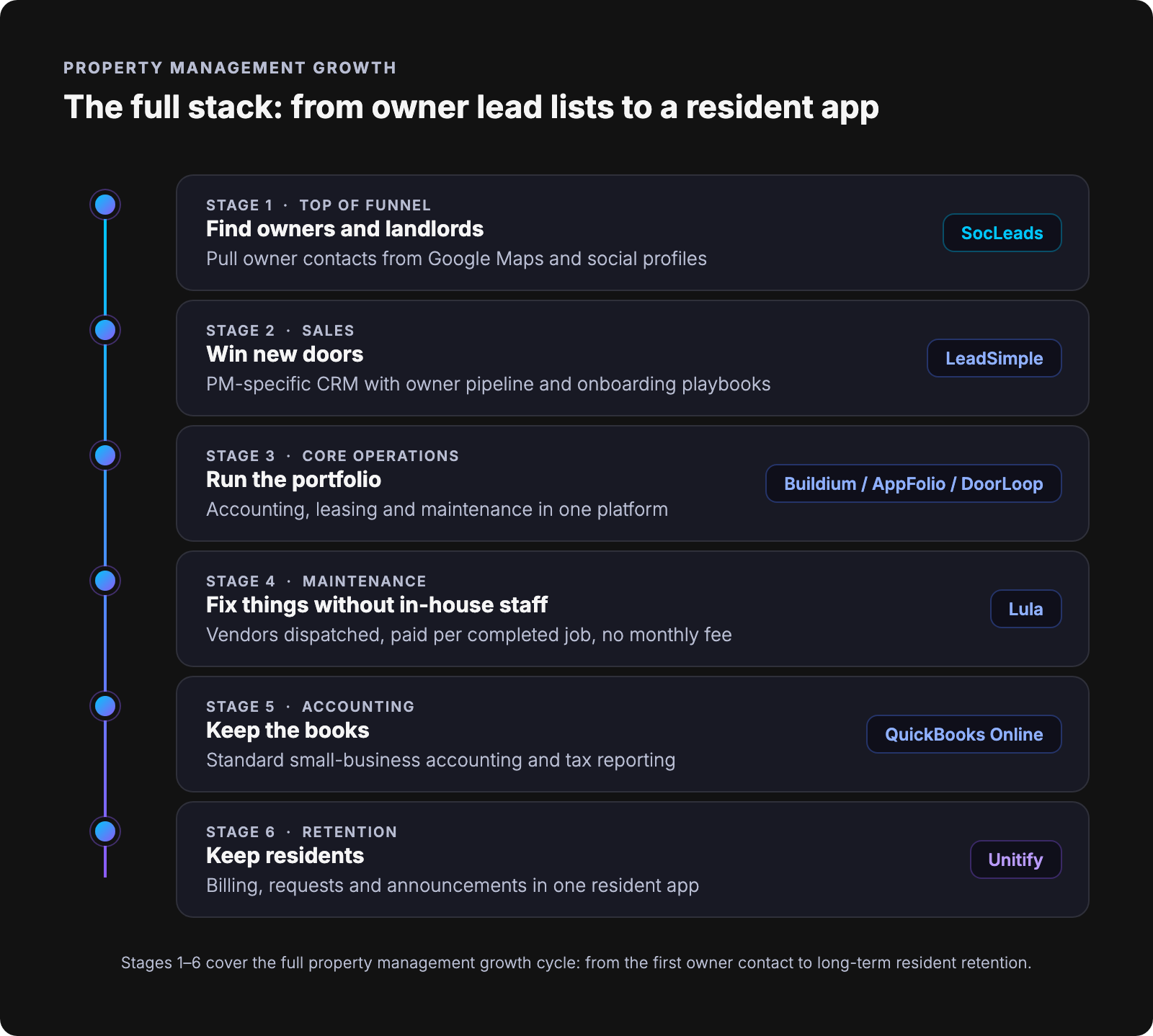
Build the stack around the stage you are weakest at, instead of around one platform that claims to do everything. A company still hunting for doors leans on SocLeads for owner lists and LeadSimple to work them into signed agreements. From there a single core platform carries the day-to-day buildings: Buildium for a flat fee, or AppFolio or DoorLoop if a per-unit rate and strong portals or AI agents suit you better. Lula covers repairs when there is no in-house crew, QuickBooks comes in when a CPA keeps the books apart, and a resident app handles retention. For rental tenants that is the portal inside your core platform; for a condo or HOA association, Unitify covers that layer.
Not every company needs the whole stack. A solo owner with a handful of doors can run everything inside one core platform, usually the flat-fee Buildium Essential, and skip the CRM and the separate accounting until the portfolio grows.
As a worked example, take a company running about 60 units. You might pair SocLeads Pro for steady owner contact, since signing roughly 60 doors means working through far more than the 2,000 contacts on Basic, with LeadSimple One covering its included doors and the rest at the extra-door rate. The core platform comes down to the billing model first: Buildium Essential flat, AppFolio Core per unit above its minimum spend, or DoorLoop One per unit against its monthly minimum. Lula handles repairs with no fee between jobs. Unitify Base fits the retention line only if those doors are condo or HOA units, since it is not built for rentals; for rental tenants that job stays with the core platform's portal.
FAQ
Do property managers need separate accounting software?
Not always. The core platforms here, Buildium, AppFolio and DoorLoop, keep the books inside the software, so a separate tool is extra work for many teams. QuickBooks comes in when a bookkeeper or CPA keeps the accounting outside the operations platform, which is common once the finances get more involved.
At how many units should I move off spreadsheets to PM software?
Around the point where the per-unit platforms start making sense. DoorLoop and AppFolio both set a minimum, by monthly spend and by unit count. Below that, a flat-fee option such as Buildium Essential, or a spreadsheet, can still cover a small portfolio. The jump usually comes when rent collection, maintenance and reporting stop fitting in a sheet.
AppFolio vs Buildium vs DoorLoop, which should a growing company pick?
The extras usually decide it once the billing model is settled. DoorLoop layers AI agents onto comms and maintenance, AppFolio is known for its resident and owner portals, and Buildium bundles the same core work on a flat base fee. All three cover accounting, leasing and maintenance, so the pick comes down to whether you want AI help, stronger portals or the steadiest base fee.
What is a resident app, and does it help retention?
A resident app is where a renter or owner pays, files a request and reads building notices from a phone. It helps retention by putting that day-to-day contact in one window instead of scattered calls and emails. Some come built into core platforms, like Buildium's Resident Center, and some are standalone, like Unitify.
Can I run everything in one platform, or do I need a stack?
One core platform runs the day-to-day operations, but finding new owners and keeping residents are usually separate jobs. Lead sourcing lives in a tool like SocLeads, resident retention in a resident app, while the core platform covers everything in between. You can lean on one platform as a solo operator, but a growing company tends to add tools at the two ends of the funnel.
Related guides
Turn this research into a lead list
Collect verified emails from Google Maps, Instagram, Facebook and LinkedIn — free to start.
Start free with SocLeads →